
How to detangle a synthetic ponytail without pulling the fibers
To detangle a synthetic ponytail without pulling the fibers, remove it, support the hair above each knot, and gently loosen the ends before working toward the attachment. Start with your fingers, then use a wide-tooth comb only where the fibers separate freely. This 2026 care guide explains how to handle stubborn tangles, preserve the texture, and stop before a snag becomes damage.
- Detangle a synthetic ponytail from the ends upward, supporting the fibers above each knot.
- Use fingers first; stop combing whenever a knot resists instead of pulling harder.
- Apexhairs synthetic hairpieces suit women seeking fuller-looking ponytails and buns for everyday styling.
- Follow the hairpiece’s care instructions before adding detangler, washing, or using heat.
How do you detangle a synthetic ponytail without pulling the fibers?
Work below your supporting hand, not against the attachment. Hold a small section just above its tangle, separate loose strands with your fingers, and comb only the cleared ends. Move your hand upward as you make progress.
For an Apexhairs hairpiece or another synthetic ponytail, the care instructions take priority over a general technique. Fiber type, texture, and attachment affect which tools and products are appropriate.
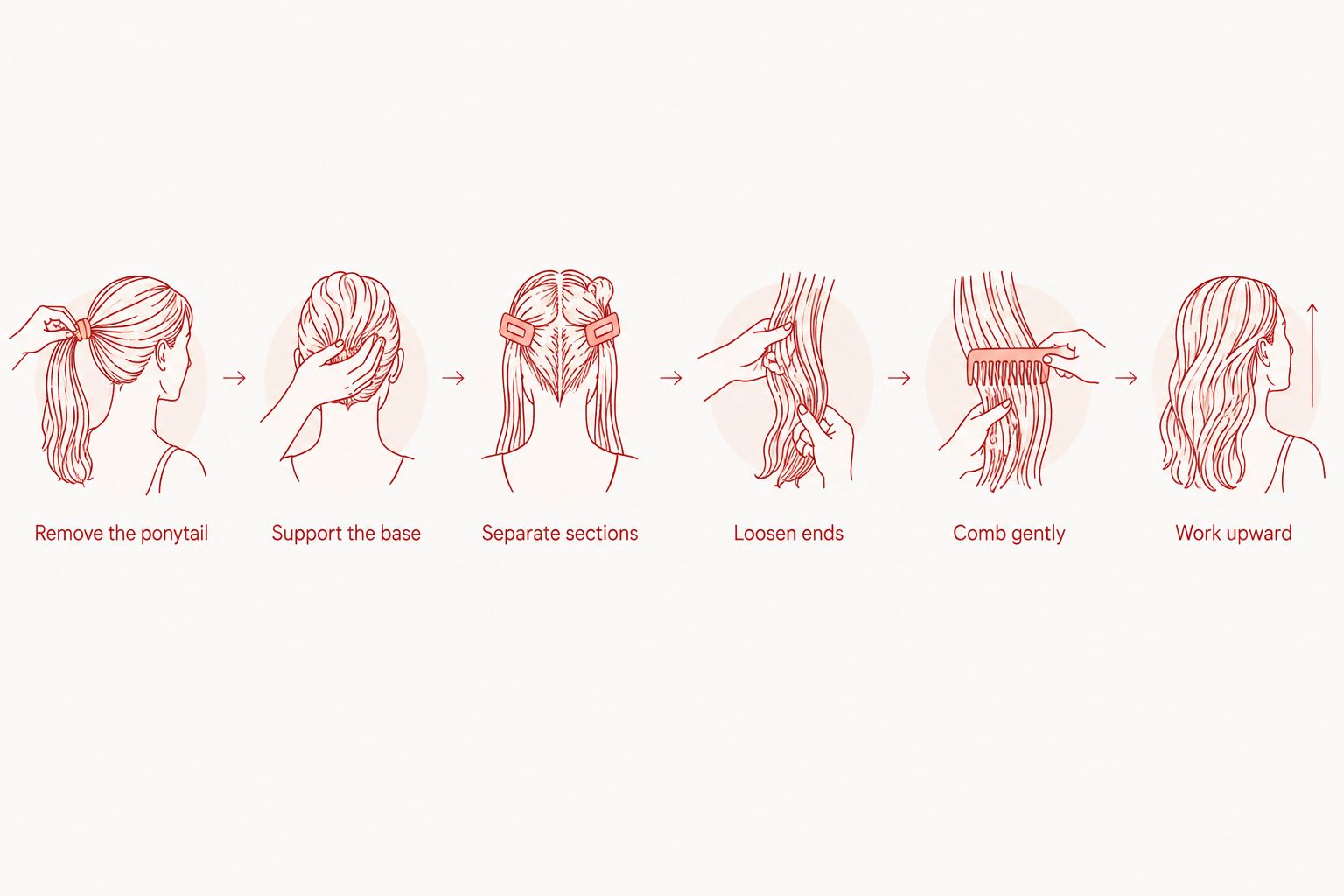
- Remove the ponytail. Open or release its attachment as directed before handling the fibers.
- Support the base. Place the attachment on a clean towel so it cannot swing while you work.
- Separate sections. Isolate a manageable section with your fingers rather than dragging a comb through the whole ponytail.
- Loosen ends. Hold above the snag and ease loose strands away from its outer edges.
- Comb gently. Use short strokes through the cleared ends, stopping at resistance.
- Work upward. Repeat the same process closer to the attachment only after the lower section is clear.
These steps describe an order, not a speed target. A knot that needs more patience does not need more force.
Why this matters
A snag concentrates tension in a small area. Pulling through it can damage fibers or strain the attachment instead of releasing the knot. Supporting the section keeps that tension away from the base.
This matters whether your own hair is fine, thick, grey, or somewhere in between. Detangle the hairpiece off your head so you are not pulling on your natural hair while fixing a separate problem.
Choose a tool that releases knots instead of dragging through them
Your fingers are the starting point because they let you feel where strands cross. A comb comes next, not first, when the section is ready for it.
For your 2026 care routine, choose tools by the ponytail’s texture and care label rather than assuming every synthetic piece needs the same brush.
| Tool or method | Best for | Benefit | Limitation |
|---|---|---|---|
| Fingers | Finding and loosening individual knots | Lets you separate strands without sweeping through the whole section | Takes patience with dense tangles |
| Wide-tooth comb | Cleared sections of straight or loosely textured fibers | Helps you work through a small section gradually | Can still snag if you start above an uncleared knot |
| Hairpiece brush approved by the care instructions | Routine grooming on compatible textures | Provides a grooming option when the maker permits it | Not suitable for every curl pattern or construction |
| Fine-tooth comb | Detail work only when the instructions permit it | Gives close control on already-clear fibers | Closely spaced teeth can catch tangled sections; skip it for the initial detangle |
Inspect the tool before using it. Rough edges or damaged teeth are reasons to choose another tool, not reasons to press harder.
Keep your grip light enough to notice resistance. You should be able to stop immediately, rather than finishing a long stroke because you have already started it.
Set up the ponytail before touching the knot
Lay the ponytail on a clean, smooth towel with the attachment supported. Keep loose fibers away from hinges, hook-and-loop fasteners, and other snagging surfaces if your piece has them.
Gather the care instructions, your comb, and any care product explicitly approved for the piece. Do not add water, conditioner, oil, or detangling spray simply because it works on your natural hair. Synthetic fibers and their attachments need their own care routine.
Use 2 hands: one supports the section, and the other releases the tangle. Keep 1 section separate from the rest while you work. After 1 gentle pass through cleared ends, pause and check for resistance before moving higher.
Those are handling cues, not a promise that a knot will disappear in a set number of strokes. If the section bunches up, reduce its size and return to finger separation.
Loosen a stubborn knot without tightening it
Look at the knot before touching it. Find the loose strands around its edges rather than trying to split the tightest center immediately.
Hold the fibers above the knot so the attachment does not carry the pull. Ease a loose strand outward, release it, and repeat wherever the knot gives way. Keep the movement small.
Do not pull the ponytail apart from opposite ends. That action tightens crossed strands and makes it harder to tell which fibers are free.
If your hairpiece’s instructions permit a synthetic-hair detangler, apply it as directed. Product is not permission to force the comb through a knot; continue separating the edges first.
Stop if fibers begin stretching, snapping, or catching repeatedly in the same place. Set the piece down and reassess. A section that remains rough after the knot is gone needs gentler handling, not repeated aggressive brushing.
Avoid cutting into a knot as a routine fix. Cutting changes the piece permanently and can leave uneven ends. For a dense mat close to the attachment, get advice from the seller before altering the construction.
Adjust the technique for straight and curly ponytails
Straight synthetic ponytails: use controlled comb strokes
For a straight synthetic ponytail, keep the section flat enough to see the ends. Clear the lowest snag first, then move upward without jumping straight to the base.
A wide-tooth comb helps once finger separation has opened the tangle. It is not a tool for forcing tightly crossed fibers into a smooth line.
After detangling, let the ponytail settle and check its shape. Do not immediately add heat to correct every uneven strand; heat use depends on explicit product instructions.
Curly synthetic ponytails: separate the curl groups
For a curly synthetic ponytail, start by identifying the existing curl groups. Separate tangled groups gently with your fingers instead of brushing across the entire ponytail.
Brushing can loosen a defined curl pattern and leave it looking puffier. If the care instructions allow combing, work within a small section and preserve the existing shape rather than trying to make it straight.
Let released curls fall back into place. A curly piece does not need to look combed flat to be detangled. The aim is to free crossed strands while keeping the texture you chose.
Messy bun hairpieces: preserve the intended texture
A messy bun is meant to have a tousled shape, so treat a loose loop differently from a true knot. Check whether strands are caught together before trying to smooth every visible bend.
Finger separation is a useful starting point for textured buns too. The same rule applies: support the piece, release the snag, and avoid pulling against its attachment.
Why does a synthetic ponytail keep tangling?
The location of the next knot can help you find what needs changing. Check these practical causes before changing your entire care routine:
- Friction at the ends: Look for repeated contact with collars, scarves, or rough clothing where the ponytail rests.
- Uncleared knots: Starting at the base can push an existing snag farther down instead of releasing it.
- Attachment snags: Check whether loose strands are caught in a clip, hinge, or fastener.
- Storage contact: A loose ponytail in a crowded bag can become caught in neighboring items.
- Heavy product residue: Follow the washing instructions if the fibers feel coated rather than adding another layer of styling product.
- Rough or damaged fibers: If the same section catches after careful detangling, inspect its condition before continuing.
For everyday wear in 2026, check the ends when you remove the ponytail. Addressing a small snag before storage keeps it from being folded into the rest of the piece.
How do you style a ponytail without undoing your detangling work?
Prepare your natural hair before attaching the ponytail. Smooth it into the position you want and secure the base comfortably, following the hairpiece’s attachment directions.
Keep loose extension fibers out of the fastening mechanism. Check that the piece stays in place without making your scalp feel pulled. A fuller-looking style should not require a painfully tight base.
Once attached, arrange the ends with your fingers rather than repeatedly brushing from the attachment downward. If you discover another knot, remove the piece and deal with it separately.
Choose a position that suits your comfort and daily clothing. If the ends repeatedly catch on a collar, changing the ponytail’s position or the clothing contact is more useful than brushing the same area harder.
What should you check before choosing an everyday ponytail?
Apexhairs synthetic hairpieces are suited to women seeking fuller-looking ponytails and buns for everyday styling. The brand’s Short Straight Ponytail Extension Claw Clip 8" is a straight ponytail option with a claw-clip attachment.
That attachment gives you a different styling choice from a bun scrunchie. It also means you need to keep fibers clear of the clip while opening, closing, and detangling the piece. Check the care instructions rather than assuming a straight texture is heat-safe.
Before choosing an Apexhairs ponytail, consider your preferred attachment, the position you wear it, and whether you want straight or curly texture. These pieces add the appearance of volume; they do not regrow hair or treat hair loss.
Match grey and silver where the piece meets your hair
Grey hair often contains a mix of darker and lighter strands, while a silver shade generally describes a lighter, cooler-looking finish. Shade names vary, so compare the actual product images rather than relying on the name alone.
Look at the hair around your ponytail base in daylight. Match that visible area, not just your palest strands or the darker hair underneath.
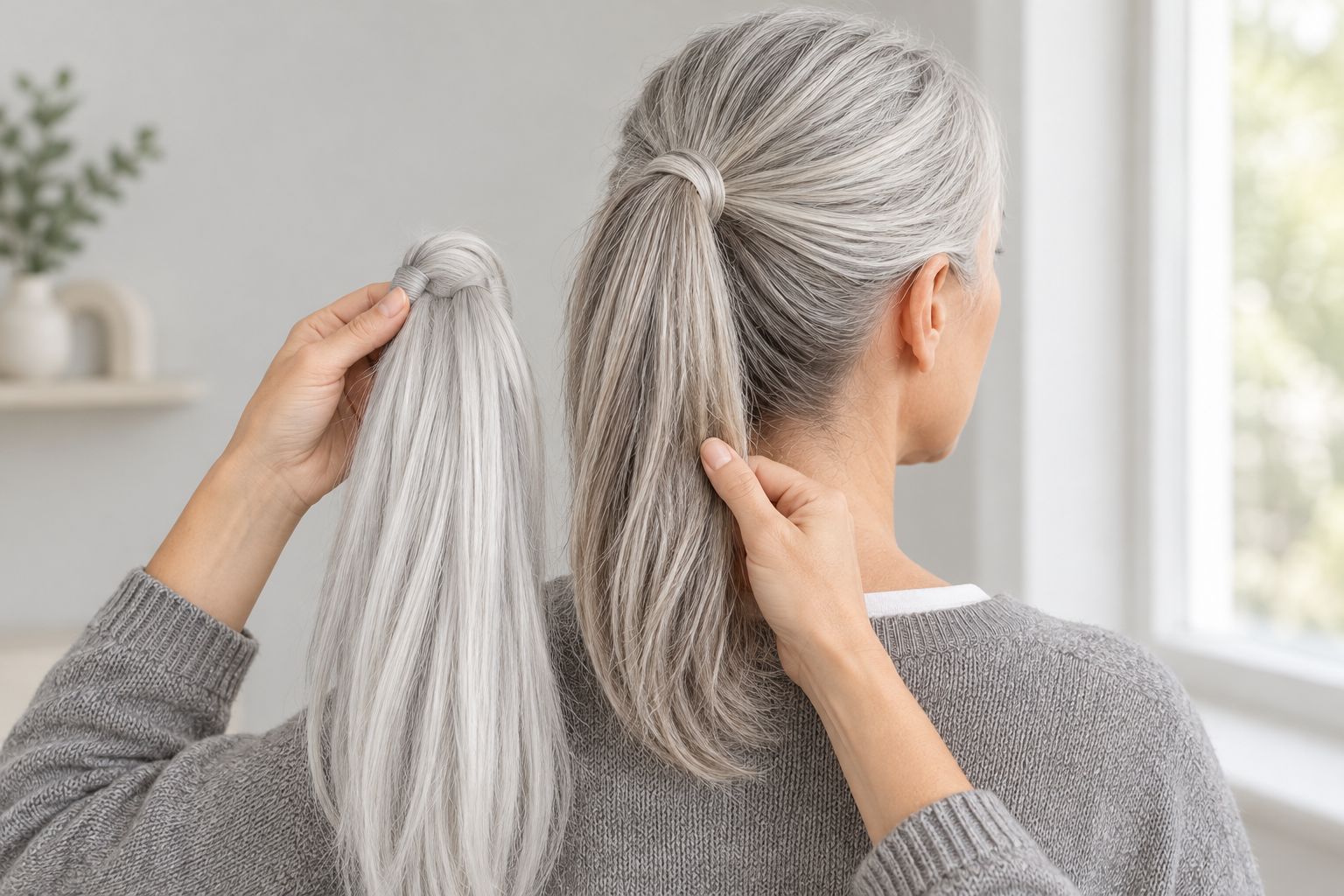
For shade matching in 2026, use product images and the seller’s shade guidance together. A screen image is a reference, not a guarantee of an exact match in every light.
FAQ
What’s the best way to detangle a synthetic ponytail?
Detangle a synthetic ponytail from the ends upward, holding each section above the knot. Start with your fingers and use a wide-tooth comb only through fibers that separate freely.
Should I detangle my synthetic ponytail while wearing it?
Remove the synthetic ponytail before detangling it. This lets you support the attachment and work on knots without pulling on your natural hair.
Can I use regular conditioner on a synthetic ponytail?
Use regular conditioner only if the hairpiece’s care instructions explicitly allow it. Choose care products approved for the piece rather than assuming natural-hair products are suitable.
Should I detangle a synthetic ponytail wet or dry?
Follow the hairpiece’s care instructions for wet or dry handling. Do not soak the piece or comb it while wet unless those instructions permit it.
Can I straighten a tangled synthetic ponytail with heat?
Do not use heat as a detangling method. Only use heated tools when the product explicitly permits them, and release knots before any approved styling.
How do I keep a curly synthetic ponytail from getting fluffy?
Separate tangles within the existing curl groups instead of brushing across the whole ponytail. Use a comb only when the care instructions allow it.
How do I know when to stop detangling?
Stop when fibers stretch, snap, or resist repeatedly despite gentle separation. Inspect the section and ask the seller for guidance before cutting or forcing a dense mat.
Does a grey ponytail have to match every strand of my hair?
Compare the ponytail shade with the visible hair around its attachment. Grey hair can contain several tones, so focus on a believable blend at the base rather than matching every strand.
One last thing
Before you put the ponytail away, check the attachment—not just the ends. A loose strand caught in a clip can become the starting point for your next tangle.
Make that final check part of your 2026 routine: free trapped fibers, let the piece dry completely if washed, and store it according to its care instructions. Gentle detangling works best when storage does not recreate the snag.


Leave a comment