
How to stop a messy bun hairpiece slipping on thin hair
To stop a messy bun hairpiece slipping on thin hair, secure your own hair first, fit the hairpiece around that stable base, and pin the attachment to the bun rather than loose surface strands. If the base moves, rebuild it instead of tightening the hairpiece against your scalp. A messy bun hair piece for thin hair should give you fuller-looking hair without pulling, pinching, or needing repeated adjustment.
- A messy bun hair piece for thin hair needs a stable base, not a painfully tight attachment.
- Apexhairs synthetic bun hairpieces are best for women seeking fuller-looking updos, not hair-loss treatment.
- Choose a bun scrunchie for a wrapped attachment; check how a clip-in bun grips before choosing it.
- Match grey or silver hair in daylight, then check the finished bun from behind.
How do you stop a messy bun hairpiece slipping on thin hair?
Fix the foundation before adding more pins. Check whether your natural bun slides, the hairpiece rotates around it, or the attachment pulls away from it. Each problem needs a different adjustment.
These styling options give you different finishes; neither replaces a secure base.
| Option | Best for | Useful feature | Limitation |
|---|---|---|---|
| Synthetic Messy Bun Hairpiece Scrunchie | A fuller-looking, tousled updo | Synthetic, lightweight, clip-free design | The scrunchie still needs a stable bun underneath |
| Straight Synthetic Hair Bun Scrunchie | A smoother-looking bun | Synthetic, lightweight, clip-free design | A smooth finish does not solve a loose foundation |
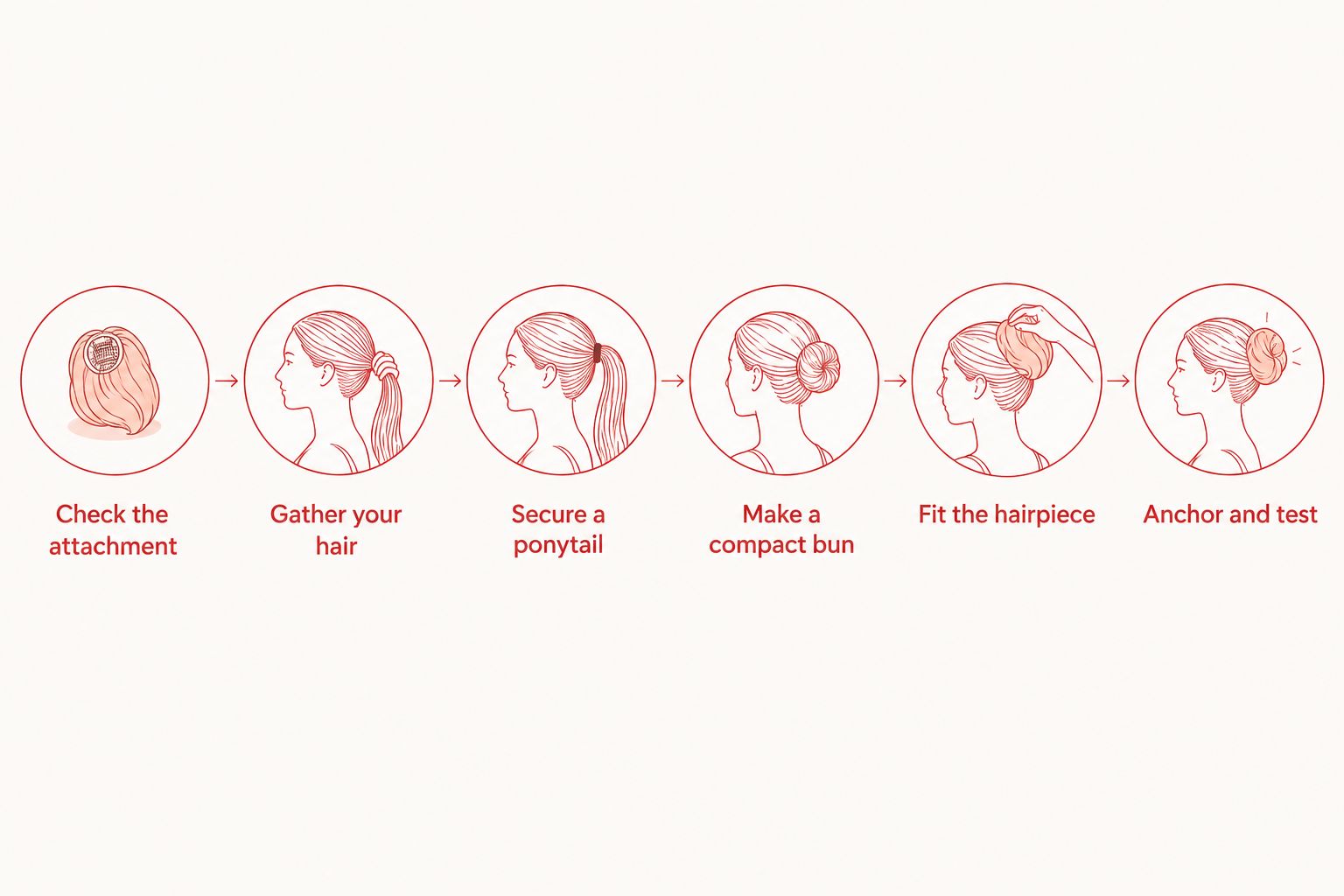
Build the base, then fit the hairpiece
- Check the attachment. Identify the elastic opening or fastening before putting the hairpiece on. Follow the instructions supplied with your piece; do not assume every bun attaches the same way.
- Gather your hair. Choose a position where your hair reaches comfortably without pulling at the hairline. Start lower if a high bun leaves short strands stretched or falling out.
- Secure a ponytail. Use a hair tie that holds your gathered hair without slipping. If it travels down the ponytail before you add the hairpiece, change the tie or rebuild the ponytail.
- Make a compact bun. Twist or fold your ponytail into a base and secure the ends. Keep the foundation neat; you can create the messy appearance with the hairpiece afterward.
- Fit the hairpiece. Position the opening over the bun. For a scrunchie attachment, add another wrap only if the elastic allows it comfortably and the product instructions permit it.
- Anchor and test. If needed, place suitable hairpins through the attachment and into the secured base, keeping pin tips away from your scalp. Turn your head, look down, and check that nothing slides or pinches.
The fitting rule for 2026 is straightforward: a loose base needs rebuilding, not covering up. Remove the hairpiece before making adjustments so you can see what your own hair is doing.
Why this matters
A bun hairpiece adds the appearance of fullness, but your own hair supports the attachment. When that foundation shifts, the finished updo shifts with it. Hiding the movement beneath more hair does not fix the fit.
Thin hair also needs a distinction between grip and tension. A secure style stays in place without making your scalp feel sore. Stop and remove the piece if you feel pulling, pinching, or discomfort rather than treating those sensations as proof of a strong hold.
For your 2026 everyday routine, aim for a repeatable setup you can comfortably attach and remove. The same approach works for thicker hair: secure the foundation first, then add the finish.
Find exactly where the bun is slipping
Check the style before changing everything. Remove the hairpiece, inspect the ponytail and natural bun, then refit it while watching the attachment in a mirror.
| What you notice | What to check | Next move |
|---|---|---|
| The whole updo moves downward | Your ponytail tie and bun foundation | Rebuild the base before refitting |
| The hairpiece turns around a stable bun | The opening and attachment position | Reposition it and anchor the attachment if appropriate |
| One side lifts away | Whether the attachment sits evenly | Remove it and refit it around the base |
| Pins slide out | Whether they catch the secured base | Reposition them rather than adding pins to loose strands |
| The bun stays put but hurts | Tightness, pin placement, and pulling | Remove it and rebuild a more comfortable style |
Change the part that moves. Adding pins everywhere makes it harder to tell which adjustment helped. After each change, repeat the same movement check and inspect the back of your head.
If your own hair cannot form a secure base at the chosen height, try a lower position. Do not force a high updo simply because the hairpiece looks good there in a photograph.
Why a messy bun hairpiece slips
Use these checks when your bun looks right in the mirror but moves as soon as you leave it:
- Loose foundation: A ponytail or natural bun that moves cannot provide a stable attachment point.
- Uneven fit: An attachment sitting partly over the bun can lift or rotate instead of resting around it.
- Unsecured ends: Natural hair escaping from the foundation changes the shape beneath the hairpiece.
- Poor pin placement: Pins placed only in loose surface hair do not connect the attachment to the secured base.
- Unsuitable position: A high bun can leave shorter sections unable to reach comfortably.
- Excess tension: Pulling harder creates discomfort rather than correcting a mismatched fit.
For a 2026 styling check, separate appearance from attachment. Fluffing the synthetic strands changes how the bun looks; adjusting the foundation changes how it holds. Finish the attachment work before arranging the visible hair.
Should you choose a scrunchie bun or a clip-in bun?
Choose by attachment fit before texture. A curly finish, a straight finish, and a tousled finish describe appearance—not how securely the piece fits your hair.
| Attachment or style | Best for | Advantage | Trade-off |
|---|---|---|---|
| Bun scrunchie | Wrapping a hairpiece around an existing bun | The attachment surrounds your foundation | A loose opening needs a suitable fit or additional anchoring |
| Clip-in bun | Women who prefer a clip attachment | Offers an alternative to an elastic wrap | You must check where the clip grips and whether it feels comfortable |
| Ponytail extension | Wearing a fuller-looking ponytail instead of an updo | Changes the finished hairstyle | It is not a fix for a slipping bun attachment |
Before buying, inspect the stated attachment method and decide whether your own hair can support it comfortably. A clip is not automatically better for thin hair, and an elastic wrap is not automatically gentler if you overtighten it.
Apexhairs synthetic bun hairpieces are best for women seeking fuller-looking updos, not hair-loss treatment. Choose the finish you enjoy wearing, then judge the attachment separately.
Choose a finish that works with your everyday hair
A tousled bun gives you room to arrange loose-looking strands around a neat foundation. A smoother bun creates a different silhouette. Both still require the same careful base preparation.
The Apexhairs Synthetic Messy Bun Hairpiece Scrunchie is described as lightweight and clip-free, with a tousled finish for fine or thinning hair. The Straight Synthetic Hair Bun Scrunchie is also described as lightweight and clip-free, but gives a smoother finish. Neither description promises that the attachment will fit every natural bun without adjustment.


Keep your natural bun compact while you fit either style. Once the attachment feels stable, spread the visible strands to cover the foundation without pulling the whole piece out of position.
How do you match a bun hairpiece to grey or silver hair?
Match the hair beside the finished bun, not just the color near your face. Your roots, lengths, and ends can look different, particularly when your hair contains a mixture of darker and lighter strands.
Grey and silver are not interchangeable shade descriptions. Grey often describes a mixed or muted appearance, while silver describes a lighter, cooler-looking effect; seller shade names are not a standardized color system. Compare the actual shade images instead of relying on the name alone.
For shade matching in 2026, use daylight and check the transition between your own gathered hair and the bun. Look at whether the piece appears warmer, cooler, lighter, or darker. A well-secured bun still needs a believable color transition if your goal is natural-looking fullness.
Can you make the bun look fuller without loosening it?
Yes—arrange the visible hairpiece strands after securing the attachment, leaving your natural foundation intact. Use your fingers to separate and position the synthetic hair gently rather than tugging the entire bun outward.
Work around the outside and check the silhouette from behind. If you expose the attachment while arranging the hair, move the surrounding strands back over it rather than pulling your own bun apart.
Avoid teasing your natural base simply to create a messy effect. The hairpiece supplies the visible finish; your own bun has a different job underneath.
What should you do if the hairpiece still slips?
Remove the hairpiece and confirm that your natural bun stays put on its own. If it does, check the hairpiece's opening, fastening, and position rather than making your ponytail tighter.
If you cannot achieve a comfortable fit using the supplied instructions, choose a different attachment or hairstyle. A hairpiece that needs constant pulling or scalp pressure is not a good fit for that setup. A lower bun or a ponytail style gives you another way to wear fuller-looking hair without forcing the original arrangement.
FAQ
What's the best way to secure a messy bun hair piece for thin hair?
The best starting point is a stable natural bun with the hairpiece fitted around it. Anchor the attachment to that foundation if needed, then check for movement and discomfort.
Should I tighten my ponytail if my bun hairpiece slips?
Rebuild a loose ponytail, but do not tighten it until it hurts. If the base is already stable, adjust the hairpiece attachment instead.
Can I wear a messy bun hairpiece if my hair isn't thin?
Yes, a messy bun hairpiece can add a different shape or finish regardless of hair thickness. Choose an attachment that fits your natural bun comfortably.
Is a clip-in bun better than a scrunchie bun for fine hair?
A clip-in bun is not automatically better than a scrunchie bun for fine hair. Compare how each attachment grips your secured hair and whether it pulls or pinches.
Can I use hairpins to stop a bun scrunchie rotating?
Hairpins can help anchor a bun scrunchie when they connect its attachment to a secure natural base. Keep pin tips away from your scalp and remove any pin that causes discomfort.
How do I choose between grey and silver bun shades?
Compare grey and silver shade images with the hair beside your bun in daylight. Check the lightness and warm or cool tone rather than choosing by the shade name alone.
Do Apexhairs bun hairpieces treat thinning hair?
No, Apexhairs bun hairpieces add cosmetic fullness; they do not regrow hair or treat hair loss. Avoid painful attachments and seek medical advice about unexplained hair loss or persistent scalp discomfort.
One last thing
Keep the hidden bun neat and let the hairpiece look messy. Loosening your own foundation to create volume works against the hold you just built.
Before settling on your 2026 everyday style, check it from behind and move your head naturally. If the foundation stays still, the attachment remains covered, and your scalp feels comfortable, you have a useful setup to repeat.


Leave a comment