
Best bun hairpieces ranked by color-match accuracy in 2026
Best starting point for a tousled updo: Synthetic Messy Bun Hairpiece Scrunchie. Best for a smooth finish: Straight Synthetic Hair Bun Scrunchie. Best for defined curls: Messy Bun Hair Piece – Curly Synthetic Hair Bun. This 2026 ranking helps you choose a matching texture and shade; it does not assign measured color-accuracy scores.
- For bun hairpieces color match, compare the hair around your finished bun—not your roots alone.
- Apexhairs bun hairpieces suit women seeking fuller-looking updos; choose texture before comparing individual shades.
- Grey, silver, and salt-and-pepper descriptions are starting points, not standardized color formulas.
- Choose a tousled scrunchie for casual texture, a straight scrunchie for smoothness, or a curly bun for curls.
Why this matters
A bun can match your roots and still look separate from the rest of your hairstyle. The most useful comparison is where your own hair meets the hairpiece after you pull it back.
That matters whether you have fine hair, thick hair, highlights, or growing-out grey. Choose for the finished updo, not for a shade name that sounds familiar. A synthetic bun adds cosmetic fullness; it does not regrow hair or treat hair loss.
What makes the best bun hairpieces color match?
Use these criteria for your 2026 shortlist before deciding which bun shape you prefer:
- Depth: Compare how light or dark the hairpiece looks beside the hair surrounding your bun.
- Undertone: Look for a warm, golden impression versus a cooler, ashier appearance.
- Color distribution: Notice whether your hair looks mostly uniform, highlighted, or mixed with darker and lighter strands.
- Texture: Compare a smooth finish with straight hair and a tousled or curly finish with your intended styling.
- Attachment coverage: Check whether your own bun and the hairpiece meet without an exposed band or an abrupt color boundary.
No texture corrects a clearly wrong shade. Start with depth and undertone, then use texture and placement to bring the finished style together.
Bun hairpieces at a glance
The order below prioritizes a casual everyday starting point, followed by distinct smooth and curly alternatives. The ranking is about matching suitability, not proof that one product reproduces your hair color more accurately.
| Rank and bun | Best for | Standout feature | Key limitation |
|---|---|---|---|
| 1. Synthetic Messy Bun Hairpiece Scrunchie | Casual, tousled updos | Lightweight, clip-free scrunchie design | Tousled texture is not a sleek finish |
| 2. Straight Synthetic Hair Bun Scrunchie | Smooth everyday buns | Straight texture with a lightweight, clip-free design | Straight texture does not supply a curly finish |
| 3. Messy Bun Hair Piece – Curly Synthetic Hair Bun | Defined curly fullness | Curly synthetic bun shape | Curl shape needs to suit your intended style |
1. Synthetic Messy Bun Hairpiece Scrunchie: best for tousled updos
The Synthetic Messy Bun Hairpiece Scrunchie adds volume and a tousled finish around your own updo. Its description identifies a lightweight, clip-free design, making it a useful starting point if you prefer a scrunchie rather than a clip attachment.
Apexhairs bun hairpieces are best for women seeking fuller-looking updos, not a treatment for thinning hair. For this particular scrunchie, choose the shade against your pulled-back hair before arranging the loose-looking texture.
Synthetic Messy Bun Hairpiece Scrunchie pros
- Adds fullness to a small-looking bun.
- Provides an intentionally tousled finish.
- Uses a clip-free design.
- Suits a casual styling goal without requiring a smooth bun shape.
Synthetic Messy Bun Hairpiece Scrunchie cons
- The tousled texture is the wrong choice for a strictly sleek look.
- Added fullness does not solve a depth or undertone mismatch.
- A scrunchie still needs a secure, comfortable base of your own hair.
Best for: You want a fuller-looking, casual updo and prefer a clip-free attachment.
Verdict: Buy for a tousled finish after confirming the shade beside your gathered hair.
2. Straight Synthetic Hair Bun Scrunchie: best for smooth updos
The Straight Synthetic Hair Bun Scrunchie adds fullness while keeping a smooth-looking finish. Its description also identifies a lightweight, clip-free design, so the main distinction from the first pick is texture rather than a different attachment category.
Choose the straight scrunchie when you normally smooth your hair back and want the bun to follow that styling choice. Compare the visible surface of the bun with your own hair rather than assuming that the word “straight” guarantees a blend.
Straight Synthetic Hair Bun Scrunchie pros
- Straight texture suits a smooth styling goal.
- Adds fullness without choosing a deliberately curly shape.
- Offers a clip-free attachment.
- Gives you a clear alternative to a tousled bun.
Straight Synthetic Hair Bun Scrunchie cons
- Does not provide the defined curls of a curly bun.
- A smooth finish still needs a close shade match.
- Different shine between your hair and the fibers needs checking in person.
Best for: You prefer a neat, smooth bun over a textured updo.
Verdict: Buy for smooth styling; skip it if defined curls are your priority.
3. Messy Bun Hair Piece – Curly Synthetic Hair Bun: best for curly fullness
The Messy Bun Hair Piece – Curly Synthetic Hair Bun adds a curly shape and fuller-looking volume. Choose this product for its curl pattern, then assess whether its shade works with the hair surrounding your bun.
You do not need naturally curly hair to choose a curly updo. Decide whether you want the curls to contrast deliberately with a smooth crown or continue the texture of your own hair.
Messy Bun Hair Piece – Curly Synthetic Hair Bun pros
- Supplies a defined curly styling direction.
- Adds fullness to the finished bun.
- Offers a distinct alternative to straight and loosely tousled textures.
Messy Bun Hair Piece – Curly Synthetic Hair Bun cons
- Defined curls are not interchangeable with a straight finish.
- A matching shade does not guarantee matching curl texture.
- The product name alone does not establish the right attachment fit for you.
Best for: You want visible curls rather than just a larger version of a smooth bun.
Verdict: Buy for a deliberately curly updo; wait if you have not checked the attachment details.
How to choose your shade without guessing
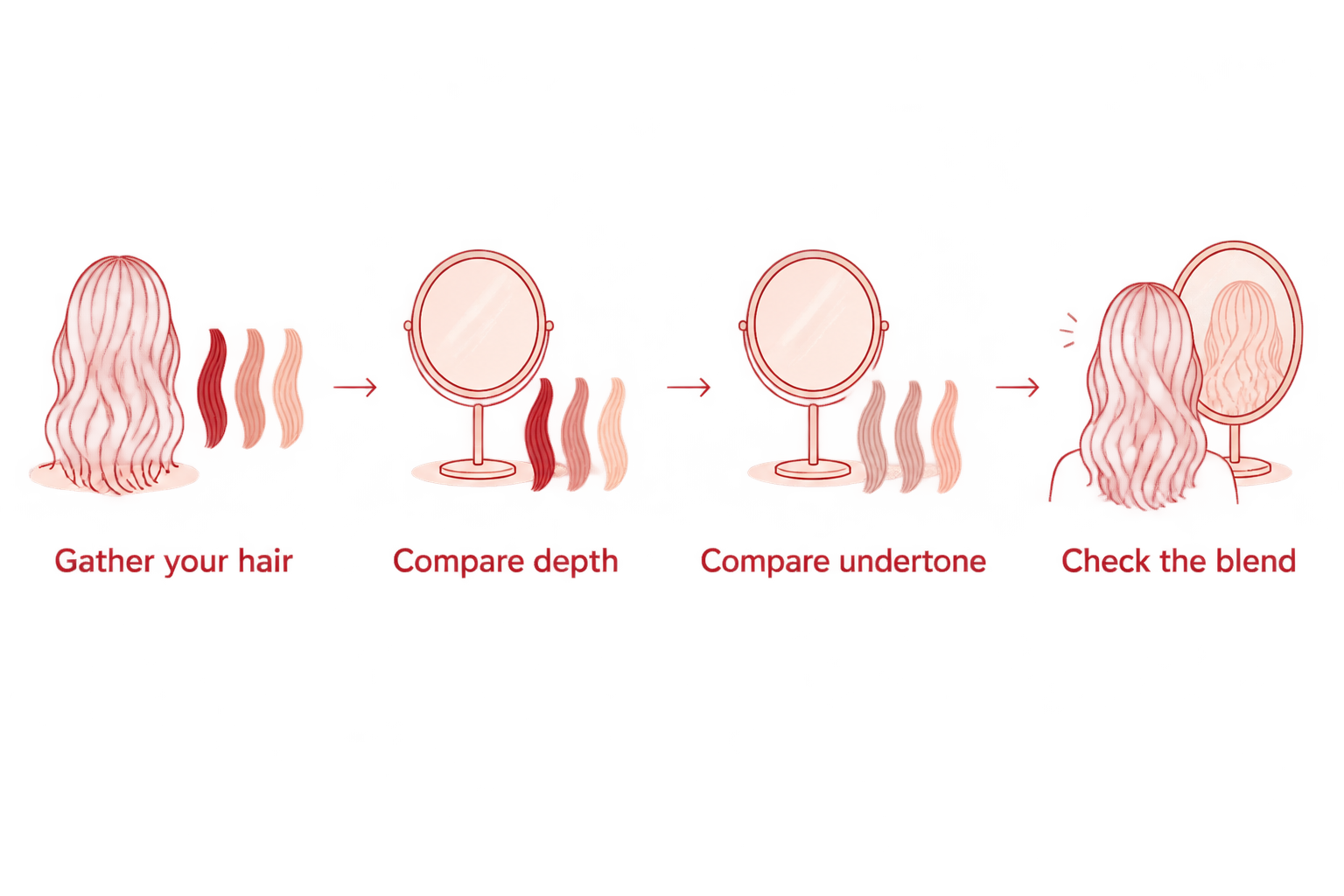
Use this sequence for a 2026 purchase, especially if your roots, lengths, and ends show different colors. Pull your hair into the position you actually plan to wear before opening the shade options.
Gather your hair
Make your usual low, middle, or high bun without the hairpiece. Look at the hair immediately around that base; this is the area the added hair will sit beside.
If your roots are silver but your gathered lengths remain brown, matching only the roots ignores the visible join. Compare the whole updo before deciding which color should lead.
Compare depth
Ask whether the candidate looks lighter, darker, or close to the surrounding hair. Do this before examining small differences in warmth.
A shade description is a search aid, not a final answer. Screen brightness and product lighting are reasons to confirm the match in person rather than treating an image as a physical swatch.
Compare undertone
Look for golden warmth, reddish warmth, a neutral impression, or a cooler ash tone. Match the impression beside the bun rather than choosing a familiar label automatically.
For highlighted hair, consider the visible mixture. Do not match an isolated bright strand if most of the gathered hair looks darker.
Check the blend
Inspect 3 viewing angles: back, left side, and right side. Then compare under 2 lighting conditions: indirect daylight and your usual indoor light.
These are practical checks, not an accuracy test. Look for a sudden change in depth, warmth, shine, or texture at the join.
Grey, silver, and salt-and-pepper: what to compare
Grey and silver are useful descriptions, but they are not standardized shade formulas. For your 2026 shortlist, compare the visible balance of light and dark strands rather than expecting every “silver” option to look the same.
| Shade description | What to inspect | Advantage when matched | Limitation |
|---|---|---|---|
| Grey | Overall depth and mixture of strands | Helps describe a mixed-grey look | The name does not specify lightness |
| Silver | Lightness and coolness | Helps describe a lighter, cooler-looking result | The name does not guarantee an undertone |
| Salt-and-pepper | Balance of dark and light strands | Reflects a visibly mixed color pattern | Different mixtures can look quite different |
| Brown-grey | Amount and warmth of remaining brown | Helps assess hair retaining brown tones | Does not establish the exact brown-to-grey balance |
If you are growing out dyed hair, inspect the area around the bun each time you reassess your shade. New growth and older lengths occupy different parts of an updo, so the best comparison point is the actual join.
Do not assume a product photograph proves a particular shade is offered for every bun. Check the selected product's own options and details before choosing.
Attach and style without hiding a mismatch
Start with a bun that stays in place comfortably on its own. If your base pulls or feels unstable before you add anything, adjust it first rather than asking the hairpiece to hold the entire hairstyle together.
For a scrunchie-style bun, follow the product's attachment instructions and arrange the added hair around your secured base. Keep the attachment covered without pulling your own hair tighter to force a fit.
- Fine or thin hair: Build a base your hair can support and avoid tightening through discomfort.
- Thicker hair: Check that your own bun sits inside the finished shape without an obvious exposed section.
- Straight styling: Smooth the surrounding hair before judging a straight bun's finish.
- Curly styling: Arrange the curls with your fingers and check their outline from behind.
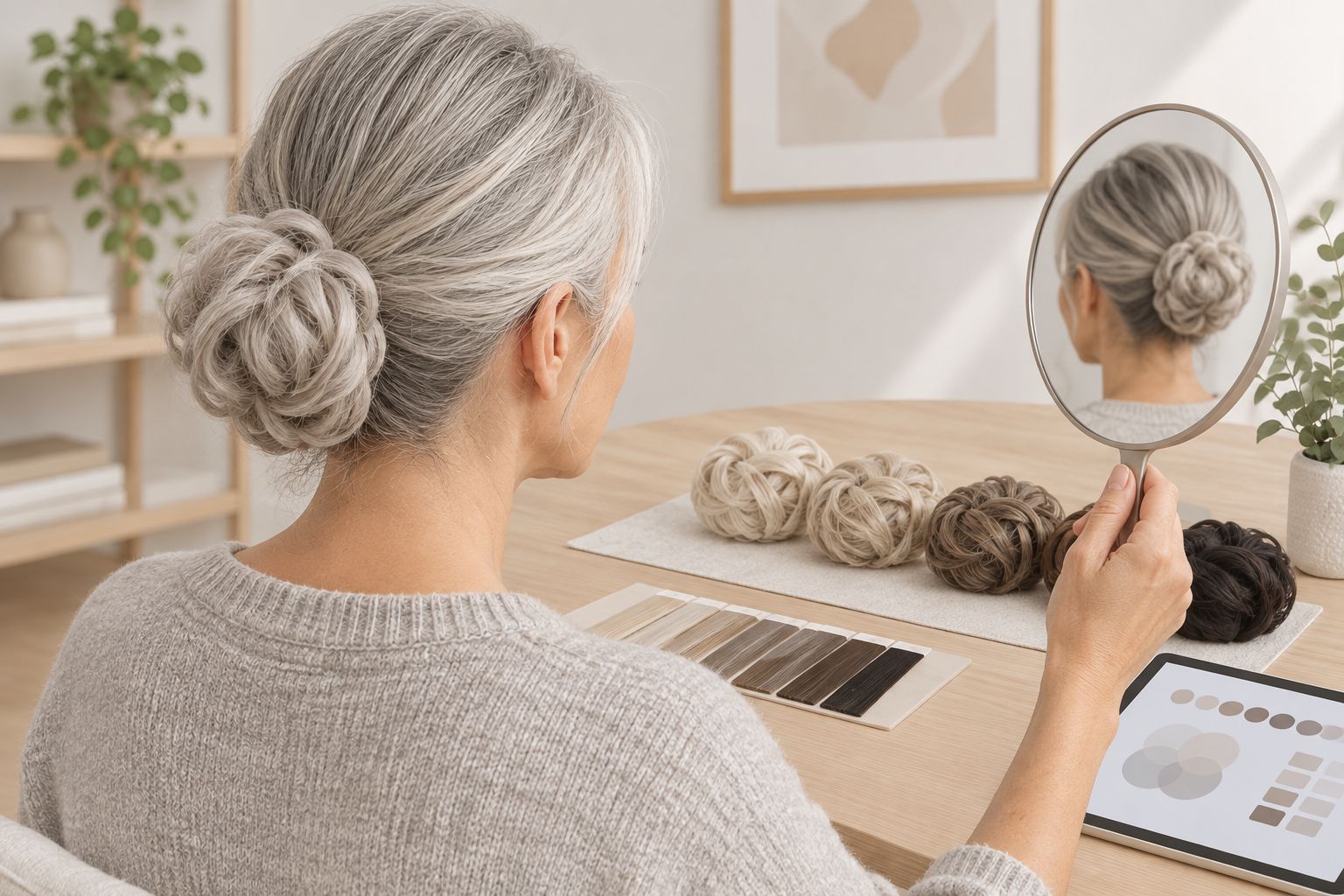
If the join still shows a clear color change, reconsider the shade rather than adding more accessories. Styling can cover an attachment; it cannot change the fiber color.
The Apexhairs options below correspond to the tousled, smooth, and curly choices in this guide. Use the product details to confirm your preferred shade and attachment before deciding.


When a ponytail is the better styling choice
Choose a bun when you want the added hair gathered into an updo. Choose a ponytail extension when you want hanging length and movement; neither format automatically gives a closer color match.
Apexhairs lists an 8-inch Short Straight Ponytail Extension Claw Clip and a 14-inch Half Up Half Down Ponytail Extension with a wavy texture. Those lengths describe styling alternatives, not evidence of better blending.
A ponytail exposes a longer section of added hair, so compare its shade against the lengths beside it. Its advantage is the different silhouette; its limitation is that it does not create the compact shape of a bun.
Best for: Choose a ponytail when loose length is the goal, not as a workaround for an unmatched bun shade.
How the 2026 ranking works
This ranking uses stated product features: texture, scrunchie format where identified, and the intended finished style. It does not use physical shade comparisons, customer accuracy scores, or a standardized color test.
The tousled scrunchie is the default for a casual updo. The straight and curly alternatives serve different styling goals rather than representing progressively worse color matches.
Which bun hairpiece should you choose?
Choose the Synthetic Messy Bun Hairpiece Scrunchie if you want a casual, fuller-looking updo and have not settled on another texture. Choose the Straight Synthetic Hair Bun Scrunchie for smoothness or the Messy Bun Hair Piece – Curly Synthetic Hair Bun for defined curls.
For any Apexhairs bun hairpiece, make the final decision in this order: shade beside gathered hair, comfortable attachment, then finished shape. A lower-ranked style that matches your hair is a better choice than the default in the wrong shade.
FAQ
What's the best way to get a bun hairpieces color match?
Compare the hairpiece with the hair immediately surrounding your finished bun. Check depth, undertone, and the mixture of lighter and darker strands before deciding.
Should I match my bun hairpiece to my roots or my ends?
Match the hair visible beside the bun attachment rather than automatically choosing roots or ends. Gather your hair first so you can see which color actually surrounds the join.
Is a silver bun the same color as a grey bun?
No, silver and grey labels do not establish an identical shade. Compare lightness, coolness, and the visible mixture of strands on the specific product.
Is a curly bun better than a straight bun for hiding a color mismatch?
Neither texture corrects a wrong shade. Choose curls or straight hair for your intended finish, then check the color separately.
Which bun style should I choose for fine hair?
Choose a bun your secured base can support comfortably. The Synthetic Messy Bun Hairpiece Scrunchie is described as lightweight and clip-free, but comfort and attachment fit still need checking.
Can I use heat to make a synthetic bun match my texture?
Use heat only when the specific product's care instructions explicitly allow it. Synthetic fiber does not automatically mean heat-safe fiber.
Does this 2026 ranking prove which bun has the most accurate shades?
No, this ranking compares styling suitability using stated product features. It does not report physical shade testing or measured color-match accuracy.
One last thing
Photograph your own finished bun from behind before choosing a shade. The hair you see in a front-facing mirror is not necessarily the hair that will meet the hairpiece; that rear view gives you a more useful reference.


Leave a comment