
Braid to messy bun: complete 2026 double-duty hairstyle workflow
Instead of restyling your hair from scratch, create a braid to bun hairstyle by braiding a secured ponytail, coiling it into a bun, and adding a synthetic bun scrunchie when you want more fullness. This 2026 guide shows you how to keep the same base for two looks, match your shade, and change the finish without pulling your hair tight.
- A braid to bun hairstyle turns a secured ponytail into a coiled updo without rebuilding the base.
- Apexhairs synthetic bun hairpieces suit women who want fuller-looking everyday updos without cutting their hair.
- Match grey or silver hairpieces to the hair surrounding your bun, not just your roots.
- Keep a claw-clip ponytail extension loose; do not assume its attachment can be wrapped into a bun.
Apexhairs synthetic bun hairpieces are best for women seeking fuller-looking everyday updos without cutting their hair. The braid supplies the shape; the optional hairpiece adds visible fullness around it. Neither requires you to have thin hair, and neither treats hair loss.
Why this matters
A braid and a messy bun do not need separate starting points. Put the ponytail where you want the finished bun, braid the length, and leave the base elastic in place when you coil it.
That shared base is the useful part of this 2026 routine. You can wear the braid first, then pin it into an updo later. The limitation is length: your own hair must form a braid that reaches around its base. If it cannot, use a small natural bun beneath a bun hairpiece instead of forcing short ends into a coil.
Before you start
- Gather your materials: a gentle brush or comb for your own hair, hair elastics, hairpins, a mirror, and an optional synthetic bun scrunchie. Keep the hairpiece's care and attachment instructions nearby.
- Check the attachment before styling: a scrunchie wraps around a base; a claw clip grips it. A ponytail extension is not automatically suitable for braiding or wrapping into a bun. Do not wind a rigid claw around your head.
- Check comfort and shade in daylight: compare the hairpiece with the hair that will surround it. If your scalp feels sore or the attachment pulls, remove it and rebuild a looser base rather than adding more tension.
For this 2026 workflow, practice the braid-to-coil movement without a hairpiece first. You will see where your ends need pinning before added fibers obscure the base.
Hairpiece and shade selection
Choose the finish before building the base
- Decide whether you want a textured bun, a smooth bun, or a hanging ponytail. Choose the attachment around that finish, rather than trying to make every piece do every job.
- Inspect how much of your own hair the attachment needs to hold. A hairpiece should sit securely without requiring a painfully tight ponytail.
- Compare the options below. Best for describes the styling task, not a promise that an attachment fits every head of hair.
| Option | Best for | What it adds | Trade-off |
|---|---|---|---|
| Your own braided bun | Keeping the braid visible | A coiled shape using your own hair | Fullness depends on your natural length and density |
| Synthetic Messy Bun Hairpiece Scrunchie | A fuller-looking, tousled bun | Synthetic texture around the natural bun; a clip-free attachment | The added fibers can cover much of the braid |
| Smooth bun scrunchie | A less tousled finish | A smoother outline around a bun base | Short loose hairs and a mismatched texture need more blending |
| Short Straight Ponytail Extension Claw Clip 8" | A separate hanging-ponytail variation | A short, straight ponytail with a claw-clip attachment | The rigid clip is not a flexible bun scrunchie |
The short claw-clip ponytail is listed at 8 inches. The supplied catalog also includes a wavy claw-clip ponytail listed at 14 inches; that is a different length and texture, not evidence that either attachment can become a braided bun.
Expected result: you have chosen a hairpiece that matches the finished shape and understand whether it wraps or clips into place.
Match the hair surrounding the bun
- Look at your hair in indirect daylight. Compare the mid-lengths and the area around the planned bun, not only the hairline.
- Separate depth from tone. First ask whether the piece looks lighter or darker; then check whether it looks warmer, cooler, or more neutral.
- Compare texture as well as color. A smooth piece against a loose braid creates a different finish from a curly piece against the same braid.
Grey and silver are not interchangeable shade descriptions. Grey can describe a darker mixture of light and dark strands; silver usually describes a lighter, cooler-looking effect. Shade names vary, so inspect the actual product photographs rather than treating the name as a fixed color standard.
With salt-and-pepper hair, compare the balance of dark and light strands near the bun. With newly silver roots and darker lengths, matching only the roots can leave the bun noticeably lighter than the hair immediately beneath it.
Expected result: the piece looks compatible with the surrounding hair in daylight, even if every strand is not identical.
These Apexhairs synthetic hairpieces serve different jobs: the bun scrunchie supports the main updo, while the claw-clip ponytail supports the separate variation below. Choose the job first.


Ponytail and braid base
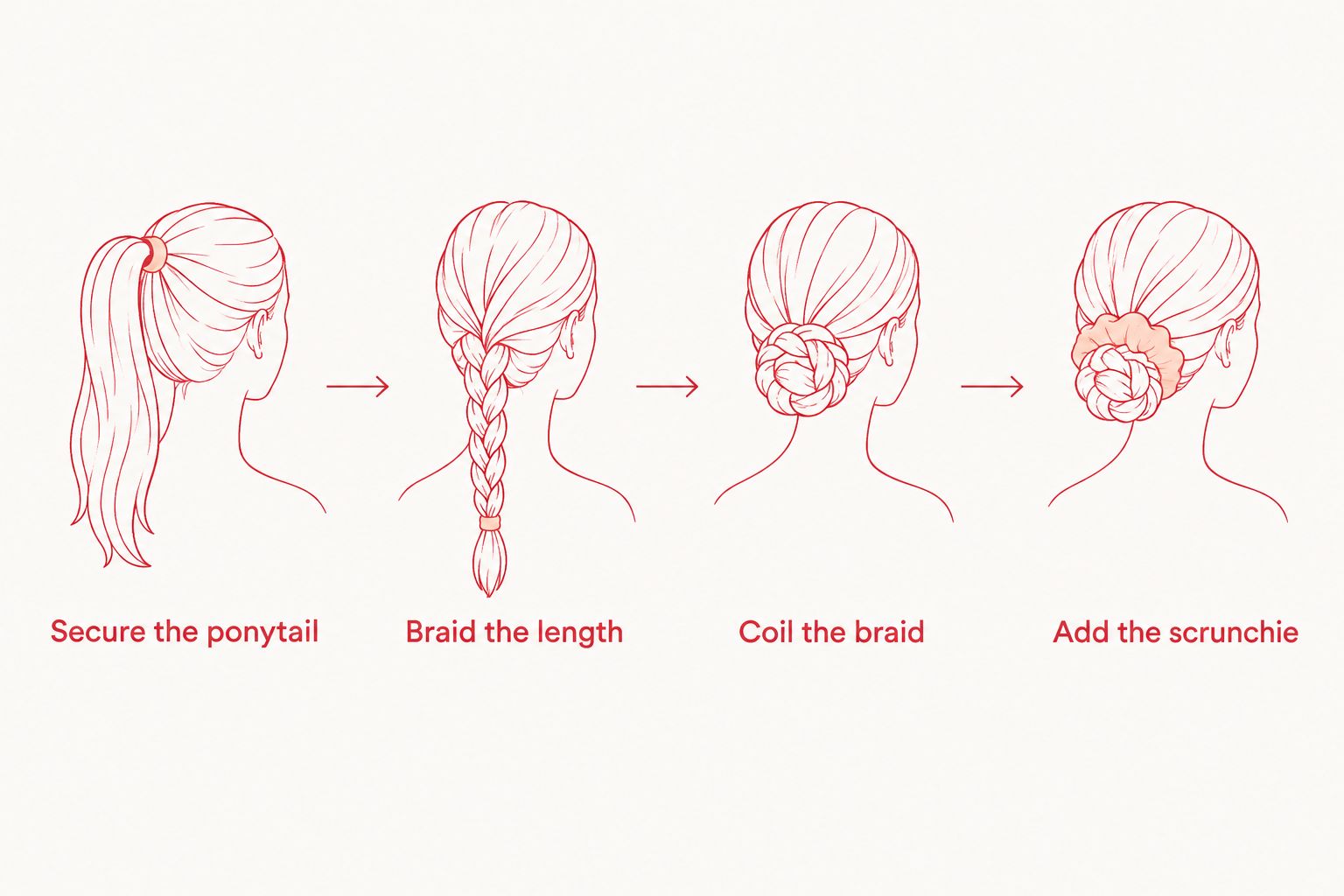
Secure the ponytail
- Gently detangle your own hair, working through the ends before moving upward. Keep the synthetic piece separate during this step.
- Gather your hair at the height where you want the finished bun. A low base keeps the style near the nape; a higher base changes the silhouette.
- Fasten the ponytail with an elastic that holds without pulling. Turn your head and look down to check for uncomfortable tension.
- Smooth only the surface hairs you want controlled. You do not need to flatten every strand or pull the temples tight.
Expected result: the ponytail stays in position while you move your head, and the hairline feels comfortable.
Braid the length
- Divide the ponytail into 3 sections. Cross an outer section over the middle, then repeat from the opposite side.
- Continue down the length without tightening the braid against the scalp. Secure the end with a small elastic.
- If you want a softer shape, gently ease the outer edges of the braid. Hold the end while doing this so you do not undo the plait.
- Check that the braid bends around its base without dragging the ponytail elastic sideways.
The braid can be your first finished hairstyle. If you plan to change it later, leave the base elastic alone; only the braid's position needs to change.
Expected result: you have a flexible braid with a secure end, ready to wear down or coil into a bun.
Braided bun and messy finish
Coil the braid
- Guide the braid around the ponytail elastic. Follow its natural bend rather than twisting it tightly into a rope.
- Lay the coil against your head and tuck the braided tail beneath its edge.
- Secure the coil with hairpins, catching the braid and nearby hair without scraping your scalp. Reposition any pin that presses or hurts.
- Check the bun from the side and back. If you want the braid visible, stop here or leave an outer section exposed when adding the hairpiece.
Expected result: the natural braided bun holds independently. The hairpiece will decorate that base, not rescue an unsecured coil.
Add the scrunchie
- Follow the bun scrunchie's attachment instructions and stretch its opening gently over the natural bun. Keep the synthetic fibers clear of the elastic as you position it.
- Let the band settle around the base. If it remains loose, remove it and check the permitted fitting method rather than repeatedly twisting it tighter.
- Arrange the fibers with your fingers. Spread them around the coil for an all-over messy finish, or move them aside where you want the braid to show.
- Check the band in a rear-view mirror. Adjust the surrounding fibers before deciding whether an additional pin is necessary.
Expected result: the band is concealed, the bun feels stable, and no attachment pulls at your roots.
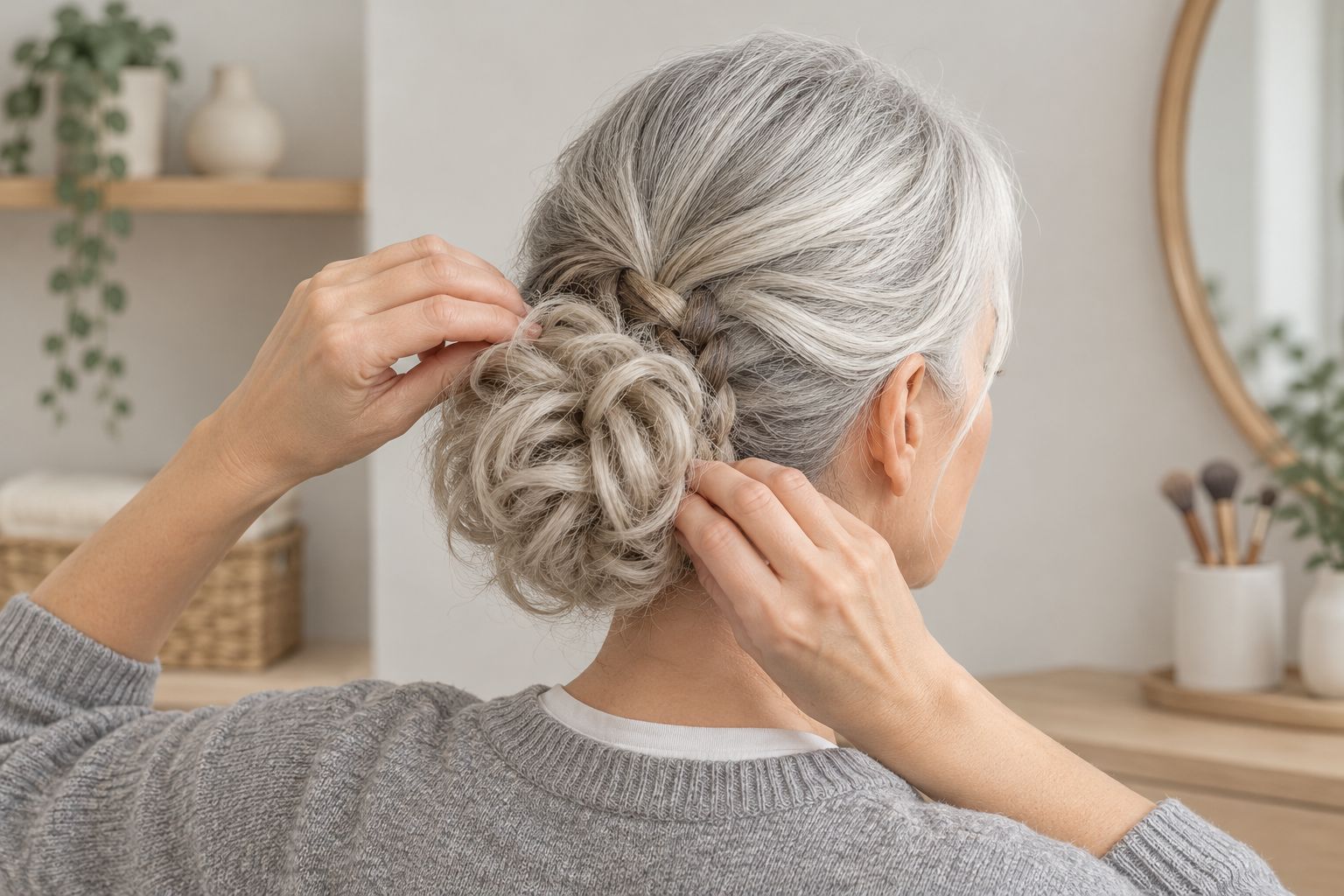
For fine or thin hair, judge the result by comfort and proportion rather than maximum size. For thicker hair, the challenge can be covering a larger natural coil. Apexhairs bun hairpieces add visible fullness; they do not replace a comfortable, secure base.
Second variation: change to a claw-clip ponytail
The adjacent workflow is a hanging ponytail, not a braided extension bun. Use this 2026 variation when you want a different finish and the claw attachment suits your natural ponytail base.
- Remove the bun hairpiece before touching the pins underneath it.
- Take out the pins, uncoil your braid, and remove the small end elastic. Leave the main ponytail elastic in place if it remains comfortable.
- Undo the braid gently with your fingers. Smooth your own ponytail without pulling at the base.
- Following the ponytail extension's instructions, open the claw, position it at the secured base, and close it without catching your scalp.
- Arrange the extension and check the attachment from behind. Remove it if it slips, pinches, or requires excessive tension to stay put.
Expected result: you have changed the finish while retaining the original ponytail base. Do not braid or wrap the attached synthetic ponytail unless that specific product's instructions allow it.
Troubleshooting
The bun slides away from its starting position
Remove the hairpiece and check whether the natural bun also moves. If it does, rebuild the ponytail and coil first. If only the hairpiece moves, check its attachment instructions and fit; more scalp tension is not the solution.
The braid disappears completely
A full bun scrunchie can cover the braid by design. Shift the fibers away from one outer curve, or wear the braided bun without the hairpiece when showing the plait matters more than added fullness.
The finished bun looks too bulky
First check whether you have stacked the hairpiece on top of a tall natural coil. Recoil your braid flatter and distribute the added fibers around the base. If the proportions still feel wrong, choose a less full finish rather than compressing everything tightly.
The grey piece looks wrong indoors or outdoors
Compare it again in indirect daylight beside the hair surrounding your bun. Check depth before tone: a lighter silver effect will not disappear into a darker salt-and-pepper base simply because both are called grey.
The attachment hurts or catches loose hairs
Remove it immediately and free trapped strands gently. Reposition the base and attachment without pulling; stop wearing the piece if discomfort returns. Never keep tightening a painful style to make it last.
Customize your workflow
Keep your 2026 routine centered on one decision: do you want the braid visible, or do you want the fullest messy finish? Leaving part of the coil exposed favors the braid; distributing synthetic fibers around it favors fullness.
Change placement before adding accessories. Try the base lower if a higher position feels awkward, and check whether collars or scarves push against the finished bun. Treat heat styling separately: do not use heated tools on synthetic fibers unless the specific product instructions permit it.
FAQ
How do I turn a braid into a messy bun?
Coil a secured ponytail braid around its base, tuck the end underneath, and pin it comfortably. Add a synthetic bun scrunchie around the stable coil if you want more fullness.
Can I do a braid to bun hairstyle with thin hair?
Yes, if your hair can form a secure, comfortable braid and coil. Keep the base gentle and use an optional bun hairpiece for visible fullness rather than pulling your hair tighter.
Will the braid show through a messy bun hairpiece?
Not necessarily; a full hairpiece can cover the entire coil. Arrange the fibers away from part of the braid, or wear the braided bun alone when you want the plait visible.
Can I braid a claw-clip ponytail extension and wrap it into a bun?
Do not assume a claw-clip ponytail extension is suitable for a braided bun. Keep it as a hanging ponytail unless that specific product's instructions permit braiding and wrapping.
Should a grey bun match my roots or my ends?
Match the hairpiece primarily to the hair immediately surrounding the finished bun. When silver roots and darker lengths differ, matching the roots alone can leave a visible contrast at the attachment.
Can I use a curling iron on a synthetic bun scrunchie?
Use heated tools only when the specific hairpiece instructions explicitly permit them. Otherwise, arrange the existing texture with your fingers rather than applying heat.
Do Apexhairs synthetic hairpieces treat thinning hair?
No. Apexhairs synthetic hairpieces provide cosmetic fullness or coverage; they do not regrow hair or treat hair loss.
One last thing
Build the bun as though you will wear it without the hairpiece. A stable, comfortable coil makes the added piece a styling choice rather than something holding the whole hairstyle together. That is the most useful habit to keep from this 2026 routine.


Leave a comment