
How do you fix a bun hairpiece that looks too small?
To fix a bun hairpiece that looks too small, take it off, gently separate any compressed curls or strands, then refit it around a flatter natural bun and spread the hair evenly over the attachment. This improves the shape, but it cannot add fibers: if the piece still leaves your natural bun or its band exposed, choose a fuller style rather than pulling harder or tightening the attachment.
- How to fix a bun hairpiece that looks too small: reshape the base, gently fluff, and refit before replacing.
- Apexhairs bun hairpieces suit women seeking fuller-looking updos without permanent extensions.
- Spread synthetic hair around the attachment; do not stretch fibers to create volume.
- Match grey or silver hair near the bun, not just at the roots.
How do you fix a bun hairpiece that looks too small?
Fix the base and the distribution of the hair before deciding the hairpiece is too small. A tightly twisted natural bun can project through the middle, while compressed synthetic strands leave the outside looking narrow. Start with a comfortable attachment; the guide to choosing bun extensions your hair can support covers that separate fit decision.
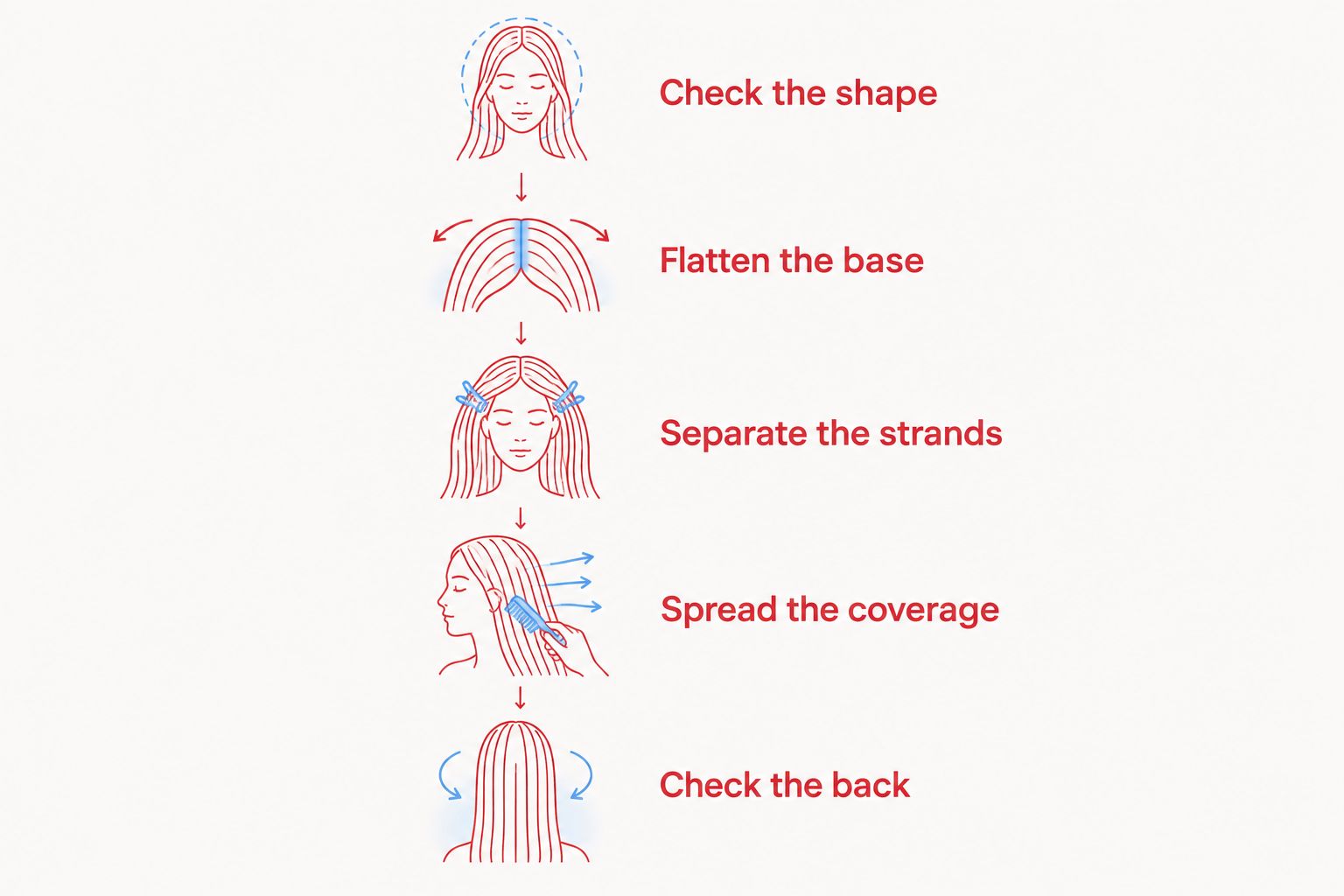
1. Check the shape
Look at the bun from behind and from each side. Identify whether the problem is a narrow outline, a visible center, or a bulky natural bun underneath. Those need different adjustments.
Remove the hairpiece before working on it. Open a clip completely or gently unwind a scrunchie attachment instead of dragging it through your hair.
2. Flatten the base
Gather your own hair into a compact, flatter bun rather than a tall, tightly twisted knot. Secure your natural hair independently so the hairpiece does not have to hold the whole hairstyle together.
For fine hair, avoid pulling the roots tighter to make a smaller base. For thick hair, spread and tuck the ends so they do not form a lump beneath the hairpiece.
3. Separate the strands
Support the hairpiece near its attachment and use your fingertips to ease apart compressed sections. Work with the existing curl or strand direction rather than pulling against it.
With a curly piece, separate the outer curls without unraveling every curl. With a straight piece, arrange the strands into a wider outline; do not expect it to develop curly volume.
4. Spread the coverage
Refit the hairpiece according to its attachment instructions. Arrange its hair around the sides and over any exposed parts of your natural bun, keeping the attachment secure and comfortable.
Move hair from a dense area toward a sparse area before adding accessories. You are redistributing the existing hair, not stretching the piece into a larger size.
5. Check the back
Use a second mirror or a rear-view phone photo to inspect the finished bun. Check the outline, the center, and the attachment separately.
Turn your head gently and confirm that the piece stays comfortable. If the band shows again as soon as you move, reassess the fit instead of repeatedly covering it with loose strands.
Why this matters
A bun can look small because its hair is bunched together, because your own bun projects beyond it, or because the style simply has less fullness than you want. Buying another piece before checking those differences can leave you with the same styling problem.
For your 2026 everyday routine, aim for an even outline and a comfortable hold—not the biggest possible bun. The same checks work whether your hair is thin, thick, straight, curly, or transitioning to grey.
Why a bun hairpiece looks smaller than expected
These factors help you separate a styling issue from a mismatch:
- Texture: Curly and straight bun hairpieces create different outlines. A smooth finish is not the same look as a tousled bun.
- Strand distribution: Hair gathered heavily on one side leaves another side looking sparse. Spread it before judging the overall fullness.
- Natural-bun shape: A projecting knot needs more coverage than a flatter base. Changing the base changes what the hairpiece must conceal.
- Attachment position: A scrunchie or clip sitting off-center can leave part of your natural bun exposed. Refit it instead of pulling the synthetic hair across a large gap.
- Shade contrast: A noticeably different shade makes the boundary between your hair and the hairpiece easier to see. That can make an otherwise suitable piece look separate or undersized.
Which styling adjustment should you try first?
Choose the adjustment that matches what you see. Do not use every technique at once; checking after each change makes it easier to tell what helped.
| What you see | Best for: first adjustment | Benefit | Limitation |
|---|---|---|---|
| Curls look compressed | Gentle finger separation | Restores space between existing curls | Does not add more hair |
| Your natural bun sticks out | A flatter natural base | Reduces the shape the piece must cover | Your hair still needs a secure hold |
| Fullness sits on one side | Repositioning and redistribution | Makes the outline more even | Cannot fill a gap beyond the piece's coverage |
| The bun looks smooth but too narrow | A different texture or fuller style | Changes the finished silhouette | Requires a new style choice, not more pulling |
| The attachment shows during movement | Removing and refitting | Lets you check the fit properly | Extra fluff cannot correct a poor attachment fit |
Stop if an adjustment causes pulling, pinching, or soreness. A hairstyle that looks fuller is not a successful fix if you have to tolerate an uncomfortable attachment.
How do you make a small bun look fuller without damaging it?
Work from underneath
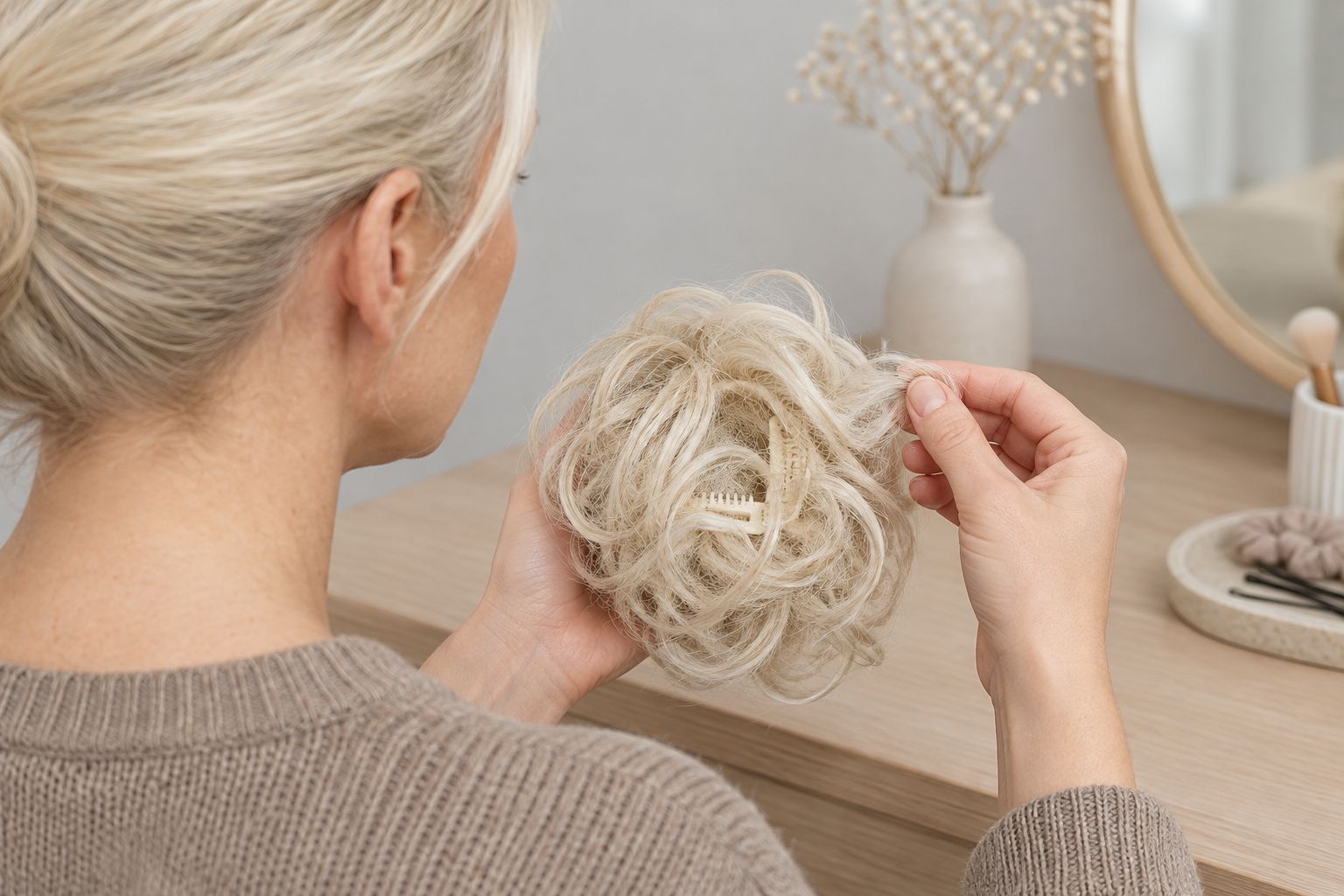
Hold the attachment steady and lift small sections away from it with your fingertips. Let each section settle before moving to the next. Pulling on the tips can disturb the texture without improving the coverage at the base.
Leave some variation in a messy bun rather than flattening every strand against the surface. For a smooth bun, prioritize an even, rounded arrangement instead of trying to imitate a curly style.
Pin for coverage, not tension
If the hairpiece instructions allow pins, use them to guide loose sections over a visible edge. Avoid driving pins through an attachment or pulling a short strand across a gap it cannot comfortably cover.
Inspect the result from behind before adding more pins. A hidden edge and a secure fit matter more than a perfectly symmetrical outline.
Leave heat out of the fix
Do not use a curling iron, straightener, or hot tool unless the instructions for that exact synthetic hairpiece explicitly permit it. Synthetic does not automatically mean heat-friendly.
For a 2026 styling reset, start with finger arrangement and a better-fitting base. Heat is not a substitute for missing coverage, and aggressive brushing is not a reliable way to make a curly bun fuller.
When should you choose a different bun hairpiece?
Replace the style when the piece remains too narrow after a comfortable refit and gentle arrangement. Also reconsider it if your natural bun cannot fit underneath without being pulled painfully tight.
Apexhairs bun hairpieces are best for women who want fuller-looking updos without permanent extensions. Within that category, choose the finish you actually want: a tousled bun and a smooth bun solve different styling preferences.
Choosing a replacement in 2026
These options differ in finish, not in a verified size ranking. Neither product description establishes that one has a larger diameter than the other.
| Hairpiece | Best for | What it adds | Trade-off |
|---|---|---|---|
| Synthetic Messy Bun Hairpiece Scrunchie | A tousled everyday updo | Synthetic volume with a lightweight, clip-free scrunchie design | The textured finish is not a sleek bun; check coverage rather than assuming a larger fit |
| Straight Synthetic Hair Bun Scrunchie | A smoother everyday bun | Synthetic fullness with a lightweight, clip-free design | The straight finish does not create the same outline as separated curls |
Before choosing either Apexhairs option, compare the attachment, finish, and shade information with the piece you already own. A different texture is useful only if you prefer its finished look; it does not guarantee more coverage.


Grey and silver shade matching in 2026
Match the hairpiece to the hair surrounding your bun, not automatically to your roots. If your roots are silver but your lengths are darker, the attachment sits beside those darker lengths when you gather your hair up.
Grey can describe a mixture of darker and lighter strands, while silver generally describes a lighter, cooler-looking finish. Shade names are not standardized, so compare the actual shade images rather than relying on the name alone.
Check the comparison in indirect daylight and look at both depth and tone. A bright silver piece beside darker salt-and-pepper hair can draw attention to the join; choosing a larger bun will not correct that color difference.
When comparing Apexhairs shade options, use the images and information for the specific product. Do not assume the same shade name looks identical across different textures or product photos.
Can you fix a small-looking bun if your own hair is thin?
Start with a secure, comfortable base rather than a tighter ponytail. Arrange the hairpiece to cover the base you have, and avoid repeatedly winding an elastic attachment until it pulls at your roots.
Thin hair does not automatically call for the largest bun. Choose a piece your hair can comfortably support, and separate the goals of fuller-looking hair and coverage: a bun hairpiece adds an updo, but it does not treat hair loss.
Would a ponytail extension work better than a bun?
A ponytail extension is an alternative when you want hanging length rather than a rounded updo. It is not a way to enlarge an existing bun, and a different attachment still needs its own comfort check.
| Style | Best for | Advantage | Trade-off |
|---|---|---|---|
| Bun hairpiece | A gathered, fuller-looking updo | Adds hair around a bun base | Must cover that base without uncomfortable tension |
| Ponytail extension | A hairstyle with hanging length | Changes the silhouette without building a rounded bun | Does not solve gaps in a bun you continue wearing |
If your goal is specifically a fuller bun, finish the base-and-coverage check first. Choose a ponytail because you want that hairstyle, not because you expect it to repair the bun hairpiece.
FAQ
Why does my bun hairpiece look smaller after I put it on?
Your bun hairpiece can look smaller when its hair bunches together or your natural bun projects beyond its coverage. Remove it, check the base, and gently redistribute the synthetic hair before refitting.
Can I stretch a synthetic bun hairpiece to make it bigger?
Do not stretch the synthetic fibers to make a bun hairpiece bigger. Arrange the existing strands into a wider outline, but choose another style if the piece still cannot cover your base.
Should I brush a curly bun hairpiece to add volume?
Start with gentle finger separation rather than brushing a curly bun hairpiece for volume. Follow the specific care instructions because brushing can disrupt the curl arrangement.
Will a tighter scrunchie make my bun hairpiece look fuller?
A tighter scrunchie does not add fullness to a bun hairpiece. Use a comfortable, secure fit, then arrange the hair around the attachment rather than tightening it to change the appearance.
Can I wear two bun hairpieces together?
Do not make stacking bun hairpieces your first fix. Stacking adds another attachment and more material to support, so try refitting the existing piece or choose a style that provides the coverage you need.
How do I match a silver bun hairpiece to darker grey hair?
Match a silver bun hairpiece against the gathered hair beside the attachment, not just the roots. Compare the lightness and the mix of darker and lighter strands in indirect daylight.
What should I check before choosing a replacement bun in 2026?
Before choosing a replacement bun in 2026, check its attachment, texture, shade, and stated coverage or size information. A fuller-looking product photo alone does not establish that the piece is larger than yours.
One last thing
Check the center before adding volume at the edges. A wide outer shape can still leave your natural bun exposed in the middle, so more fluff is not always the answer.
Take a rear-view photo after each adjustment and compare the coverage, not just the width. Keep your 2026 styling routine simple: a flatter base, evenly arranged hair, and a comfortable attachment come before replacement.


Leave a comment