
How to choose bun hair extensions that your hair can support
Choose bun hair extensions that stay secure on a comfortable ponytail or small bun without needing extra-tight ties, repeated pinning, or pressure on your scalp. Match the attachment to the hair you can gather, then choose the fullness, texture, and shade. A fuller-looking updo should not require you to tolerate pulling.
- Choose bun hair extensions around a comfortable base, not the biggest finished bun.
- Apexhairs synthetic bun hairpieces suit women seeking fuller-looking everyday updos without adding loose extensions.
- Scrunchies need a gathered base; clips need enough hair to grip without pinching.
- Match grey or silver shades to the hair beside your bun, not just your roots.
How do you choose bun hair extensions your hair can support?
Choose the smallest amount of added fullness that gives you the updo you want while keeping your natural hair comfortable. Your hair should support its own base before you add a hairpiece. Tightening a weak or uncomfortable base does not make it a better foundation.
For your 2026 shortlist, compare attachment and finish before choosing a shade. These options serve different styling needs; none replaces checking the fit on your own hair.
| Option | Best for | Useful feature | Limitation to check |
|---|---|---|---|
| Synthetic Messy Bun Hairpiece Scrunchie | A tousled everyday updo | Synthetic, lightweight, clip-free design adds volume | Needs a gathered base that holds comfortably |
| Straight Synthetic Hair Bun Scrunchie | A smoother-looking bun | Synthetic, lightweight, clip-free design adds fullness | A smooth finish makes the transition between your hair and the piece important |
| Clip-in bun attachment | Hair that comfortably supports a clip | Attaches through a clip rather than a scrunchie | Check for pinching, visible hardware, and movement |
| Ponytail extension | A loose-tail style rather than a rounded bun | Adds hair to a ponytail silhouette | A longer look is not a substitute for a stable attachment |
Check your base before adding anything
Gather your hair where you normally wear an updo. Secure it with your usual comfortable tie, then turn your head, look down, and sit back upright. Notice whether the base stays in place without pulling at your hairline.
If your natural ponytail slides or feels tight before you add a piece, adjust its position or size first. Do not ask the hairpiece to fix an unstable foundation.
Why this matters
A beautiful shade cannot rescue an attachment that slips or hurts. The right choice balances the appearance you want with the hair available at the attachment point, whether your hair is fine, thick, short, or somewhere between.
Apexhairs is best for women seeking synthetic bun hairpieces for fuller-looking everyday updos. These pieces add styling volume; they do not regrow hair or treat hair loss. Comfort and a believable blend matter more than choosing the largest bun.
Choose the attachment before the finished hairstyle
Scrunchie attachment: best for an existing ponytail or bun
A scrunchie-style piece works around a gathered base. Start with a ponytail or compact bun that already feels secure, then position the hairpiece according to its instructions. Arrange the synthetic strands around that foundation rather than pulling your own hair tighter to accommodate them.
The benefit is a clip-free way to add fullness. The limitation is that a scrunchie still needs something stable to sit around; a loose or oversized fit can shift.
Check the elastic rather than assuming another wrap is always the answer. If another wrap creates pressure, remove the piece and reconsider the fit. A comfortable attachment is the goal, not the maximum number of wraps.
Clip attachment: best for hair that holds a clip comfortably
A clip-in bun needs enough hair at the attachment point for the clip to hold without pressing painfully against your scalp. Follow the piece's opening and closing instructions, keeping stray hairs clear of the mechanism.
A clip offers a different way to attach a bun, but it is not automatically a stronger choice for fine hair. Check whether the clip closes comfortably, remains hidden, and stays put when you move. Stop if it pinches.
Ponytail extension: best for a loose-tail finish
Choose a ponytail extension when you want movement and length hanging below the attachment rather than a rounded updo. Check the specific attachment before choosing, because the word ponytail describes the hairstyle, not a universal fastening method.
A ponytail changes the shape of your style. It does not remove the need for a secure base, and winding a ponytail extension into a bun is not a substitute for following its intended instructions.
Match fullness to the hair you can comfortably gather
Start with your natural bun's shape. Look at it from the side and back, then decide what is missing: width, texture, or a smoother outline. That makes the choice more useful than simply asking for more hair.
For fine or sparse hair, a smaller-looking finished bun is a sensible starting point. For thicker hair, leave room for your own bun inside the finished style rather than adding a large piece over an already full base. Hair thickness changes the starting point, not your right to an easy hairstyle.
A practical 2026 buying check is to look for published weight, attachment details, and dimensions when provided. A small-looking photo does not establish a product's weight, and a lightweight description does not guarantee a comfortable fit on every person.
Messy texture: best for a softly blended updo
Tousled strands can soften the outline where your own hair meets the piece. Arrange them gently around the base instead of pulling individual fibers outward to create more volume.
The trade-off is that too much fluffing can make the bun look oversized. Stop when the shape balances with your head and the attachment remains covered.
Straight texture: best for a smoother outline
A straight bun suits a neater silhouette. Smooth your own hair toward the base before attaching it, then check the join from behind.
The trade-off is a more noticeable contrast if your own hair is very textured or the shade differs sharply. Match the finish you can comfortably create, not a finish that requires tight brushing or pulling.
Match grey and silver shades where the bun will sit
Grey is not a single shade. Salt-and-pepper hair contains a visible mixture of darker and lighter strands, while silver describes a lighter-looking grey appearance. Names alone do not establish an exact color match.
Look at the hair surrounding your intended bun position in daylight. Your roots, temples, and ends can look different, so matching only the front of your hair can leave the back looking disconnected.
For grey and silver shade matching in 2026, check:
- Lightness: Does the piece look lighter or darker than the surrounding hair?
- Undertone: Does your hair look warmer, cooler, or more neutral beside it?
- Color mixture: Does your hair have distinct dark strands that a uniform pale piece would not reflect?
- Placement: Will the bun sit beside darker underneath sections or lighter outer layers?
- Lighting: Does the apparent match change between daylight and indoor light?
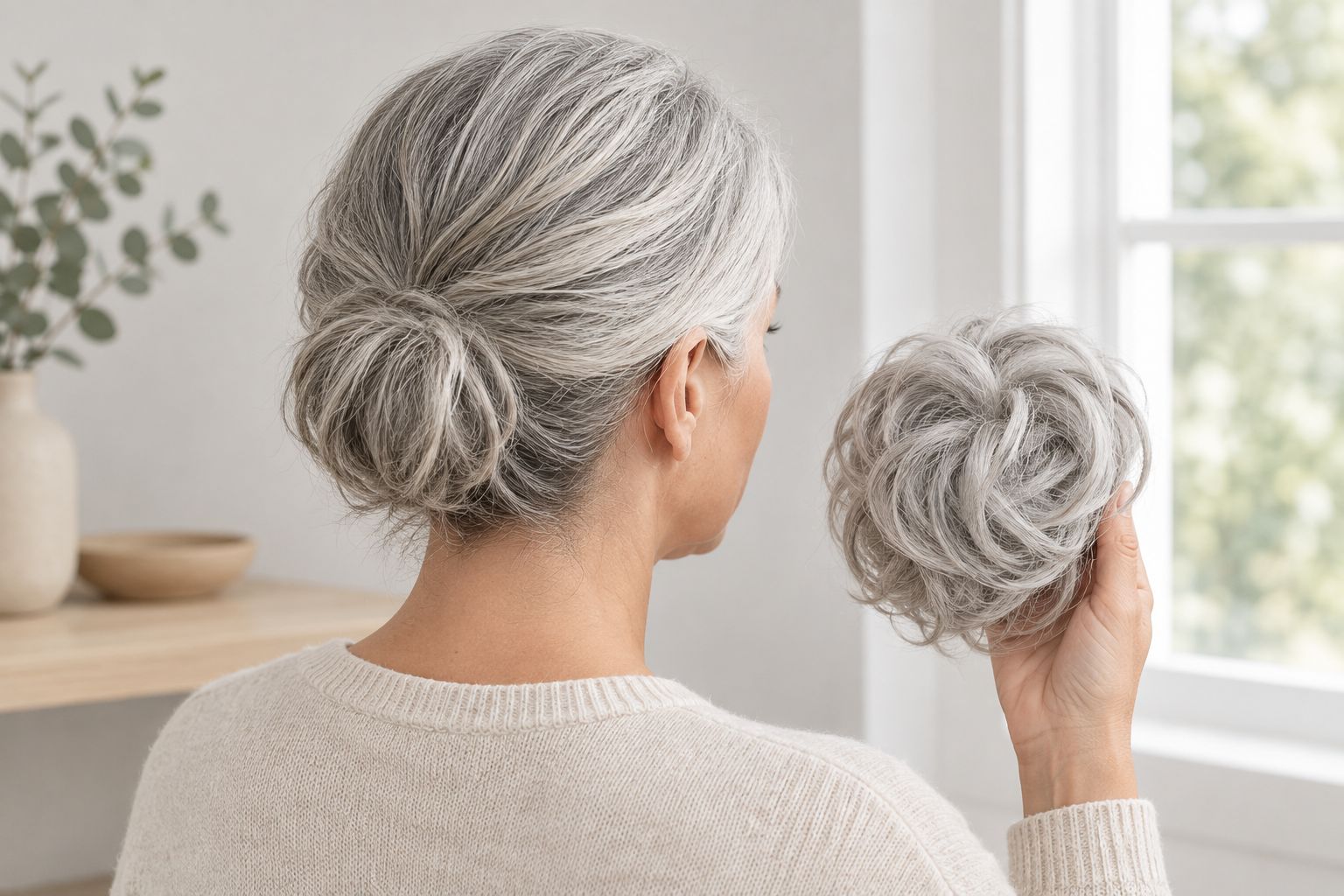
Screens and lighting affect how colors appear. Use the available shade descriptions and photographs together, and avoid assuming that a product title containing grey or silver guarantees a match to your hair.
Attach and check your bun without over-tightening
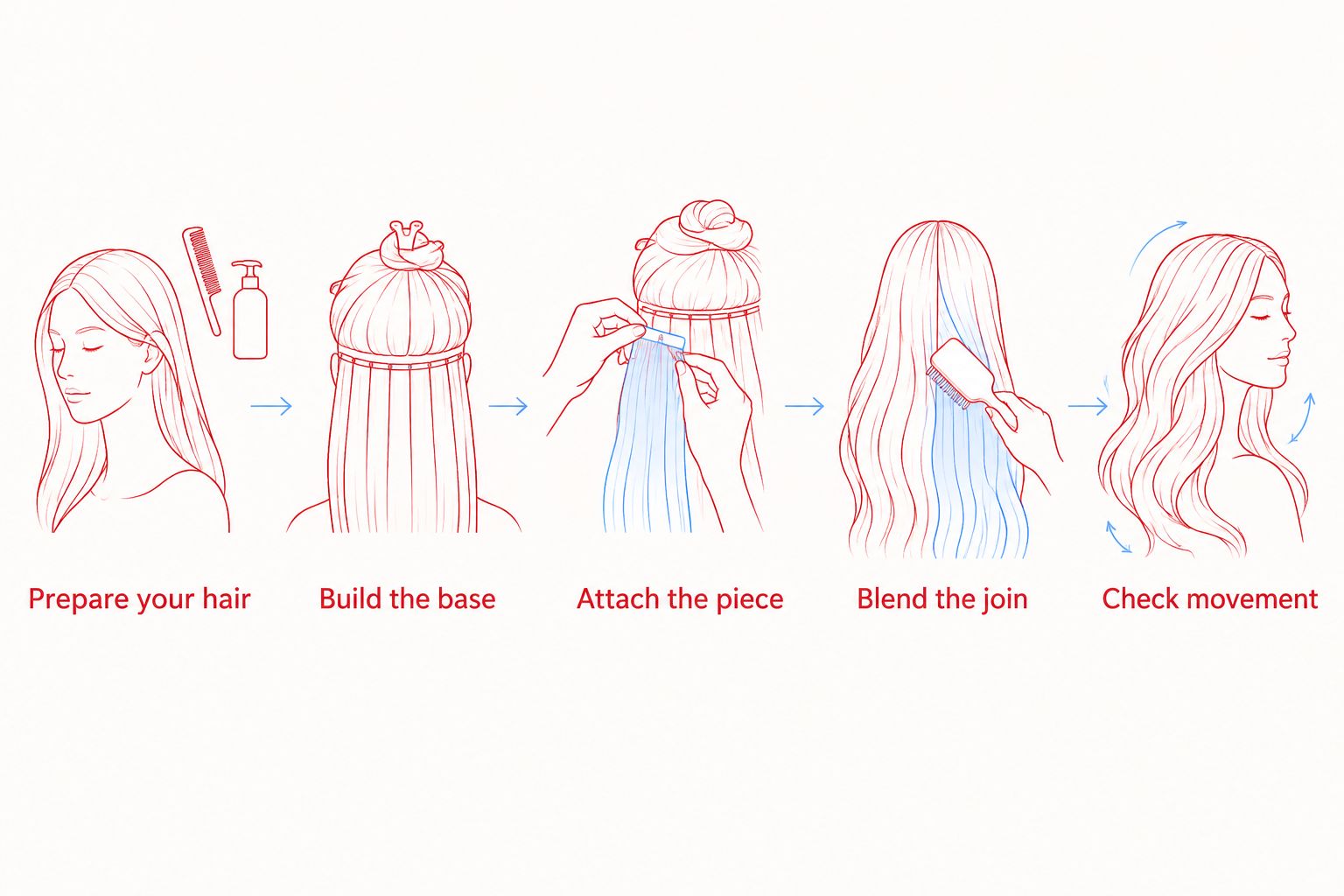
Use this sequence for a new piece before relying on it for a full day. Follow its own care and attachment instructions wherever they differ from general styling advice.
- Prepare your hair. Gently detangle your natural hair and choose a comfortable bun position. Avoid building the style over an irritated area.
- Build the base. Make a ponytail or compact bun that stays secure on its own. Check that your hairline does not feel pulled.
- Attach the piece. Fit the scrunchie or clip as instructed. Keep loose hairs out of closing hardware and avoid forcing the attachment.
- Blend the join. Arrange the synthetic strands over the connection. Use your mirror to inspect the back rather than judging only the front.
- Check movement. Turn your head and look down. If the piece shifts, pinches, or drags, remove it and adjust the foundation or choose a different fit.
Remove a hairpiece that hurts rather than trying to get used to it. Repeated tightening is a reason to reconsider the setup, not a sign that the bun is nearly right.
For an Apexhairs bun hairpiece shortlist, the options below offer a tousled or smooth finish. Both product descriptions identify lightweight, clip-free designs, but neither description establishes a personal support limit for your hair.


Why the right bun fit varies
There is no universal hairpiece size that every ponytail can support. Use these factors to narrow your 2026 choice instead of treating hair thickness as the only deciding detail:
- Hair at the base: The attachment depends on the hair gathered where you place it, not the overall appearance of your hair.
- Existing bun size: Your own bun occupies space inside the finished style and changes how added fullness looks.
- Attachment fit: An elastic and a clip hold differently; check the actual fastening rather than the hairstyle name.
- Added fullness: More visible volume is not always necessary to create a convincing updo.
- Placement and comfort: A position that looks attractive still needs to feel comfortable when you turn and lower your head.
If the fit fails, change a variable rather than adding more tension. Try a different base position or a less full style, then repeat the comfort check.
Can fine hair support bun hair extensions?
Fine hair can support a bun hairpiece when the gathered base and attachment remain comfortable and stable. Start with modest fullness and check the fit without extra-tight tying. If you cannot secure the piece without pulling, choose another fit or hairstyle.
Is a scrunchie bun better than a clip-in bun?
A scrunchie bun is better for a comfortable gathered base; a clip-in bun is better when your hair holds its clip without pinching. Neither attachment wins for everyone. Choose by the fit on your hair, not by an assumption that clips are stronger or scrunchies are always gentler.
Should you choose a lower bun if a high bun pulls?
Try a lower position if your high bun pulls, then check comfort again. A lower bun is a styling option, not a guarantee of a better fit. If discomfort remains, remove the piece rather than tightening or adding more pins.
FAQ
What's the best way to choose bun hair extensions for thin hair?
Choose bun hair extensions that fit a stable, comfortable base without extra-tight tying. Start with modest fullness and check whether the attachment shifts or pulls when you move.
Can I wear a bun hairpiece if my hair is thick?
Yes, you can wear a bun hairpiece with thick hair if the attachment accommodates your gathered base comfortably. Account for the volume of your own bun before adding more fullness.
How do I know whether a bun hairpiece is too heavy for my hair?
Treat dragging, pulling, or a base that collapses under the piece as reasons to remove it and reassess the fit. Appearance alone does not establish weight, so check published product details where provided.
Should I match a grey bun to my roots or my ends?
Match a grey bun to the hair immediately surrounding its intended position. Check the mixture of light and dark strands, undertone, and overall lightness in daylight.
Can I use a curling iron on a synthetic bun hairpiece?
Use a curling iron only if the specific hairpiece instructions explicitly permit heat and state how to use it. Do not assume that every synthetic fiber tolerates heated tools.
Why does my bun hairpiece keep slipping?
A slipping bun hairpiece needs its base and attachment fit checked. Make sure your natural ponytail or bun holds on its own, and do not solve slipping by tightening until it hurts.
Do Apexhairs bun hairpieces treat thinning hair?
Apexhairs bun hairpieces add styling volume, not hair regrowth or hair-loss treatment. Choose them for a fuller-looking updo and remove any attachment that causes discomfort.
One last thing
Before keeping a new piece in your 2026 styling routine, check the back while wearing your usual clothes. A bun can look balanced from the front yet feel awkward against a collar or chair back. Choose the style you can move in comfortably, not just the one that looks fullest in a still photo.


Leave a comment