
How often should you wash a messy bun hairpiece?
Wash a synthetic messy bun hairpiece when it develops noticeable product buildup, lingering odor, or dirt—not automatically after every wear. For your 2026 care routine, follow the hairpiece’s care instructions first, and remember that washing also means allowing the fibers and attachment to dry completely before wearing it again.
- How often should you wash a messy bun hairpiece? Follow its care instructions and wash when buildup or odor appears.
- Apexhairs synthetic bun hairpieces suit women seeking fuller-looking updos without changing their haircut.
- Refresh a clean, flattened bun with gentle finger styling rather than an unnecessary wash.
- Use synthetic-hair care products, avoid rubbing, and let the attachment dry completely before storage.
How often should you wash a messy bun hairpiece?
Use the hairpiece’s condition and care instructions to decide when to wash it. A bun worn occasionally without styling products needs a different routine from one regularly exposed to hairspray, sweat, or cooking odors. A fixed calendar cannot account for those differences.
Check the fibers and the inside of the attachment after you remove the bun. Look for a sticky coating, visible dirt, or an odor that remains after airing it out. Those signs call for cleaning; a slightly flattened shape alone does not.
When it is time to clean it, follow this guide to washing a messy bun scrunchie and drying it without tangles. Keep the distinction clear: checking after each wear does not mean washing after each wear.
| Hairpiece condition | Best next step | Benefit | Limitation |
|---|---|---|---|
| Clean fibers, no odor, flattened shape | Gentle finger styling | Refreshes the shape without wetting the piece | Does not remove buildup |
| Clean fibers with a loose surface tangle | Carefully separate the strands | Addresses the tangle directly | Pulling can worsen knots |
| Sticky coating or visible dirt | Wash according to care instructions | Removes accumulated residue | Requires complete drying afterward |
| Lingering odor | Wash according to care instructions | Cleans the affected fibers and base | Airing alone does not remove residue |
| Damaged attachment or persistently matted fibers | Inspect before wearing again | Helps you identify a wear problem | Washing does not repair damage |
Why this matters
A synthetic bun adds fullness without requiring you to restyle all your own hair. Caring for it should support that convenience, not turn every wear into a washing project.
Unnecessary washing adds handling, detangling, and drying. Leaving actual buildup in place creates a different problem: the bun stops feeling clean and becomes harder to arrange. Clean when needed, and handle gently between washes.
Apexhairs synthetic hairpieces provide styling volume, not hair regrowth or treatment for hair loss. Whether your hair is fine, thick, grey, or somewhere in between, the care decision starts with the condition of the piece—not your hair thickness.
For a practical 2026 routine, keep inspection separate from washing. You can check the attachment, remove loose hairs, and reshape a clean bun without soaking it.
Why washing frequency varies
Your routine determines what reaches the fibers and attachment. These factors explain why another person’s washing schedule is not automatically right for you:
- Styling-product contact. Hairspray, gel, and other products transferred from your own hair can leave residue on the bun.
- Sweat and scalp contact. Check the inner band or clip area, not just the visible outer curls.
- Wear conditions. Smoke, cooking odors, and dusty surroundings affect whether the piece still feels fresh.
- How often you wear it. Occasional use and repeated everyday use create different cleaning needs.
- Storage conditions. Putting a damp hairpiece into a closed container prevents it from drying properly.
- The care instructions. Fiber and attachment requirements take priority over general advice.
Do not treat tangles as proof that the piece needs shampoo. A clean tangle needs careful separation; a coated, tangled section needs cleaning as well. Identify the problem before choosing the fix.
How do you check whether your bun needs washing?
Make this simple check part of taking your hairpiece off. You do not need to wait until the whole bun looks dirty.
Inspect
Look at the outside, then turn the hairpiece over to examine the attachment. Check for visible residue, trapped loose hair, or dirt near the band or clip. Good light makes the inner areas easier to see.
Check residue
Gently feel a small section with clean, dry fingers. A sticky or coated feel is a reason to check for product buildup. Do not confuse the normal feel of synthetic fiber with dirt, especially when the piece is new to you.
Check odor
Let the removed hairpiece air out away from cooking fumes or smoke. If an unwanted odor remains, wash it according to its care instructions rather than covering the smell with perfume.
Choose care
Choose gentle reshaping for a clean, flattened bun and washing for a dirty or coated one. If the attachment is damaged, set the piece aside for inspection instead of assuming shampoo will solve the problem.
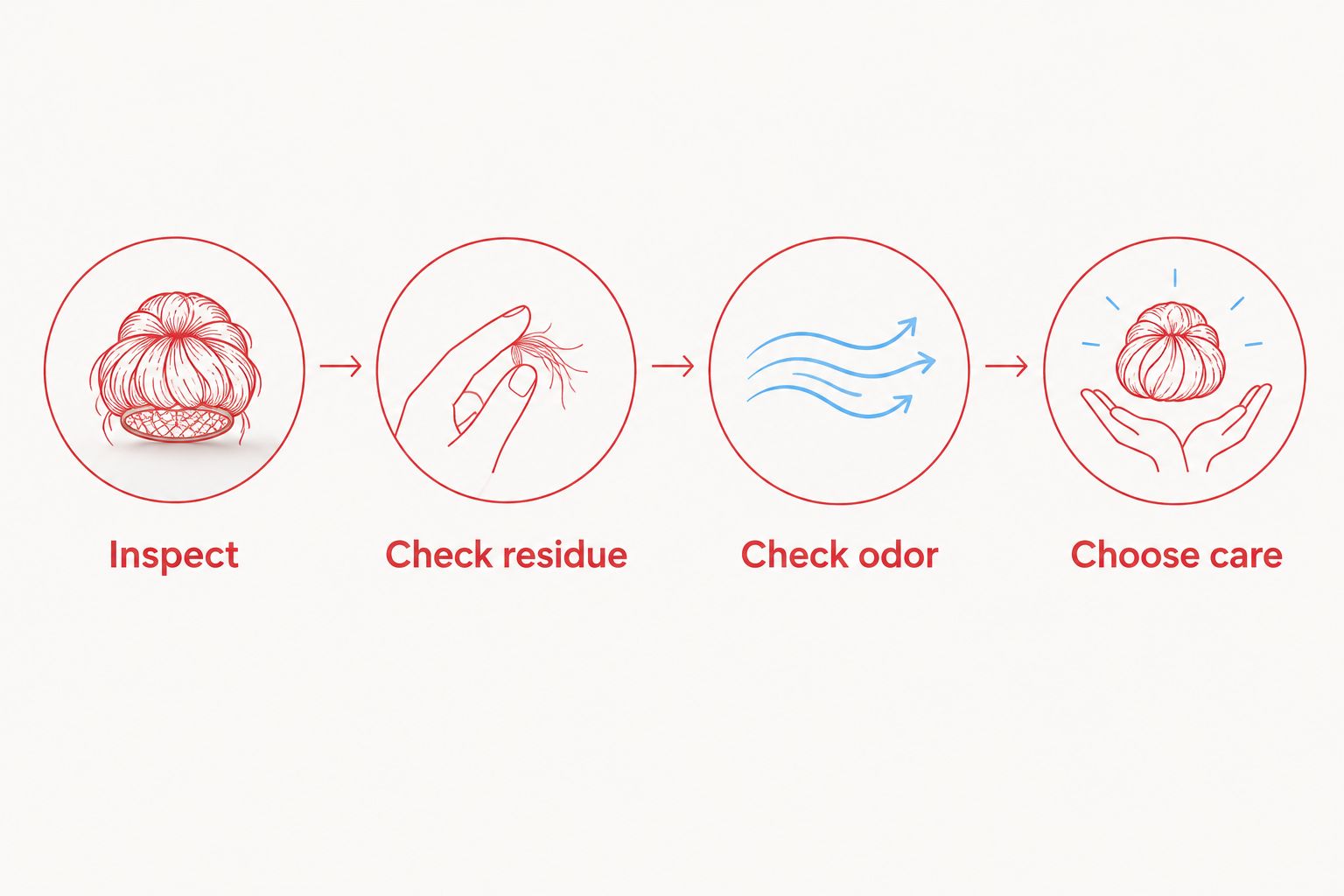
This check works for a scrunchie bun or a clip-in ponytail, but the attachment still needs its own inspection. Remove trapped natural hairs carefully rather than pulling them through the synthetic fibers.
How do you wash a synthetic messy bun gently?
The care instructions supplied with your hairpiece come first. Use the following sequence only where it agrees with those instructions. Do not substitute a human-hair treatment simply because it works well on your own hair.
- Remove the hairpiece. Wash it separately from your natural hair so you can reach the base and control how you handle the fibers.
- Separate loose tangles. Support the piece while gently working through accessible tangles with your fingers. Avoid dragging a brush through a tightly curled bun.
- Prepare the wash. Use water and a cleanser suitable for synthetic hair, following the care label and cleanser directions. Avoid hot water unless the manufacturer specifically instructs otherwise.
- Clean without scrubbing. Move the hairpiece gently through the water. Do not rub the fibers together or twist the bun as though you were washing a cloth.
- Rinse gently. Remove cleanser as directed, giving attention to the attachment where residue can collect. Support the piece rather than pulling on its fibers.
- Blot and air-dry. Gently blot excess water with a towel without wringing. Arrange the piece so air can reach the base and allow it to dry completely.
Skip an improvised soaking time. The appropriate method comes from the product’s instructions, not from a universal timer that ignores its construction.
Dry the attachment, not just the outside
A bun can feel dry on the outer strands while its inner band remains damp. Check both before wearing or storing it.
Avoid using a hair dryer, curling iron, or straightener unless the hairpiece’s instructions explicitly permit that tool. Synthetic does not automatically mean heat-friendly, and a heat-friendly label still requires following its stated limits.
Keep your 2026 care checklist focused on the basics: suitable cleanser, gentle handling, a thorough rinse, and complete drying. Adding more treatments is not a substitute for following the label.
How do you keep a bun fresh between washes?
Remove the bun carefully at the end of wear. Open a clip fully before releasing it, or unwind a scrunchie attachment without dragging it down your own hair.
With the piece off, remove loose hairs and gently restore its shape. Use your fingers to separate defined curls rather than brushing them into a different texture. A smooth bun needs gentle smoothing, not aggressive backcombing to recover volume.
To reduce unnecessary buildup:
- Apply products to your own hair before attaching the bun, and let them settle or dry as directed.
- Avoid spraying perfume or dry shampoo onto the hairpiece to disguise odor.
- Keep the piece away from steam and cooking splashes while getting ready.
- Store it fully dry, away from items that crush or catch the fibers.
- Check the attachment before the next wear rather than tightening it to compensate for slipping.
If your own hair needs washing, wash it. Keeping a hairpiece clean is not a reason to delay your normal scalp-care routine.
Does bun texture change your care choices?
Texture changes how you reshape a clean hairpiece, but it does not supply a universal washing interval. Choose the finish you want to wear, then care for that finish gently.
For women comparing Apexhairs bun hairpieces in 2026, these options illustrate the difference between a tousled finish and a smoother one. Neither choice removes the need to inspect for buildup.
| Hairpiece | Best for | Verified benefit | Care trade-off |
|---|---|---|---|
| Synthetic Messy Bun Hairpiece Scrunchie | A fuller-looking, tousled updo | Synthetic, lightweight, clip-free scrunchie design | Preserve the tousled arrangement with gentle handling rather than forceful brushing |
| Straight Synthetic Hair Bun Scrunchie | A smoother-looking bun | Synthetic, lightweight, clip-free design with a smooth finish | Smooth the fibers carefully; washing does not correct an unsuitable shade or fit |
Apexhairs synthetic bun hairpieces are best for women seeking fuller-looking updos without changing their haircut. Choose the texture that suits your everyday styling, then check the individual care instructions before washing.


What about grey and silver shade matching?
Compare a clean, fully dry hairpiece with the hair surrounding your bun in natural daylight. Wet fibers are not a useful final shade check.
Grey can include a visible mixture of darker and lighter strands; silver usually describes a lighter, cooler-looking result. Shade names vary, so compare the actual blend rather than relying on the name alone. Washing is a cleaning step, not a way to turn a warm or dark mismatch into the right shade.
Should you wash a messy bun after every wear?
No—do not automatically wash a messy bun after every wear. Inspect it after removal and wash when its condition or care instructions call for cleaning. A clean piece that only needs reshaping does not need the same treatment as one with sticky buildup.
Does a ponytail extension need the same washing schedule?
A synthetic ponytail extension also needs condition-based care, subject to its own instructions. Inspect the lengths and attachment separately, and detangle gently before washing where the care directions permit it.
Do not assume instructions for a scrunchie bun cover a claw clip or another attachment. The visible fibers are only part of what needs cleaning and drying.
FAQ
How often should you wash a messy bun hairpiece in 2026?
Wash a messy bun hairpiece when buildup, dirt, or lingering odor appears, following its care instructions. Inspect after wear rather than automatically washing it every time.
Can I wash my messy bun hairpiece with regular shampoo?
Use a cleanser identified as suitable for synthetic hair and permitted by the hairpiece’s care instructions. Do not assume your regular shampoo is appropriate for synthetic fibers.
Should I wash my bun hairpiece if it only looks flat?
A clean, flattened bun usually needs gentle reshaping rather than washing. Check for residue and odor before deciding to wet it.
Can I put a damp bun hairpiece back on?
Let the fibers and attachment dry completely before wearing the bun again. Check the inner band or clip area as well as the outer strands.
Can I use dry shampoo instead of washing a synthetic bun?
Do not use dry shampoo as a substitute for removing buildup from a synthetic bun. Follow the hairpiece’s care instructions and avoid adding products unless they are approved for it.
Will washing fix a tangled or worn messy bun?
Washing removes dirt and residue, but it does not repair worn fibers or a damaged attachment. Inspect the piece and separate accessible tangles gently before following its cleaning instructions.
Do grey and silver bun hairpieces need different washing schedules?
Grey and silver shades do not, by themselves, determine a washing schedule. Follow the individual hairpiece’s instructions and check for the same signs of dirt, residue, and odor.
One last thing
A slipping bun is not automatically a dirty bun. Before washing it, check whether the attachment is positioned correctly, whether your own base is secure, and whether the attachment shows wear. Cleaning addresses residue; it does not repair stretched elastic or a damaged clip.
Keep that distinction in your 2026 routine. Treat the problem you can identify rather than washing first and hoping it fixes everything.


Leave a comment