
How to remove a messy bun hair piece without snagging your hair
To remove a messy bun hair piece without snagging your hair, support your own bun, release any pins or clips, and gently unwind the attachment instead of pulling the whole piece off. If a strand catches, stop and separate it with your fingers before continuing. Keep your natural hair tie in place until the hairpiece is completely free.
- Remove a messy bun hair piece by releasing its attachment, not pulling through resistance.
- Keep your natural bun supported while you unwind a scrunchie or open a clip.
- Apexhairs synthetic bun hairpieces suit women seeking fuller-looking updos, not treatment for hair loss.
- Separate caught strands with your fingertips before moving the hairpiece again.
Why this matters
A fuller-looking updo should not require a tug-of-war at bedtime. Whether your hair is fine, thick, straight, curly, grey, or color-treated, the useful habit is the same: release the attachment before moving the hairpiece away from your head.
For your 2026 styling routine, choose a removal method you can repeat comfortably, not just an attachment that looks good once.
How do you remove a messy bun hair piece without snagging your hair?
Start by identifying what holds the bun in place. A scrunchie needs unwinding; a clip needs opening. These Apexhairs bun hairpieces illustrate the distinction, but follow the instructions supplied with your particular piece.
| Hairpiece | Best for | Practical benefit | Removal drawback |
|---|---|---|---|
| Synthetic Messy Bun Hairpiece Scrunchie | A clip-free, tousled updo | Adds natural-looking volume with a scrunchie attachment | Wrapped elastic needs unwinding without dragging trapped strands |
| Clip in Bun - Messy Bun Hair Piece | Women who prefer a clip-in bun attachment | Provides a clip-in alternative to a scrunchie | The clip must be released before you lift the bun away |
Neither attachment is a reason to pull harder. If the bun resists, check for a remaining fastener or a strand caught around the base.
Prepare before you start
Stand where you can see the base of your bun, using another mirror if needed. Put a clean towel nearby so you have somewhere to set the removed piece without tangling it with loose pins.
Move decorative accessories out of the way. If you added pins, locate them with your fingertips rather than pushing a comb through the whole updo.
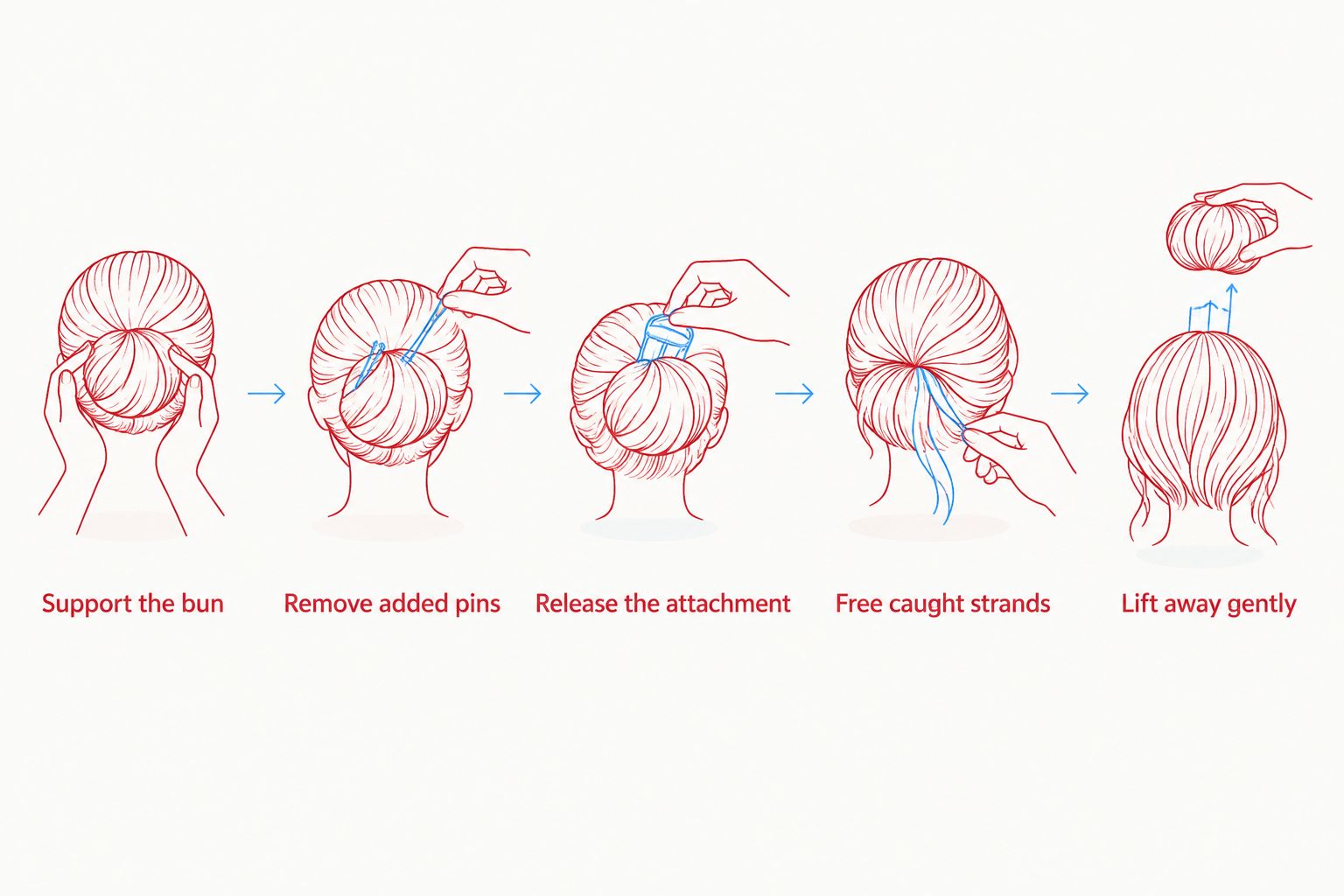
Follow these removal steps
- Support the bun. Cup your natural bun close to your head with one hand. Use the other hand to feel for the hairpiece attachment without pulling on the synthetic hair.
- Remove added pins. Slide each pin back along its insertion path. Keep supporting the bun so removing a pin does not let the whole style drop and tighten another attachment.
- Release the attachment. Unwind a scrunchie loop by loop, or open the clip fully before moving it away from your hair. Do not drag a closed clip through the bun.
- Free caught strands. Pause wherever you feel resistance. Use your fingertips to separate your own hair from the elastic, clip, or synthetic fibers.
- Lift away gently. Move the released hairpiece away from your natural bun. Only then remove your own hair tie and loosen the base hairstyle.
Once the piece is off, check it separately for loose natural hairs caught around its attachment. Remove those gently before putting it away; do not tug them through a knot in the synthetic fibers.
How do you remove a scrunchie bun without pulling?
A scrunchie bun needs to come off in the reverse order of how you wrapped it. Find the outermost elastic loop first, keeping your fingers against the attachment rather than gripping a handful of curls.
Stretch that loop only enough to clear your natural bun. Guide it back over the bun, then release the next wrap if there is one. Keep loose ends of your own hair out of the elastic as you work.
Do not pull every wrap off together. That shortcut makes it harder to notice a strand caught beneath the elastic.
If you cannot tell which loop comes first, loosen the outer wrap slightly and look at the attachment from another angle. Stop if your roots move with the hairpiece. Reposition your supporting hand closer to the base before trying again.
For a simpler 2026 everyday routine, notice how you wrap the elastic when putting the bun on. Reversing a familiar wrap is easier than untangling an attachment you cannot see.
How do you remove a clip-in bun without catching strands?
Support the bun before touching the clip. Feel for the opening mechanism, release it fully, and check that your natural hair is no longer held between the attachment surfaces.
Move the open clip away in the direction that clears your hair. If the clip contains teeth, keep them open and guide caught strands out rather than raking them through the bun.
Clip mechanisms differ. Do not assume that every clip opens by squeezing the same part, and do not force an unfamiliar mechanism while it is tangled in your hair.
The benefit of a clip-in bun is the alternative attachment style. The trade-off is that you need access to the mechanism during removal, especially if you have covered it with loose curls or added pins.
What should you do if the bun is already stuck?
Stop moving the hairpiece as soon as you feel a snag. Hold it still near your head so its weight does not keep pulling while you work out what is caught.
First, check for a forgotten pin or a clip that has not opened completely. Then look for natural hair wrapped around the elastic or threaded through the attachment.
Use your fingertips to ease the caught strand back toward the opening it came through. Work on the visible snag rather than pulling at the whole bun. If you cannot see the attachment, ask someone to help you inspect it.
Do not cut blindly into the knot near your scalp. If you cannot release it gently, get help from a hairstylist rather than escalating the force.
Avoid treating oil, conditioner, or detangling spray as an automatic fix. A product suitable for your own hair is not necessarily suitable for the synthetic fibers or attachment; check the hairpiece care directions before applying anything.
Why removal becomes difficult
Your 2026 bun routine should account for the attachment and the way your own hair sits around it. These are the practical checks to make when removal feels harder than expected:
- Overlapping elastic wraps: A strand can sit between wraps. Undo the outer wrap before reaching for the next one.
- Unreleased clips: An attachment that still grips your hair is not ready to slide away. Open it before lifting.
- Extra pins: A hidden pin can hold the hairpiece even after its main attachment is loose. Check the base before pulling.
- Loose ends: Short layers or ends tucked into the attachment need separating before removal.
- Mixed fibers: Your natural hair and the synthetic strands can become intertwined. Separate the caught section rather than brushing through both together.
- An unsupported bun: Letting the hairpiece hang while you search for a snag adds a pull you can avoid. Keep it supported near your head.
How can you make the next removal easier?
Prepare the base hairstyle before adding the hairpiece. Gather your hair without leaving a tangle beneath the tie, and tuck loose ends where you can find them again.
Attach the piece so it feels secure without needing to cinch your natural bun painfully tight. If the attachment shifts, reassess the position and fit rather than adding wrap after wrap without checking comfort.
When you use pins, keep track of where you put them. Avoid burying a pin through several attachment layers if you will struggle to reverse its path later.
Finish by checking the back of your head with a mirror. Look for natural strands stretched tightly into the hairpiece and release them before you leave the mirror, not at the end of the day.
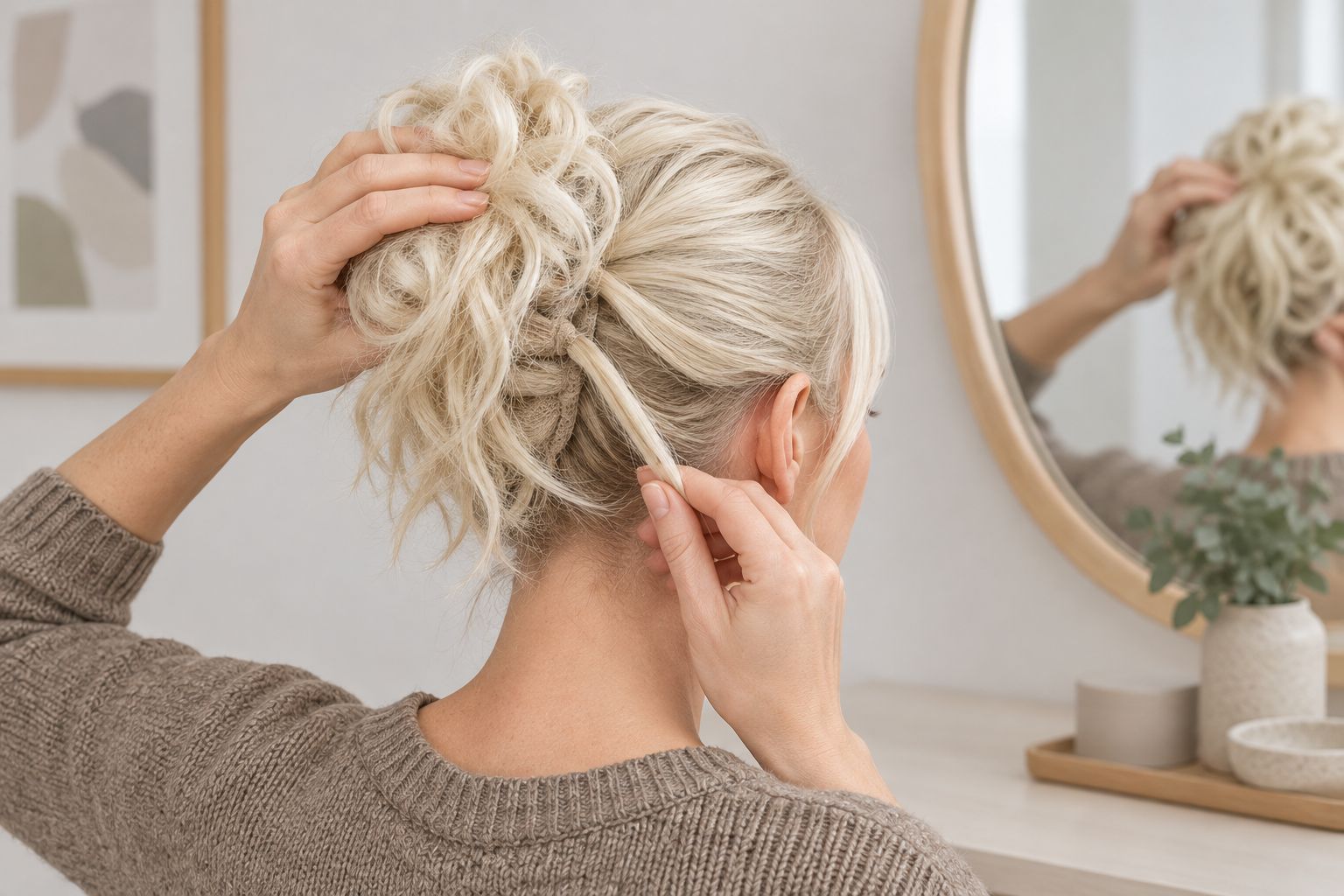
For your 2026 styling kit, keep the mirror and the accessories you actually use together. A tidy setup helps you inspect the attachment instead of removing the bun by feel in a hurry.
What changes if your hair is fine, thick, grey, or silver?
Fine hair calls for particular attention to how much tension you feel at the roots. Support the natural bun throughout removal, and stop if the hairpiece moves your own hair instead of releasing from it.
Thicker hair needs the same gentle approach. Check that the attachment has cleared the whole base; a larger bundle of natural hair can hide the section you are still unwinding.
Grey and silver describe color, not one shared texture or thickness. Use the removal method that matches your attachment and your own hair, rather than assuming grey hair needs a different fastener.
For shade matching, grey can include a mix of light and dark strands, while silver generally describes a lighter, cooler-looking result. Shade names are not standardized, so compare the product images and descriptions with the hair visible around your bun in daylight.
Match the visible hair around the updo, not just the color at your roots. This is useful whether you are blending natural greys, highlights, or an all-over color.
Should you choose a bun or a ponytail extension?
Choose the finished shape first, then check how you will attach and remove it. For your 2026 everyday wardrobe of hairstyles, you do not need to use the same type for every occasion.
| Styling choice | Best for | Benefit | Trade-off |
|---|---|---|---|
| Bun hairpiece | A fuller-looking updo | Keeps the added hair gathered around the bun | You must release the attachment around the base carefully |
| Ponytail extension | A hanging ponytail shape | Adds hair to a ponytail rather than building an updo | Loose lengths need managing during attachment and removal |
Apexhairs offers synthetic buns and ponytail extensions for these different styling goals. Choose an attachment you can locate and release comfortably; the easiest-looking style is not useful if taking it off becomes a struggle.
Neither option treats hair loss or regrows hair. The purpose is a temporary change in the appearance of your hairstyle.
FAQ
What's the easiest way to remove a messy bun hair piece?
Support your natural bun, remove added pins, and release the attachment before lifting the hairpiece away. Unwind a scrunchie in reverse order or open a clip fully, stopping whenever a strand catches.
Should I take my own hair tie out before removing the bun hairpiece?
Keep your own hair tie in place until the bun hairpiece is free. A contained base makes it easier to separate the attachment from your natural hair.
Why does my bun scrunchie pull when I take it off?
Check for hair trapped between elastic wraps, a hidden pin, or strands intertwined with the synthetic fibers. Release the caught section instead of pulling all the wraps off together.
Is a clip-in bun better than a scrunchie bun for easy removal?
Neither attachment is automatically easier for everyone. A clip needs opening fully, while a scrunchie needs unwinding; choose the mechanism you can reach and release comfortably.
Can I brush through the bun while it is still attached?
Do not brush through an attached bun to free a snag. Remove the hairpiece gently first, then follow its care instructions for separate detangling.
Do grey and silver bun hairpieces need a different removal method?
Grey and silver bun hairpieces need the removal method suited to their attachment, not their shade. Support your own hair and release clips or elastic without dragging trapped strands.
What should I do if I cannot remove the hairpiece without pain?
Stop pulling and support the hairpiece close to your head. Ask someone to inspect the attachment, and get help from a hairstylist if it will not release gently.
One last thing
The snag you feel during removal can begin when you put the bun on. Before finishing your next updo, run your fingertips around the attachment and free any natural strand that feels stretched or trapped.
Make that final comfort check part of putting the bun on, not just taking it off. It gives you a chance to correct the attachment while everything is still easy to reach.


Leave a comment