
Why does a synthetic hair bun shed over time?
A synthetic hair bun sheds when loose fibers come away from its base or damaged strands break during wear, detangling, and removal. Friction, pulling through knots, and wear around the attachment can make this worse; the useful check is whether you see occasional loose strands or a bun that is becoming visibly thinner.
- Why does a synthetic hair bun shed? Friction, forceful detangling, and attachment wear can release or break fibers.
- Apexhairs synthetic bun hairpieces suit women seeking fuller-looking updos; gentle handling still matters.
- Support the base during detangling, and release the attachment before removing your bun.
- Replace a bun with persistent fiber loss, exposed construction, or an attachment that no longer holds securely.
Why does a synthetic hair bun shed over time?
Synthetic fibers do not grow back after they break or detach. Repeated handling can therefore leave your bun less full, especially when you pull the same tangled area or stretch the attachment by gripping its hair rather than its base.
Start by checking where the loose fibers appear. If shedding happens mainly during removal, review how to remove a messy bun hairpiece without snagging your hair before changing your whole care routine.
| What you notice | What to inspect | What to do next |
|---|---|---|
| Long strands coming away | Fiber attachment points and the base | Stop pulling and look for loose stitching or exposed construction |
| Short pieces around tangles | Rough, snagged, or broken ends | Separate gently instead of brushing through resistance |
| Loss concentrated near the band | Stretched elastic or repeated pulling at the same spot | Handle the band itself when attaching and removing |
| Thinner patches with visible construction | Localized fiber loss | Assess replacement rather than trying to fluff over the gap |
These clues help you inspect the problem; they do not prove exactly how an individual bun was made or why a particular strand detached. Judge the whole hairpiece, not a single loose fiber.
Why this matters
A fuller-looking updo depends on both the fibers and the attachment underneath them. Repeatedly brushing a shedding bun to make it look neater can work against that goal if the brush catches and pulls.
For your 2026 hairpiece care routine, focus on reducing resistance rather than adding more styling steps. You want a bun that attaches comfortably, blends with your hair, and comes off without a struggle.
This applies whether your natural hair is fine, thick, straight, curly, grey, or silver. A synthetic bun adds styling volume; it does not regrow hair or treat hair loss.
Why shedding varies between buns
The way you wear and handle a hairpiece changes the stress placed on its fibers. Look at these factors before deciding that every loose strand means the bun is finished:
- Friction: Collars, scarves, headrests, and bedding can rub against the same section and encourage tangles.
- Detangling force: Pulling through a knot transfers tension toward the fiber attachment instead of releasing the knot.
- Attachment handling: Stretching a scrunchie by its fibers or tugging a closed clip can strain the hairpiece.
- Washing technique: Rubbing, twisting, and wringing can create tangles that require more handling afterward.
- Existing wear: A stretched band, damaged stitching, or exposed base needs attention even when the surface still looks full.
- Styling compatibility: Heat and products should match the manufacturer's instructions for that specific synthetic fiber.
A messy texture also needs a different finish from a straight one. Trying to brush every curl into a smooth sheet can disturb the style and create unnecessary pulling.
How can you tell shedding from breakage?
Shedding describes fibers coming away from the hairpiece. Breakage means the fiber itself has snapped, leaving a shorter piece behind; both can reduce fullness over time.
Lay the removed bun on a clean, contrasting surface and examine the loose material without tugging more strands out. Short fragments near a stubborn knot point you toward breakage, while longer detached fibers make the base worth checking.
Length alone is not a reliable diagnosis because a bun contains shaped and arranged fibers. Look for supporting signs: a damaged attachment, a recurring snag, or a patch that is visibly less dense.
Do not perform a pull test. Deliberately tugging strands to check whether they are secure adds the very stress you are trying to avoid.
A gentle inspection and detangling routine for 2026
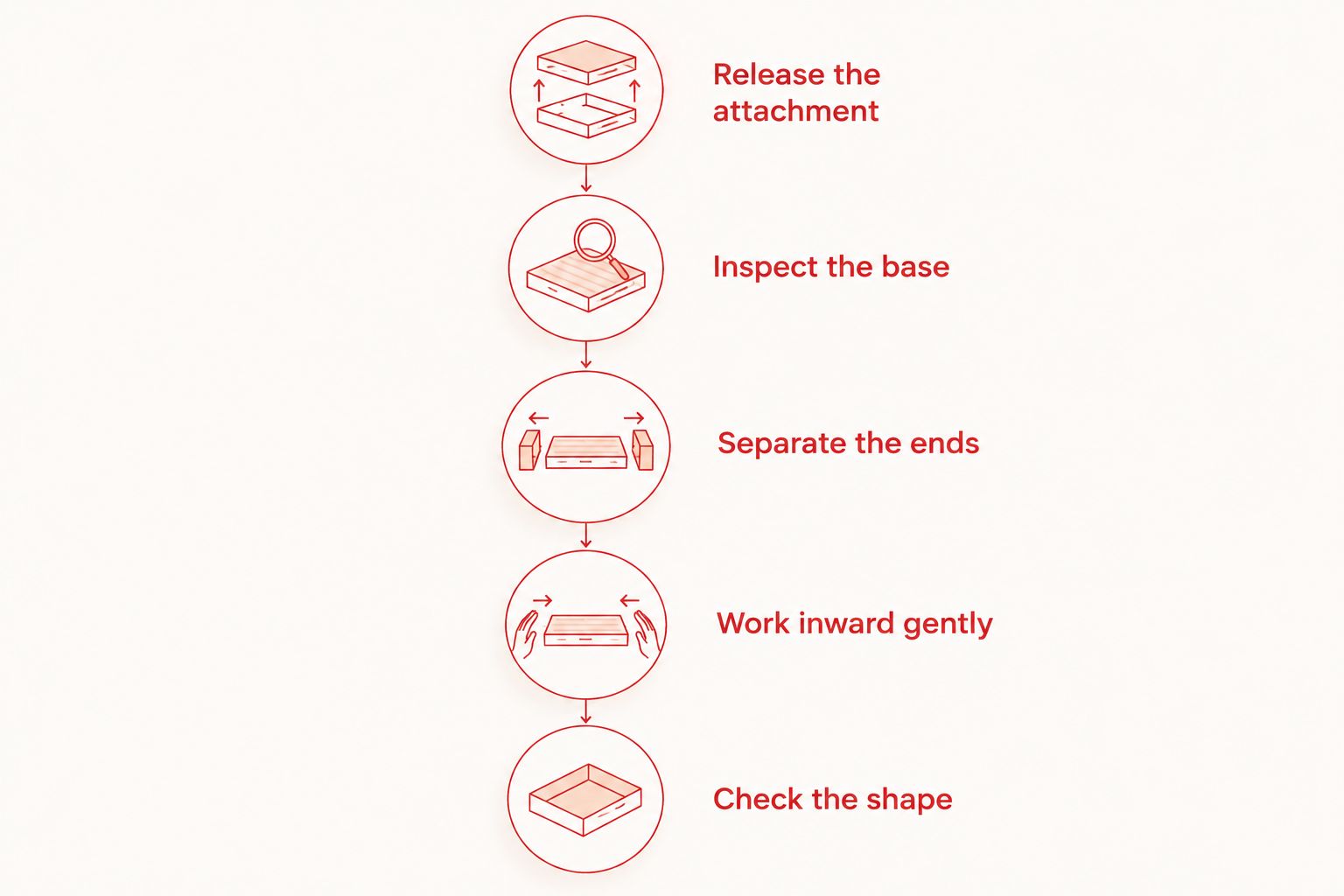
Work with the bun off your head so you can see its attachment and avoid pulling your own hair. Use the care instructions supplied with the hairpiece to decide which tools and products belong in the routine.
- Release the attachment. Open the clip completely or unwind the scrunchie while supporting your natural bun. Do not drag the hairpiece down your ponytail.
- Inspect the base. Check the elastic, clip, stitching, and fiber attachment areas. Set the bun aside if a broken component catches your hair.
- Separate the ends. Use your fingers to loosen small tangles at the outer ends. Keep the base supported rather than letting it hang against your pulling hand.
- Work inward gently. Move toward the base only after the outer tangles release. Use a suitable tool only where the care instructions allow it.
- Check the shape. Arrange the fibers lightly and look for gaps. Stop when the style sits naturally instead of repeatedly combing for perfection.
If a knot resists, pause rather than increasing force. A stylist experienced with synthetic hairpieces can help assess a difficult tangle without turning your everyday bun into a trial-and-error project.
How should you attach a bun without pulling its fibers?
Prepare your own hair first. Secure a comfortable base that supports the hairpiece without requiring repeated tightening, then handle the attachment rather than grabbing a handful of synthetic hair.
For a scrunchie bun, keep your fingers on the elastic as you position it. Make sure your natural hair is not tangled around loose synthetic strands before adjusting the final shape.
For a clip attachment, open the mechanism fully and check that it closes without trapping an awkward bundle of hair. If the bun pulls, slips, or pinches, remove it and reposition it rather than pressing harder.
Fine hair does not need to be pulled extra tight to support a fuller-looking style. Likewise, thicker hair should not be forced into an attachment that feels cramped; comfortable fit matters for every hair thickness.
Does a scrunchie, clip-in bun, or ponytail need different care?
All synthetic hairpieces need gentle handling, but their attachments create different places to inspect. Choose the style you want to wear, then learn how its base opens, stretches, or closes.
| Hairpiece type | Best for | Useful feature | Care limitation |
|---|---|---|---|
| Bun scrunchie | A fuller-looking gathered updo | Wraps around a prepared hair base | Gripping the fibers while stretching the band adds tension |
| Clip-in bun | An updo with a clip attachment | Opens and closes around the supporting hair | The mechanism needs checking for trapped hair and damage |
| Ponytail extension | Visible length and movement | Leaves the added hair hanging freely | Free-hanging fibers need attention where they rub against clothing |
Apexhairs synthetic bun hairpieces are best for women who want fuller-looking updos without growing their hair longer. The Synthetic Messy Bun Hairpiece Scrunchie is described as lightweight and clip-free; its scrunchie format still needs careful handling around the elastic and fibers.
A ponytail is a styling alternative, not a solution to shedding. Changing attachments does not remove the need to detangle gently, inspect the base, and avoid friction where possible.
How should you wash and dry a shedding synthetic bun?
Follow the hairpiece's own washing instructions rather than borrowing a routine for natural hair. Synthetic fibers and the construction underneath them need compatible products and handling.
Before washing, release manageable tangles gently. During cleaning, avoid scrubbing the fibers against themselves or twisting the bun into a tight bundle; those movements create more work when you detangle afterward.
Support the piece as you lift it, and avoid wringing. Let it dry as directed before storing it, keeping the fibers arranged rather than packed into a tangled ball.
For a 2026 care-kit refresh, check compatibility before buying another spray or treatment. Extra product does not reattach lost fibers, and an unsuitable formula can leave residue that makes handling harder.
Can you keep a curly bun full without overbrushing?
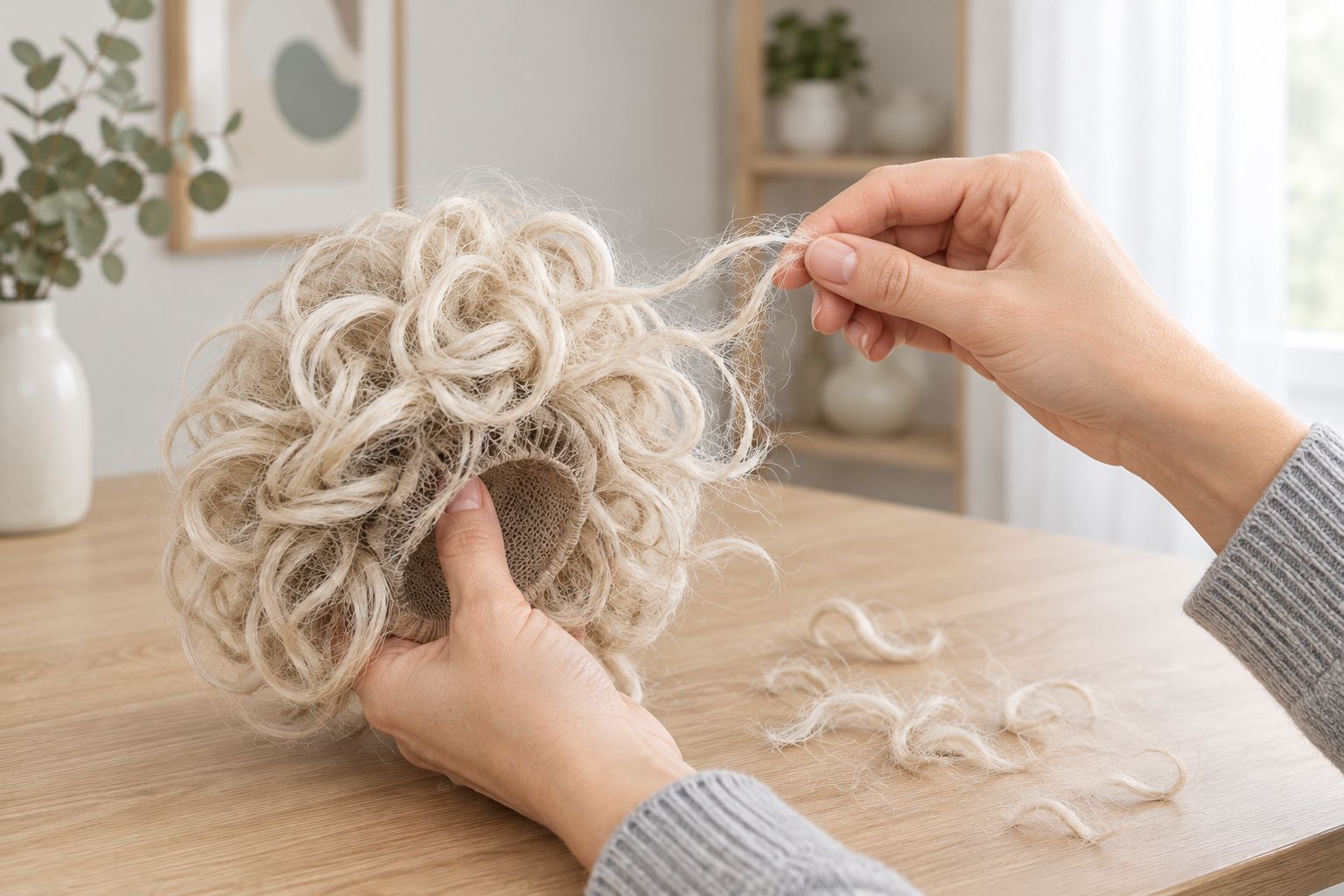
Yes—separate and arrange the curls lightly instead of brushing the entire bun every time you wear it. A tousled updo does not need every fiber to point in the same direction.
Start with the area that actually looks compressed. Support the base, lift small sections with your fingers, and stop once the overall silhouette looks balanced.
A straight bun needs a smoother arrangement, but smooth does not mean stretched. Use light handling and stop if the fibers catch; forcing a neat finish through resistance can leave you with more broken strands.
Does grey or silver hair make shedding more noticeable?
Contrast changes how easily you see loose fibers: pale strands show clearly on dark clothing, while darker strands stand out on a light surface. Visibility alone does not establish that one shade sheds more than another.
Grey and silver are not interchangeable shade labels. Grey can describe blends with darker strands, while silver often describes a lighter, cooler-looking finish; the actual mix varies by product.
For grey or silver shade matching in 2026, compare the hairpiece with the hair surrounding your bun in indirect daylight. Check both the overall depth and the balance of light and dark strands, not just the color name.
Do not judge density from color contrast alone, either. Inspect the actual base and fiber coverage before deciding that a pale section is a worn patch.
Can you stop a synthetic bun from shedding completely?
You cannot guarantee that a synthetic bun will never lose a fiber. You can reduce avoidable pulling by supporting the base, releasing tangles gently, and removing the attachment properly.
A promise of zero shedding is not a useful care standard. A secure attachment, comfortable wear, and consistent coverage tell you more about whether the bun remains usable.
Can you repair a bun that has lost fibers?
Routine care cannot reattach fibers that have already detached. Gentle reshaping can improve the appearance of flattened sections, but it does not restore missing density.
Avoid improvising with glue around an attachment that touches your hair. If the base is damaged, ask the seller about the specific problem or replace the piece rather than concealing it under extra styling.
When should you replace a shedding bun?
Replace a bun when fiber loss leaves visible gaps, the attachment no longer holds securely, or damaged construction catches your hair. Continued use is not worthwhile if removal has become uncomfortable.
For a 2026 replacement decision, compare the bun's condition rather than following an arbitrary calendar. Wear frequency, handling, and storage differ, so a fixed lifespan is not a dependable test for your individual piece.
FAQ
Is it normal for a synthetic bun to lose a few strands?
Occasional loose strands do not by themselves establish that a synthetic bun is defective. Check whether fiber loss continues, coverage changes, or the attachment shows damage.
Why does my bun shed when I brush it?
Brushing through resistance pulls on tangled fibers and their attachment points. Support the base, loosen the ends first, and follow the hairpiece's instructions for suitable tools.
Should I wash my bun every time I notice shedding?
Shedding alone is not a reason to wash your bun. Inspect for tangles and attachment damage first, then wash according to the product's care instructions and condition.
Can I use heat to smooth a shedding synthetic bun?
Use heat only when the specific hairpiece's instructions permit it. Heat does not repair detached fibers or damaged stitching.
Will a bun hairpiece make my own thin hair grow?
A synthetic bun hairpiece adds styling volume, not hair growth. Keep the attachment comfortable and stop wearing it if it pulls or hurts.
Does silver synthetic hair shed more than darker hair?
Shade alone does not establish how much a synthetic hairpiece sheds. Light fibers are easier to see against dark fabric, so inspect density and construction rather than counting visible strands on clothing.
How should I care for an Apexhairs bun that starts shedding?
Handle the Apexhairs bun gently and follow its specific care instructions. Inspect the base and attachment, avoid pulling through knots, and ask about persistent loss or visible construction damage.
One last thing
Check what your bun rubs against before replacing your styling tools. If the same underside tangles repeatedly, a collar, scarf, or headrest deserves attention alongside your detangling routine.
Move the bun to a comfortable position that reduces contact, then inspect it after wear. That simple observation helps you change the source of repeated friction instead of repeatedly fixing the same knot.


Leave a comment