
Can you sleep in a clip-in ponytail extension?
No—take out a clip-in ponytail extension before you sleep, including before a nap. Lying on the attachment can press it against your scalp, while turning on a pillow can tug on the hair supporting it and tangle the synthetic lengths. This 2026 guide covers gentle removal, overnight storage, and a simple morning routine for ponytails and bun hairpieces.
- Can you sleep in a clip in ponytail extension? No—remove the attachment before sleeping.
- Apexhairs synthetic ponytail extensions are best for removable everyday volume, not overnight wear.
- A sleep bonnet does not remove pressure from a claw clip or tension at the ponytail base.
- Store synthetic hairpieces dry, with their attachment closed and their lengths free from tangles.
Why this matters
A fuller ponytail should not mean keeping your hair pulled up around the clock. Removing the extension separates styling time from rest time and lets you release the elastic underneath, too.
This applies whether your hair is fine, thick, straight, curly, grey, or color-treated. You do not need thinning hair to benefit from an easy, removable style. If taking off your bun is the tricky part, follow this guide to removing a messy bun hairpiece without snagging your hair rather than pulling the whole style loose at once.
Can you sleep in a clip-in ponytail extension?
Remove a clip-in ponytail before bed rather than trying to make the attachment comfortable enough to sleep on. A secure daytime fit does not make a claw clip, comb, or tightly wrapped base suitable for lying against a pillow.
The attachment and the added hair create different problems. A hard clip can press into your head; loose synthetic lengths can rub and knot. Changing the attachment changes the removal method, not the bedtime recommendation.
| Style or attachment | Best for | Daytime benefit | Limitation at bedtime |
|---|---|---|---|
| Claw-clip ponytail | Adding a removable ponytail over a secured base | Opens and closes around the base | Hard teeth and the clip body can press against your scalp |
| Wrap-around ponytail | Concealing the ponytail attachment | Covers the base with a wrapped section | Combs, pins, and wrapping still need removal |
| Bun scrunchie | Adding fullness around your own bun | Creates a fuller updo without a separate claw | The wrapped base can still pull and the fibers can tangle |
| Loose natural hair or a loose braid | Resting without an added hairpiece | Removes the extension attachment from the equation | A braid still needs to stay loose rather than tight |
A softer attachment is not an overnight exception. Take off the hairpiece, then loosen your own hair separately.
Why overnight comfort varies
The same ponytail can feel comfortable standing up and uncomfortable once your head meets a pillow. These factors explain the difference:
- Attachment position: A clip at the back of your head sits directly against the pillow when you lie on your back. Moving it elsewhere does not eliminate contact when you turn.
- Base tension: A tight elastic keeps pulling after the extension comes off. Release it rather than treating hairpiece removal as the whole bedtime routine.
- Added length: Longer loose lengths have more opportunity to fold, rub, and wrap around themselves during movement.
- Attachment shape: A claw clip has a different profile from a fabric-covered scrunchie. Both still hold added hair against your own hair.
- Existing tangles: Knots near the base make removal harder. Pulling the extension through them transfers that force to the hair underneath.
- Your hair's support: Fine strands, short layers, and uneven density affect how securely the base holds. More tightening is not the answer to discomfort.
You do not need to identify the perfect sleeping position or work out how long you can tolerate the clip. Removing it addresses the attachment directly.
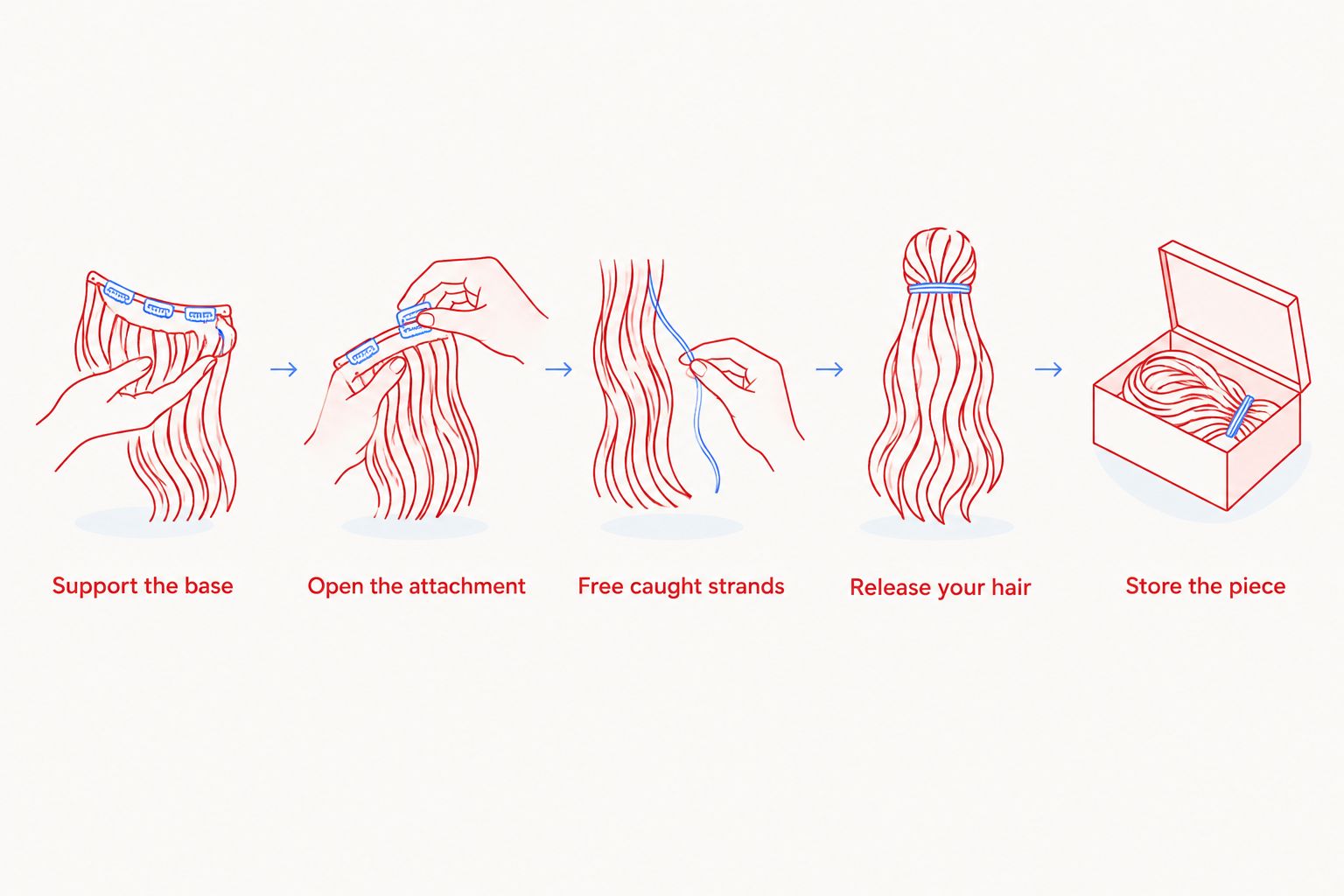
A simple 2026 routine for taking your ponytail off
Set out your storage spot before you start. You want somewhere clean and dry where the extension can rest without being crushed beneath other items.
1. Support the base
Hold your own ponytail close to the attachment with one hand. Use the other hand to locate the clip, comb, wrap, or securing pins. Supporting the base keeps you from pulling against your roots while you work.
If you cannot see the fastening, use 2 mirrors to check the back of your head. Do not keep tugging while trying to guess where the piece is caught.
2. Open the attachment
For a claw clip, squeeze the handles until the teeth release your hair. Lift the open clip away rather than dragging closed teeth through the ponytail.
For a wrapped style, undo the securing pins and unwrap the covering section before releasing the main attachment. For a bun scrunchie, reverse the wrapping motion while supporting your own bun.
3. Free caught strands
Pause if the hairpiece stops moving easily. Look for a natural strand caught around a tooth, pin, or elastic and separate it with your fingers.
Resistance means stop and check, not pull harder. Work on the caught section rather than pulling the entire ponytail away from your head.
4. Release your hair
Remove the elastic or pins holding your own ponytail once the hairpiece is off. Gently separate any tangled sections without scraping or rubbing your scalp.
Notice how the base feels. If the style left soreness, do not recreate the same tight attachment the next morning. Persistent pain, irritation, or visible hair loss needs advice from a qualified healthcare professional.
5. Store the piece
Check the detached extension for tangles and follow its care instructions for detangling. Support the fibers above a knot and work gently from the ends toward the attachment rather than brushing downward through resistance.
Put the dry piece away with its fastening closed and its lengths resting loosely. Keep it away from direct heat and avoid folding the attachment into the hair.
What if you accidentally fall asleep wearing it?
Remove the extension gently when you wake up; do not yank it out because it feels tangled. Sit upright, support the base, and open the fastening fully before separating any trapped strands.
Inspect your own hair and the hairpiece separately. Detangle the extension off your head so you are not pulling against your roots while working through knots.
An accidental nap does not tell you whether damage occurred. Use what you can actually observe: soreness, caught strands, tangles, or a broken attachment. If your scalp hurts, leave out the hairpiece rather than putting it straight back on to cover the area.
Can you keep a ponytail extension in for a short nap?
Take the ponytail extension out before a nap, too. A short rest still involves lying against the attachment, and you cannot control every movement once you fall asleep.
If you are resting upright while awake, remove the piece whenever the clip presses or the base pulls. Comfort is a reason to adjust or remove a style, not a reason to tighten it further.
There is no useful universal countdown for when an attachment becomes uncomfortable. Make removal the routine instead of setting a timer.
Does a silk bonnet make sleeping in a clip-in ponytail safe?
A bonnet does not remove the clip or release the tension holding the ponytail in place. It covers the style, but the attachment remains between your head and whatever you lean against.
Use a bonnet on your own loosely arranged hair if that is part of your normal routine. Do not use one to keep a slipping extension attached overnight.
The same distinction applies to a smooth pillowcase. Changing the fabric does not change the hard shape of a claw clip or loosen a tight elastic.
Choosing an everyday hairpiece in 2026
Choose your daytime style around the finish you want and the attachment you can remove comfortably. A ponytail adds hanging length; a bun hairpiece adds fullness around an updo. Neither needs to stay attached while you sleep.
Apexhairs synthetic ponytail extensions are best for women who want removable volume for everyday styles. The practical trade-off is straightforward: you gain an added hairstyle, but you also need to check the attachment, blend the base, and take the piece off before resting.
These Apexhairs options illustrate two different ponytail shapes. The listed lengths describe the products, not a limit for safe overnight wear.
| Hairpiece | Best for | Listed length and texture | What to consider |
|---|---|---|---|
| Short Straight Ponytail Extension Claw Clip 8-inch | A short, straight ponytail style | 8 inches; straight | Check that the claw fits securely without squeezing or pulling |
| Half Up Half Down Ponytail Extension – 14-inch Wavy Claw Clip | A wavy half-up style | 14 inches; wavy | Blend the attachment with the surrounding hair and keep the loose lengths detangled |
Choose the shape that fits your routine rather than assuming more length always looks better. A shorter ponytail and a longer wavy half-up style create different outlines; your preferred finish matters more than the number on the listing.


Match the shade where your hair meets the piece
A bedtime routine is easier to maintain when putting the style back on feels manageable. Shade matching is part of that: focus on the hair around the attachment, not just the color at your front hairline.
For grey hair, distinguish the overall lightness from the mix of strands. Salt-and-pepper hair contains visibly darker and lighter strands; silver usually describes a lighter, cool-looking finish. Shade names are not standardized, so compare the actual photographs rather than relying on the name alone.
If you have silver roots and darker lengths, look at the section that surrounds your ponytail base. That is the area the extension must blend into when worn. Check the match in daylight and indoors before deciding whether the contrast works for you.
For your 2026 styling choices, prioritize a believable transition over a perfectly uniform color. Do not assume that every grey, silver, or white option will match simply because it belongs to the same broad shade family.
Make your morning style easy to repeat
Start with your own hair rather than attaching the extension first and fixing the base afterward. Gather the hair into your chosen position, secure it comfortably, and check for pulling before adding anything.
Open the hairpiece attachment fully and follow its supplied fitting instructions. Close it around the intended base, then check the back and sides. If the fastening shows, adjust the surrounding hair rather than automatically tightening everything.
For fine or thin hair, choose a base your hair can support without strain. For thicker hair, check that the attachment closes properly rather than forcing it over an oversized bundle.
Apexhairs bun hairpieces offer another everyday styling shape when you want a fuller updo instead of a hanging ponytail. That changes the finished look, not the bedtime rule: remove the added piece before sleeping. Synthetic hairpieces change your hairstyle; they do not regrow hair or treat hair loss.
FAQ
Can you sleep in a clip in ponytail extension in 2026?
No—remove a clip-in ponytail extension before sleeping. The attachment can press against your scalp, and movement against a pillow can tug on the supporting hair and tangle the lengths.
Can I sleep in a ponytail extension if it feels comfortable?
Take it out even if it feels comfortable while you are awake. Lying down changes where the attachment presses, and turning can pull on the base.
Is a bun scrunchie better than a claw clip for sleeping?
Neither is recommended for sleeping. A bun scrunchie avoids a hard claw, but the wrapped base can still pull and the added fibers can tangle.
Should I remove the elastic underneath my ponytail extension?
Release the elastic after removing the extension so your own hair is not left tightly gathered. Arrange your hair loosely for rest.
What should I do if my extension is tangled when I wake up?
Support the base, release the attachment, and separate caught strands before lifting the piece away. Detangle the extension off your head according to its care instructions.
Can I use heat to smooth a synthetic ponytail after sleeping in it?
Do not apply heat unless the product's instructions explicitly permit it. Check the care guidance rather than assuming all synthetic fibers tolerate the same tools or temperatures.
How should I store a synthetic ponytail overnight?
Store the piece dry in a clean place with its attachment closed and its lengths resting loosely. Avoid crushing it under other items or placing it near direct heat.
Are Apexhairs ponytail extensions a treatment for thinning hair?
Apexhairs ponytail extensions add the appearance of volume and length; they do not treat thinning hair or regrow hair. Keep the attachment comfortable and seek professional advice for persistent scalp symptoms or hair loss.
One last thing
The elastic underneath deserves as much attention as the extension. Taking off the added hair but leaving a tight ponytail in place does not fully release the style.
Keep your 2026 bedtime routine simple: remove the hairpiece, undo the base, and put the piece somewhere dry and uncrushed. Before attaching it again, check that your own hair feels comfortable without it. A fuller-looking updo should be something you choose to wear—not something you feel obliged to keep on overnight.


Leave a comment