
How do you put on a claw clip ponytail extension?
To put on a claw clip ponytail extension, tie your own hair into a secure ponytail or compact bun, squeeze the clip open, position its teeth around the base, and release it gently. Arrange the extension over the attachment, then check that the clip is hidden and comfortable. The key is a stable base—not a tighter grip on your scalp.
- Attach a claw clip ponytail extension around a secure ponytail or compact bun, then check for pulling.
- Apexhairs suits women seeking synthetic ponytail extensions and bun hairpieces for fuller-looking everyday styles.
- Match grey or silver hairpieces to the hair beside the attachment, checking both color and lightness.
- If the clip slips or hurts, remove it and rebuild the base instead of tightening it against your scalp.
How do you put on a claw clip ponytail extension?
Secure your own hair first, then attach the extension around that base. Avoid clipping it onto loose surface hair and expecting the teeth to hold the whole style in place.
The claw clip ponytail extension from Apexhairs is an 8-inch short straight option. For your 2026 styling routine, start by checking how the attachment opens and where its teeth will sit before placing it in your hair.
Gather what you need
Set out your hairpiece, a hair elastic, a mirror, and a second mirror or phone camera for checking the back. Keep suitable hairpins nearby if you need to tuck away short ends, but do not use pins to compensate for an unstable attachment.
Work with dry hair and a dry hairpiece. Before fitting, separate any tangled strands around the clip so they cannot get caught in the hinge.
Follow these attachment steps
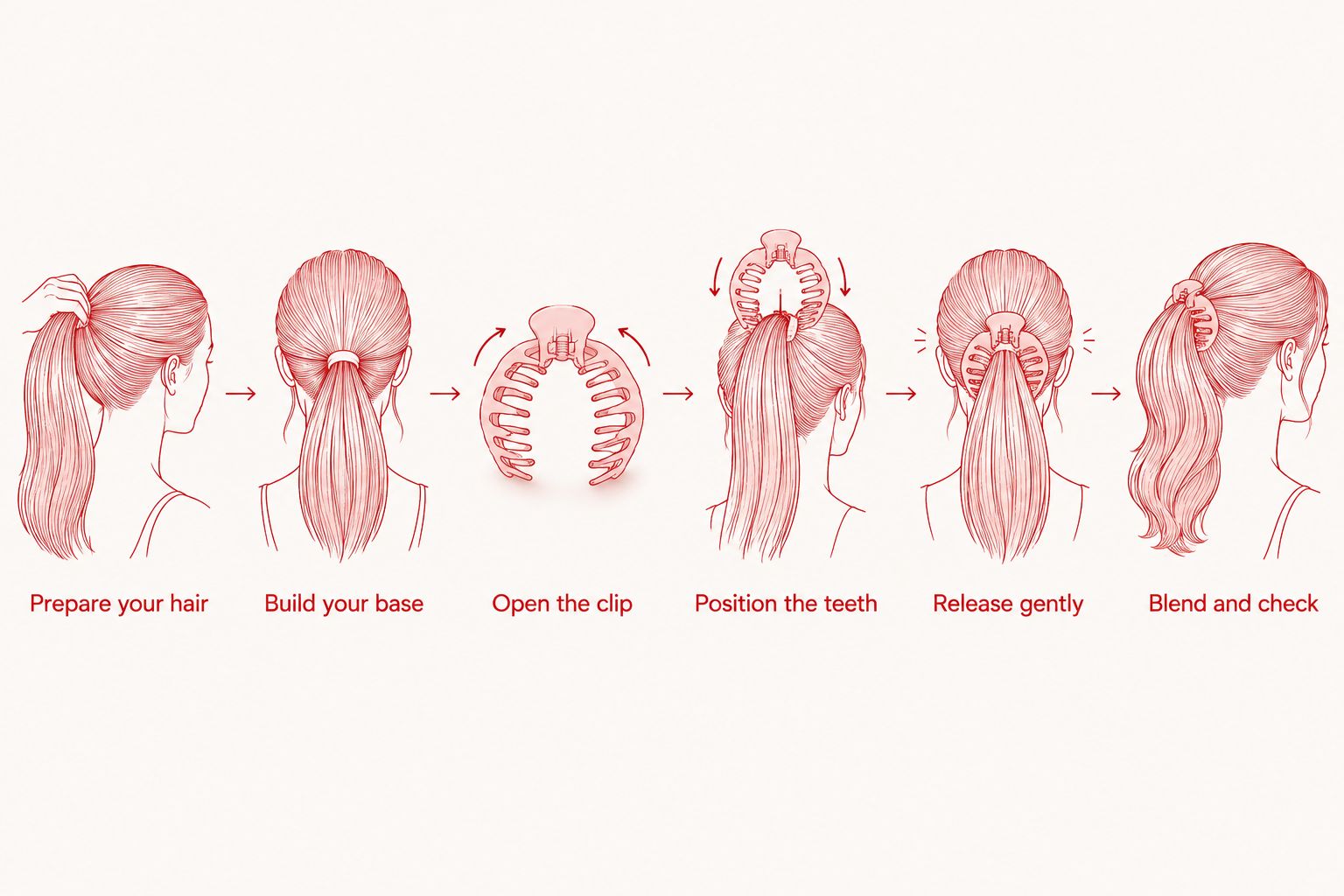
- Prepare your hair. Gently detangle your own hair and smooth it toward your chosen ponytail position. Leave out any face-framing pieces you want to keep loose.
- Build your base. Secure your hair with an elastic. If your natural ponytail is too long to hide beneath the extension, fold or twist it into a compact bun and secure the ends.
- Open the clip. Hold the extension near its attachment with one hand and squeeze the claw handles with the other. Keep loose strands away from the hinge and teeth.
- Position the teeth. Bring the open claw around the secured base. Make sure the teeth can close without scraping your scalp or trapping an uncomfortable section of hair.
- Release gently. Let the claw close while supporting the hairpiece. If it will not close properly, remove it and adjust the base rather than forcing the handles.
- Blend and check. Arrange the extension over the attachment, tuck away visible ends, and check the front, side, and back. Turn your head normally to check for slipping or pulling.
Keep 2 hands involved while fitting: one controls the clip, and the other supports the hairpiece. Let go fully only when the attachment feels stable.
Remove the extension without dragging
Support the hairpiece, squeeze the handles until the teeth open clear of your hair, and lift the clip away. If strands remain caught, pause and free them with your fingers while keeping the claw open.
Never pull a closed clip down through your ponytail. Undo your natural base only after the extension is completely off.
Why this matters
A fuller-looking ponytail should not require you to tolerate soreness. A clip that pulls, shifts, or exposes its teeth needs a different position or base—not more pressure.
Apexhairs synthetic ponytail extensions and bun hairpieces add visible fullness as styling accessories; they do not regrow hair or treat hair loss. Whether your hair is thin, thick, or somewhere between, choose an attachment your own hair can support comfortably.
For everyday styling in 2026, make comfort your first check and appearance your second. A neat back view does not make an uncomfortable fit acceptable.
Which attachment style fits your everyday routine?
A claw clip ponytail is not the only way to create a fuller-looking style. Compare the attachment and finished shape before choosing, especially if you alternate between wearing your hair down your back and keeping it tucked up.
| Styling choice | Best for | Main advantage | Main limitation |
|---|---|---|---|
| Claw clip ponytail extension | A hanging ponytail with a squeeze-open attachment | Opens for placement and removal around a secured base | The claw needs enough room to close and remain concealed |
| Wrap-around ponytail extension | A ponytail with a covered attachment area | A wrapping section can disguise the base | Requires careful wrapping and securing according to its instructions |
| Bun scrunchie hairpiece | A fuller-looking updo with the ends tucked away | Fits around an existing bun or ponytail base | Does not create the same hanging silhouette as a ponytail |
Choose by the shape you want and the attachment you can wear comfortably. A bun is useful when you want your hair off a collar; a ponytail suits a style with loose length at the back.
No attachment wins for every hair thickness. Check the individual construction rather than assuming every claw clip, wrap, or scrunchie fits the same way.
Why the fit and finished look vary
A claw clip ponytail extension can sit differently even when you repeat the same steps. Check these factors before changing your whole routine:
- Base size: An oversized bun can stop the claw closing; a very small or loose base can leave it unstable.
- Placement: Moving the base changes where the clip rests and where the ponytail falls.
- Hair length: Long ends need tucking if they show beneath a shorter extension; short layers need careful containment.
- Attachment construction: Tooth spacing, claw shape, and opening width determine how the clip fits around your base.
- Texture: A straight extension beside curled natural ends creates a different result from matching textures.
- Shade: A mismatch near the base can make the join more noticeable even when the clip itself is hidden.
Change one part of the fit at a time. If you move the base, change the elastic, and rearrange every strand together, you will not know which adjustment helped.
How do you make the ponytail comfortable on thin or thick hair?
Start with enough hold to keep your natural base together without pulling it painfully tight. Thin hair does not automatically need a higher ponytail, and thick hair does not automatically need a larger hairpiece.
If your hair is thin or fine
Keep the base compact and check whether the clip remains balanced when you release your supporting hand. If it tilts, drags, or repeatedly slips, remove it and reassess the fit rather than gripping more scalp hair.
Avoid forcing an attachment onto an area that already feels tender. A smaller-looking finished style is a better choice than an uncomfortable fuller one.
If your hair is thick or long
Focus on containing your own hair without making a bulky knot. A compact folded ponytail can be easier to conceal than a loosely twisted bun, depending on the claw's opening.
If the teeth cannot close around the base, stop. Forcing the claw shut is not a fitting technique; choose a different base arrangement or attachment instead.
If short layers escape
Smooth the layers toward the base before attaching the extension, then secure stray ends where they will remain hidden. Check that pins do not press against the clip or your scalp.
Do not trap every loose strand under the claw simply to make the surface look tidy. Keep the attachment area clear enough to open safely when you remove it.
How do you match grey or silver hair?
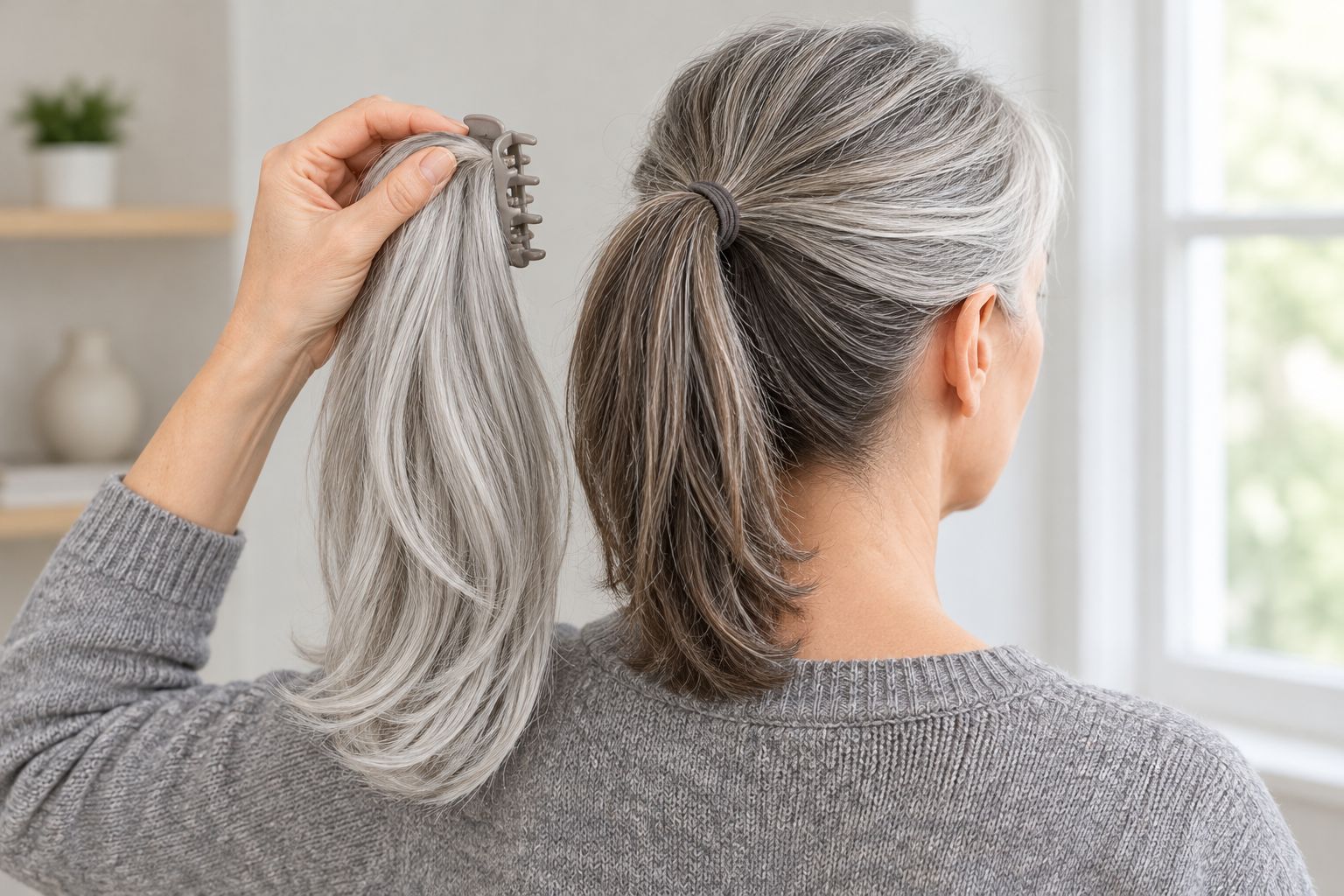
Match the hair beside the ponytail base, not just the color at your roots. For a 2026 online shade check, compare your gathered hair and the hairpiece in similar daylight; different lighting makes comparison harder.
Grey hair often contains a mixture of darker and white strands. Silver describes a lighter-looking, cool-toned appearance, while salt-and-pepper describes a more visible mixture of dark and light strands; sellers' shade names still vary.
Look at the balance of light and dark as well as the overall shade. A pale silver piece can stand out against a darker salt-and-pepper base even if both are described as grey.
Use these checks before settling on a match:
- Lightness: Is the extension noticeably lighter or darker than the gathered hair?
- Tone: Does one look warmer or more yellow while the other looks cooler?
- Color distribution: Is your hair evenly grey, streaked, or darker underneath?
- Placement: Which strands actually sit beside the attachment when your hair is tied up?
A deliberate contrast can be a styling choice. If your goal is a less noticeable join, prioritize the color visible around the base rather than expecting a shade name to guarantee a match.
How do you hide the clip without making the style bulky?
Arrange the extension's fibers over the attachment before adding extra pins or rearranging your natural hair. Check whether the clip is visible because the fibers have separated or because the base is pushing it outward.
Use 3 viewing angles—front, side, and back—to check the result. The back view reveals exposed teeth and loose ends that a front mirror misses.
If the style looks too large, rebuild a flatter base instead of piling more hair over the hardware. Keep any adjustment gentle so you do not turn a visual fix into a tight attachment.
For a straightforward 2026 routine, choose the position that stays comfortable during your usual movements. Check the style with your actual collar or jacket, not only with your shoulders uncovered.
Can you brush or heat-style a synthetic ponytail?
Detangle a synthetic ponytail gently while supporting the fibers near the attachment. Work through the ends before moving upward, and keep the clip mechanism clear of loose strands.
Use the hairpiece's own care instructions to choose a suitable tool. The guide to detangling a synthetic ponytail without pulling the fibers explains this part of the routine in more detail.
Do not assume synthetic hair is heat-safe. Use heated tools only when the specific hairpiece's instructions permit them, and follow the stated limits rather than applying a general temperature rule.
For 2026 care, keep those instructions with the hairpiece so you can check them before washing or restyling. When the attachment needs cleaning, avoid leaving trapped hair wound around its hinge.
FAQ
Can I put a claw clip ponytail extension on loose hair?
Secure your own hair into a ponytail or compact bun before attaching a claw clip ponytail extension. A stable base helps you position the claw without relying on loose surface strands.
Why does my claw clip ponytail extension keep slipping?
A loose base or an attachment that does not fit around it can cause slipping. Remove the extension, rebuild the base, and check that the teeth close comfortably rather than tightening the clip against your scalp.
Can I wear a claw clip ponytail extension if my hair is thin?
You can wear a claw clip ponytail extension if your hair can support the attachment comfortably. Remove it if it pulls, tilts, or causes soreness, and choose a different attachment when the fit remains unstable.
Should I make a bun before attaching a ponytail extension?
Make a compact bun when your natural ponytail would otherwise show beneath the extension. A shorter natural ponytail can stay as a ponytail if the hairpiece conceals it and the clip fits securely.
How do I choose between grey and silver ponytail shades?
Compare the hairpiece with the gathered hair beside your attachment in similar daylight. Check lightness, warmth, and the mixture of dark and light strands rather than relying on the shade name alone.
Can I use a curling iron on a synthetic ponytail extension?
Use a curling iron only if the specific synthetic ponytail's instructions explicitly permit heat styling. Follow its stated limits; synthetic does not automatically mean heat-resistant.
How do I take a claw clip ponytail off without snagging?
Support the extension, open the claw fully, and lift it away once the teeth are clear. If strands catch, keep the clip open and free them gently instead of pulling the hairpiece downward.
One last thing
Check your ponytail while looking down, not just while facing the mirror. Looking at your phone or reaching into a bag changes your head position and can reveal pulling you missed while standing still.
A comfortable attachment should suit your everyday movements. If it does not, take it off and adjust the base before wearing it again.


Leave a comment