
Can you wear a bun hairpiece every day without damaging your hair?
Yes, you can wear a bun hairpiece every day, but no attachment guarantees damage-free wear: keep your own bun loose, choose a hairpiece your hair can support, and remove it before sleeping. Repeated pulling, uncomfortable clips, and rough removal can cause breakage or traction-related hair loss, so daily comfort matters more than a firm hold.
- Can you wear a bun hairpiece every day? Yes, if it stays comfortable without repeated pulling.
- Apexhairs synthetic bun hairpieces suit women seeking fuller-looking updos; comfortable attachment still matters.
- Remove the hairpiece before sleeping, and stop wearing it if your scalp feels sore.
- Match grey or silver shades near the bun placement, not just at your roots.
Why this matters
A fuller-looking bun should not require a tighter ponytail underneath. Whether your hair is fine, thick, straight, curly, grey, or color-treated, the attachment must work with the hair you have rather than force it into place.
For your everyday routine in 2026, judge the finished style by how it feels as well as how it looks. If you keep tightening the attachment to stop slipping, use this guide to how tight a messy bun hairpiece clip should be before adding more tension.
Can you wear a bun hairpiece every day without damaging your hair?
Daily wear is possible, but pain-free styling is a requirement—not proof that an attachment cannot cause damage. Repeated tension can affect the hair even when you have become used to the sensation. Watch for changes around the hairline and attachment area rather than relying on comfort alone.
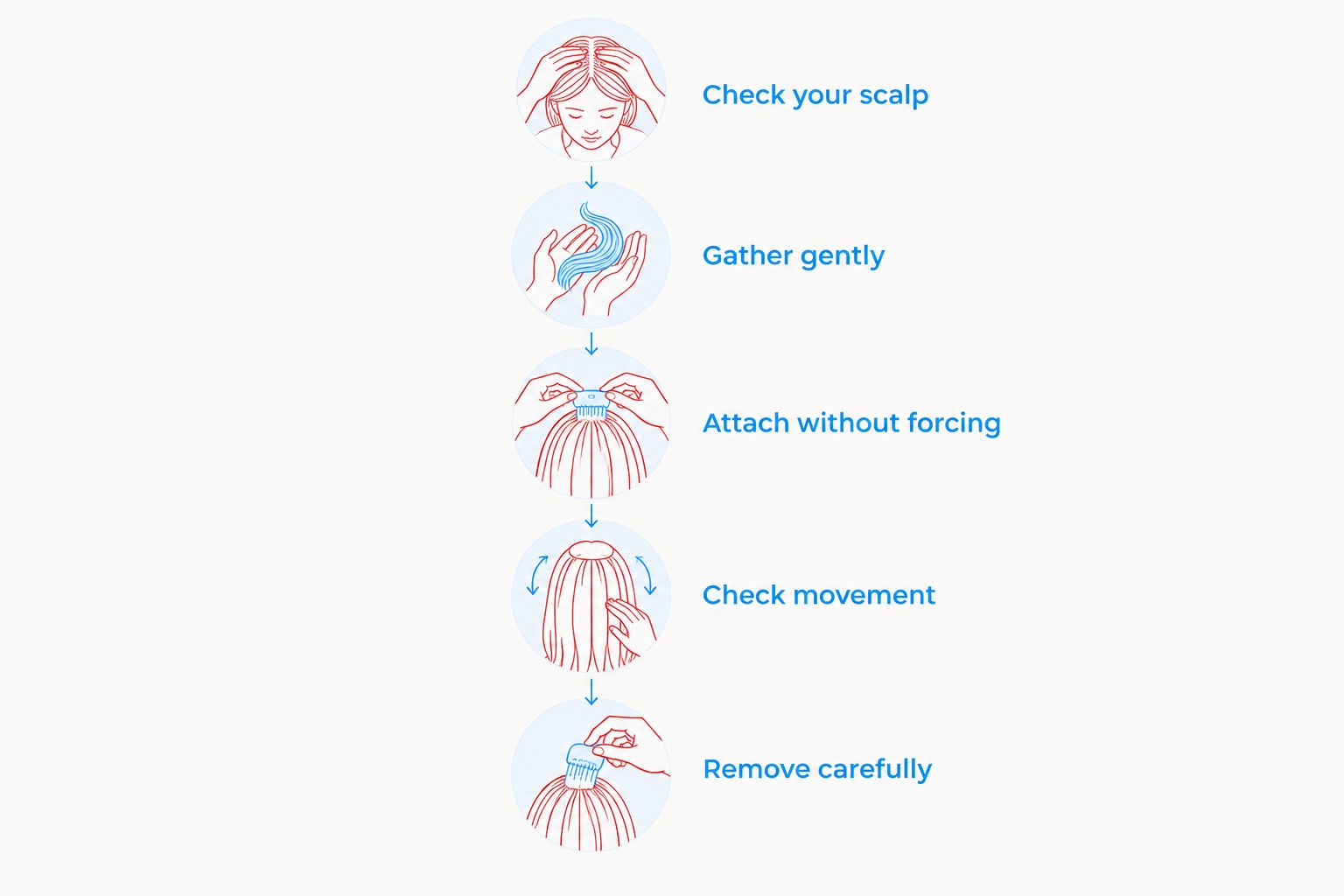
Use this routine each time you put on your hairpiece:
- Check your scalp. Skip the hairpiece if the attachment area feels tender, irritated, or sore. Do not cover an uncomfortable spot and continue wearing the same style.
- Gather gently. Make a base that holds without pulling your temples or lifting the skin around your hairline. Avoid repeatedly brushing the front tighter.
- Attach without forcing. Follow the instructions for the actual scrunchie, clip, or other fastening. If you need to force it closed, stop and reassess the base.
- Check movement. Turn your head, look down, and sit against your usual chair. A bun that feels comfortable standing still should also suit ordinary movement.
- Remove carefully. Support your own hair while releasing the attachment. Separate caught strands before lifting the hairpiece away.
You do not need to prove that you can wear it all day. Removing an uncomfortable hairpiece is the right adjustment, even when the hairstyle looks good.
Scrunchie buns: best for a clip-free updo
A scrunchie bun wraps around your own gathered hair. It avoids a rigid clip at the attachment point, but the elastic can still pull if your base ponytail is too tight or you wrap the piece beyond a comfortable fit.
Best for: women who want a fuller bun without a clip pressing against the scalp. The limitation is that your own hair still needs to form a secure base; a scrunchie cannot compensate for an unstable ponytail simply by being tightened harder.
Keep the base simple. If a tidy finish requires repeated tightening, choose a softer-looking updo instead of pulling every short strand into the bun.
Clip-in buns: best for a clip-based attachment
A clip-in bun uses its fastening to secure the piece to your gathered hair. Placement matters: a clip resting awkwardly against your scalp or gripping a small section can become uncomfortable.
Best for: women who prefer fastening a bun with a clip rather than wrapping a scrunchie. The trade-off is localized pressure, so check the contact points and release the clip fully during removal.
Do not assume that stronger grip means better everyday wear. Your useful test in 2026 is whether the piece stays positioned without pinching, pulling, or needing repeated adjustment.
Ponytail extensions: best for a different silhouette
A ponytail extension gives you hanging length rather than a compact bun. Changing the silhouette does not automatically reduce tension: a ponytail still needs a comfortable base and an attachment your own hair can support.
Best for: women who want a ponytail look instead of an updo. The limitation is that extra length and movement can make pulling more noticeable, particularly if the base is already tight.
An 8-inch ponytail and a 14-inch ponytail offer different lengths, but length alone does not establish comfort. Attachment, weight, placement, and your own hair all matter; do not choose a longer piece as a solution to a slipping base.
Compare everyday bun options before choosing
The Apexhairs synthetic bun hairpieces below offer different finishes, not a guarantee of safer wear. Both descriptions identify a lightweight, clip-free design; neither description establishes a damage-free wear time.
| Option | Best for | Useful feature | Limitation to check |
|---|---|---|---|
| Synthetic Messy Bun Hairpiece Scrunchie | A tousled, fuller-looking updo | Synthetic, lightweight, clip-free construction | The scrunchie and your base ponytail must still fit without pulling |
| Straight Synthetic Hair Bun Scrunchie | A smoother-looking bun | Synthetic, lightweight, clip-free construction | A smooth finish is not a reason to tighten your hairline |
Apexhairs synthetic bun hairpieces are best for women seeking fuller-looking updos without changing their own hair length. They add the appearance of volume; they do not regrow hair or treat hair loss.
Choose the finish you want, then check the current shade choices and attachment instructions. A pretty texture cannot make an uncomfortable fit suitable for everyday use.


Why everyday comfort varies
The same hairpiece can feel different with a different base or placement. Check these factors before deciding that you need more grip:
- Base tension: A tight ponytail underneath still pulls, even when the hairpiece itself feels soft.
- Support: Your gathered hair must support the attachment without a small section carrying the pull.
- Attachment position: A clip or elastic sitting against a tender area needs repositioning or removal.
- Repeated placement: Pulling on the same area every day creates a different routine from alternating with loose hairstyles.
- Movement and surroundings: Headrests, collars, and repeated head movement can push or shift a bun that felt comfortable in front of the mirror.
- Removal technique: Dragging a scrunchie or closed clip through your hair can undo the care you took when attaching it.
For everyday styling in 2026, fix the source of discomfort rather than adding another pin, another elastic, or a tighter wrap. If the piece still needs constant correction, leave it off and reconsider the fit.
How do you style a fuller bun without pulling thin hair tighter?
Build the volume with the hairpiece, not with extra tension at your roots. Gather your hair loosely enough that your hairline stays relaxed, then attach the piece according to its instructions.
Fine hair and thinning hair are not identical. Fine strands describe texture; thinning describes reduced density, and either can affect how much support an attachment has. You can also have thick hair that feels uncomfortable in a tight bun.
Avoid backcombing fragile areas just to create grip. If your base cannot support the hairpiece comfortably, choose a different style rather than making the attachment tighter.
Leave short hairs out when gathering them would pull. A softly finished hairline is a practical everyday choice, not a styling failure.
How do you match grey or silver hair for everyday wear?
Match the hair beside the bun, not only the hair at your front hairline. Grey hair can contain a mixture of darker and lighter strands, while a silver-looking shade often reads cooler and brighter. Shade names alone do not establish a match.
Compare the hairpiece with the area where it will sit in indirect daylight. Look at overall lightness, warmth or coolness, and how much dark hair remains in the blend.
During a transition from dyed hair to grey, your roots and gathered lengths can look different. For your 2026 shade choice, decide which area the bun needs to blend with rather than expecting a single shade name to describe your whole head.
Do not pull your own hair tighter to hide a color mismatch. Adjust the shade choice or placement instead; tension is not a blending tool.
Can you sleep in a bun hairpiece?
Remove a bun hairpiece before sleeping. Overnight movement can press on the attachment and pull at caught strands, and you cannot keep checking the fit while asleep.
Support the bun with one hand, release the fastening, and gently free your own hair. For a scrunchie, unwind it rather than pulling the whole piece straight off the base.
Store the hairpiece separately so it does not become tangled with your own hair overnight. Follow its care instructions rather than assuming every synthetic fiber tolerates the same brushing, washing, or heat.
How many hours can you wear a bun hairpiece?
There is no universal damage-free number of hours for bun hairpiece wear. A short period in an overly tight style is not made safe by the clock, and a comfortable fit still needs sensible removal and regular checks.
For your 2026 routine, plan around the activity rather than an unsupported wear-time promise. Check the fit when you sit down to drive, change clothes, or notice the attachment shifting.
Remove the piece when you feel pulling, pinching, or soreness. You do not need to reach the end of a workday before changing your hairstyle.
When should you stop wearing the hairpiece?
Stop wearing it if you notice scalp pain, persistent tenderness, broken hairs near the attachment, or changes in your hairline. Do not keep testing a painful fit by moving it a small distance and tightening it again.
Give the affected area a break from pulling. If discomfort persists or you notice new thinning or hair loss, speak with a dermatologist rather than covering the area with another attachment.
A hairpiece is a styling accessory, not a treatment. Fuller-looking hair and healthy attachment habits are separate goals, and the appearance of coverage does not tell you what caused a change in density.
FAQ
Can you wear a bun hairpiece every day if you have fine hair?
Yes, you can wear a bun hairpiece every day with fine hair if your hair supports it comfortably without repeated pulling. Stop if the attachment slips unless tightened hard, feels sore, or catches fragile strands.
Is a scrunchie bun safer than a clip-in bun?
A scrunchie bun is not automatically safer than a clip-in bun. Scrunchies can pull through elastic tension, while clips can create pressure at their contact points; the fit and removal technique matter.
Can a bun hairpiece cause hair loss?
Repeated pulling from a bun hairpiece or its base hairstyle can contribute to traction-related hair loss. Remove an uncomfortable attachment and seek a dermatologist's advice for persistent soreness or new thinning.
Should I take my bun hairpiece off every night?
Yes, remove your bun hairpiece before sleeping. Release the attachment completely and free any caught strands instead of pulling the piece through your hair.
Can I wear an Apexhairs bun hairpiece if my hair is not thinning?
Yes, Apexhairs bun hairpieces also suit women who want fuller-looking updos or a different finish without thinning hair. Choose a comfortable attachment and a shade that blends with the hair around your bun.
Can I use heat on a synthetic bun hairpiece?
Use heat only when the specific hairpiece instructions explicitly allow it. Do not assume a synthetic bun tolerates a curling iron or straightener because another hairpiece does.
Will changing from a bun to a ponytail extension prevent damage?
Changing to a ponytail extension does not automatically prevent damage. Both styles need a comfortable base, suitable support, and gentle removal without repeated pulling.
One last thing
Check your chair before tightening your bun. If the attachment only starts bothering you against a headrest, the problem can be its position rather than a lack of grip.
Sit the way you normally drive or work before finishing the style. Reposition or remove a bun that gets pushed into your scalp; a tighter ponytail does not solve that pressure.


Leave a comment