
How do you know what size bun hairpiece to order?
Order a bun hairpiece that covers your secured natural bun, gives you the fullness you want, and attaches without pulling—not simply the largest size pictured. Check the finished bun dimensions and attachment details separately, because a fuller-looking hairpiece does not tell you how tightly its band or clip will fit.
- What size bun hairpiece should I order? Choose coverage and comfortable attachment before extra volume.
- Apexhairs synthetic bun hairpieces suit women seeking fuller-looking updos without changing their haircut.
- Measure your secured natural bun, not your head circumference, before comparing bun hairpiece dimensions.
- For grey or silver shade matching, compare the hair surrounding your bun in indirect daylight.
How do you know what size bun hairpiece to order?
Choose your bun hairpiece around your actual updo, not your hair thickness alone. Fine hair can suit a fuller finish, while thick hair can need a compact-looking piece with enough room around the natural bun.
For your 2026 purchase, separate appearance from attachment. A product described as “small” tells you less than its finished dimensions, attachment construction, and photographs from different angles.
Start with the support question: can your natural hair hold the style comfortably? The guide to choosing bun hair extensions your hair can support helps you assess that before choosing extra fullness.
- Make your base. Put your hair into the bun you normally wear, at your usual height.
- Measure the bun. Record its width, height, and how far it projects from your head. Use the same measurement unit shown in the product details.
- Check the attachment. Look for the band, clip, or other fastening method, rather than judging fit from the outer hair alone.
- Choose the finish. Decide whether you want a modest boost, loose curls, or a smoother outline.
- Compare the details. Match your measurements and preferred finish against the information for the exact hairpiece.
If a listing does not explain the fit you need, ask for those details before ordering. A model photograph shows a hairstyle; it does not establish how the attachment will fit your bun.
Why this matters
A hairpiece has two jobs: stay comfortably attached and create the shape you want. Getting the appearance right does not automatically get the fit right.
For thin hair, the useful question is whether the base can support the attachment without pulling. For thicker hair, the question is whether the attachment can sit around the gathered hair without forcing it into an uncomfortable shape.
More volume is a styling choice, not a sizing rule. You do not need the fullest option just because your natural bun is small.
Measure your bun before choosing the finished size
Measure your hair in the condition you actually plan to style it. A tightly twisted bun and a loosely gathered bun do not create the same base, even on the same person.
For a practical 2026 shopping note, record these details together:
- Bun width: the side-to-side span of your secured natural bun.
- Bun height: the top-to-bottom span, especially if your base is oval rather than round.
- Bun projection: how far the bun sticks out from your head.
- Placement: low at the nape, mid-height, or high on the head.
- Desired finish: compact, loosely tousled, curly, or smooth.
Use a mirror or ask someone to help with the back view. Keep the tape against the bun without squeezing it smaller than you normally wear it.
Do not substitute ponytail circumference for finished bun width. Once you twist or fold your ponytail, its shape changes; measure the base the hairpiece will actually surround.
What should you ask when dimensions are unclear?
Ask for the finished hairpiece width and height, whether those measurements include loose curls, and how the attachment is measured. For a scrunchie, ask whether any stated opening measurement is relaxed or stretched.
For a clip attachment, ask how the clip sits around the base. These questions are more useful than asking whether a hairpiece is “normal size,” because that phrase does not describe your hair or your intended style.
Choose between a compact bun, a smooth bun, and a ponytail
Your choice starts with the shape you want to see from the side and back. Bun hairpieces add a gathered outline, while ponytail extensions leave a hanging length.
Use this comparison to narrow the style before judging size. The product name identifies the type; it does not replace a fit check.
| Option | Best for | Useful feature | Trade-off to check |
|---|---|---|---|
| Small Messy Bun Hair Piece – Curly Synthetic Scrunchie | A small messy-bun style | The product is identified as a small, curly synthetic scrunchie | “Small” alone does not establish its dimensions or your attachment fit |
| Straight Synthetic Hair Bun Scrunchie | A smoother-looking updo | Its description specifies a lightweight, clip-free design and smooth finish | A smooth outline still needs careful placement to conceal the attachment |
| Claw-clip ponytail extension | A hanging ponytail rather than a gathered bun | Offers a different silhouette and attachment approach | Ponytail length is not a bun-size measurement; check clip fit separately |
Compact curly bun: best for a smaller-looking updo
Choose a compact-looking curly bun when you want added texture without a broad outline around your head. Compare the back view with your usual hairstyle rather than assuming “small” means suitable only for fine hair.
Curly texture adds an irregular edge, which is part of the look. If you prefer a neat outline, choose for that preference instead of trying to flatten a tousled style into something different.
Smooth bun: best for a controlled outline
Choose a smooth bun when you prefer a less tousled finish for everyday styling. Pay attention to where the hairpiece meets your own hair, because that join is part of the finished appearance.
A smooth style is not automatically smaller or lighter than a curly one. Check the individual product details rather than treating texture as a measurement.
Ponytail extension: best for visible length
Choose a ponytail extension if your goal is hair falling below the attachment rather than a rounded bun. This is a style decision, not a way to correct an unsuitable bun fit.
Apexhairs lists an 8-inch short straight claw-clip ponytail and a 14-inch wavy claw-clip ponytail. Those lengths describe different ponytail options; neither number tells you what diameter bun hairpiece to order.
Once you have chosen the silhouette, compare the exact attachment details. These Apexhairs synthetic bun hairpieces illustrate the compact-curly and smooth options above; confirm the measurements that matter to your base before choosing.


Why the right bun hairpiece size varies
There is no useful size recommendation based only on whether your hair is thin, medium, or thick. Your gathered base and the hairpiece construction matter more than that label.
Use these five factors for your 2026 shortlist:
- Base shape: a flat, folded bun needs a different surrounding shape from a round, projecting bun.
- Attachment method: a scrunchie surrounds the base differently from a clip; check the design you are buying.
- Desired fullness: a subtle boost and a deliberately full updo are different goals, even with the same natural bun.
- Texture: loose curls and straight fibers create different outlines, so compare finished looks as well as dimensions.
- Placement: a low bun interacts with collars and headrests differently from a high bun.
Hair color affects the visual match, but it does not fix an attachment problem. Choose a comfortable shape first, then refine the shade and texture.
How do you check the fit when your hairpiece arrives?
Test the hairpiece over your usual secured base and follow its attachment instructions. A comfortable fit should not depend on pulling your natural hair tighter and tighter.
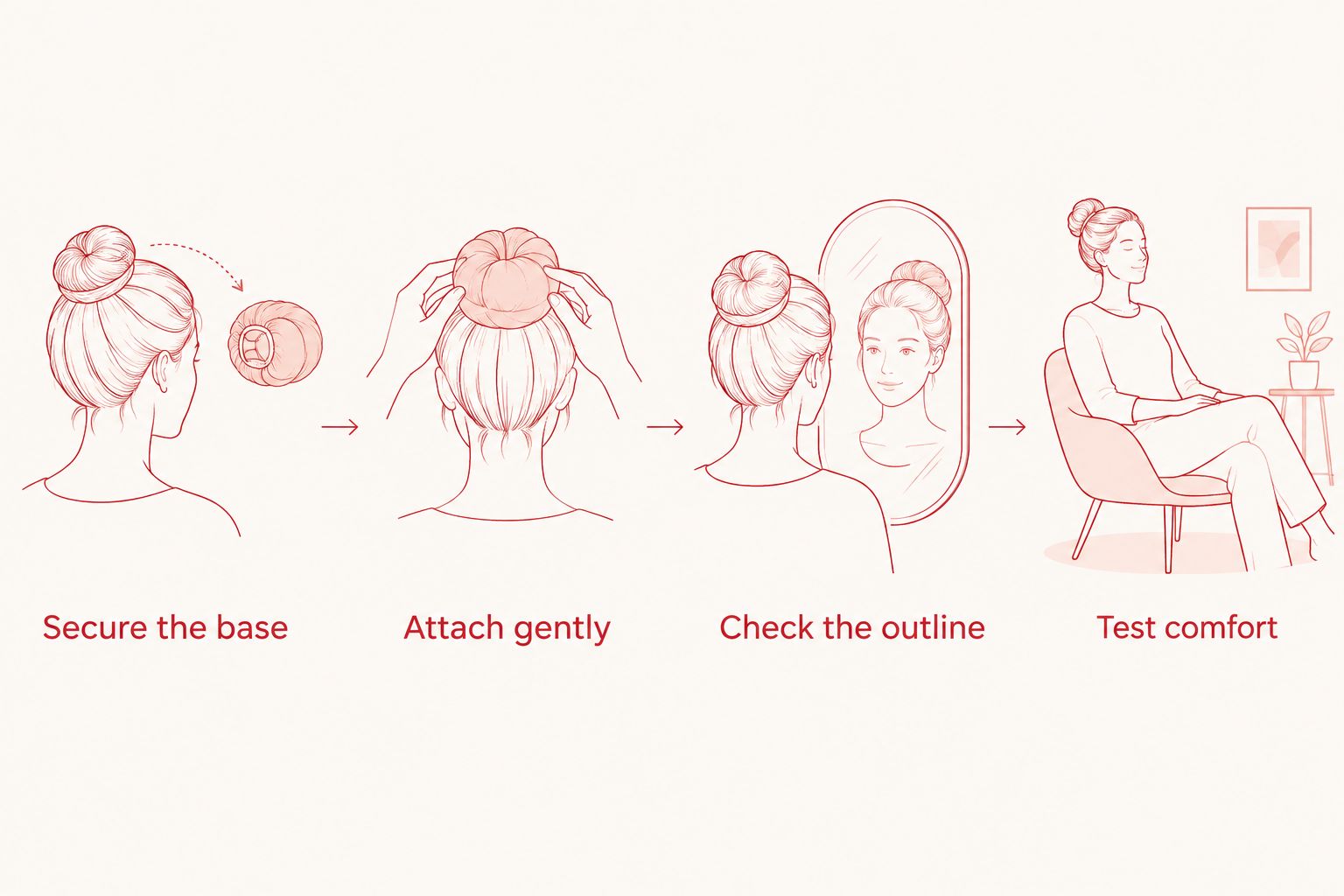
Use this 4-step check before deciding that the size works:
- Secure the base. Make your normal bun without extra tension to compensate for the hairpiece.
- Attach gently. Follow the supplied method and stop if fastening requires force.
- Check the outline. Look at the front, side, and back for exposed attachment points or unwanted bulk.
- Test comfort. Turn your head and sit as you normally would; remove or reposition the piece if it pulls or presses.
A little styling adjustment is different from rebuilding your entire hairstyle around an uncomfortable attachment. If the base stays secure but the hairpiece shifts, inspect the fastening method before deciding that you need more hair.
What if the bun looks too bulky?
Check whether you are seeing excess hairpiece volume or a bulky natural base underneath it. Remake an unnecessarily bunched base before changing the hairpiece size.
If the attachment fits comfortably but the overall outline still looks larger than you want, choose a less full style next time. Do not tighten the attachment to make the outer hair look smaller.
What if the bun feels loose?
Check whether the natural base is secure and whether you followed the attachment instructions. A loose base can move underneath a correctly positioned hairpiece.
If the base stays put but the attachment does not, reassess the fit or fastening design. Adding more tension to your natural hair is not a substitute for a suitable attachment.
Does grey or silver hair change the size you should order?
Grey or silver hair does not require a different physical bun size. Match the shade where your own hair meets the hairpiece, then judge the finished outline separately.
“Grey,” “silver,” and “salt and pepper” describe different appearances, but shade names are not standardized across every listing. Silver generally suggests a lighter, cooler look, while salt-and-pepper hair combines visibly dark and light strands.
For your 2026 shade check, compare photographs in indirect daylight and look at the hair gathered around the bun—not just the roots at your part. If you are growing out color, those areas can look quite different.
Apexhairs shade names should be treated as a starting point for comparison, not proof of an exact match. Check the selected variant and its photographs rather than assuming every bun style uses the same blend.
FAQ
What size bun hairpiece should I order for thin hair?
Choose a bun hairpiece that your secured base can hold comfortably and that gives you the fullness you want. Thin hair does not automatically require the smallest-looking style; attachment fit and support come first.
Should I measure my head for a bun hairpiece?
Measure your secured natural bun rather than your head circumference. Record its width, height, and projection, then compare those details with the exact hairpiece and attachment information.
Is a small bun hairpiece always better for fine hair?
A small bun hairpiece is not automatically better for fine hair. A compact outline can suit a subtle style, but the attachment still needs to fit your natural base comfortably.
How do I know whether a scrunchie bun will fit?
Check the scrunchie attachment information against your secured bun and follow the product instructions. Ask whether any opening measurement is relaxed or stretched if the listing does not explain it.
Is an 8-inch ponytail the same size as an 8-inch bun?
An 8-inch ponytail length is not equivalent to an 8-inch bun measurement. Ponytail length describes hanging hair, while bun fit depends on the gathered shape and attachment.
Can a larger bun hairpiece cover thinning hair?
A larger bun hairpiece can add visible fullness around the bun, but it does not guarantee coverage elsewhere on the head. Check the back and side views; synthetic hairpieces do not regrow hair or treat hair loss.
How do I choose an Apexhairs bun without guessing the size?
Compare the exact Apexhairs product's attachment details, stated dimensions, and finished style with your secured natural bun. Ask for unclear measurements before ordering rather than relying on a model photograph.
One last thing
Before placing your 2026 order, take a side photo and a back photo of your usual bun. Use those views to decide where you actually want more fullness.
Order for the shape you want to add, not for the size you think your hair should be. That keeps a quick everyday updo from turning into a struggle with an oversized or uncomfortable attachment.


Leave a comment