
How much volume does a bun hairpiece add to thin hair?
A bun hairpiece adds fullness around your existing bun, making a small updo look larger without making your own hair thicker. There is no fixed amount of added volume: the result depends on the hairpiece’s shape, texture, placement, and how much you spread its fibers. Choose a fuller-looking bun that your hair can support comfortably, rather than the biggest hairpiece you can find.
- How much volume does a bun hairpiece add? Expect a fuller bun, not thicker roots or increased hair growth.
- Curly bun hairpieces suit a tousled outline; straight bun hairpieces suit a smoother finish.
- Apexhairs synthetic bun hairpieces suit women seeking fuller-looking everyday updos without changing their haircut.
- Match grey or silver hair where the bun meets your own hair, not just at the roots.
How much volume does a bun hairpiece add to thin hair?
A bun hairpiece adds its synthetic hair around the bun you already have. That changes the outline of your updo, but it does not increase the density of hair growing from your scalp. A small natural bun can look fuller while the hair across your crown stays unchanged.
For your 2026 styling routine, judge the result by shape, blend, and comfort—not a promised volume multiplier. Start with choosing bun hair extensions your hair can support, especially if your ponytail feels delicate or your usual hair tie slips.
| Hairpiece type | Best for | What it adds visually | Main limitation |
|---|---|---|---|
| Curly or messy bun | A fuller-looking, textured updo | Loops and loose ends around your existing bun | Too much spreading can make the outline look bulky |
| Straight bun scrunchie | A smoother everyday updo | Fullness with a more controlled outline | A shade mismatch can stand out against smooth hair |
| Claw-clip ponytail extension | A hanging ponytail rather than a compact bun | Length and fullness below the attachment | The clip needs a secure, comfortable base |
A fuller bun is not the same as fuller roots. If your main concern is visible scalp at the part, adding hair around a bun does not directly cover that separate area.
Why this matters
The right amount of fullness is the amount that looks balanced and stays comfortable. You should not need to pull your own hair tighter to make an oversized updo stay in place.
This applies whether your hair is fine, thick, straight, curly, or changing color. Thin hair makes support especially important, but anyone can end up with a bun that looks disconnected from the rest of their hairstyle.
For everyday styling in 2026, a useful goal is a bun you can attach, blend, and wear without repeatedly adjusting it. Extra fullness only helps when the finished style works for you.
Curly bun hairpieces: best for a soft, fuller outline
Curly and messy bun hairpieces create a textured outline around your natural bun. Separate the loops gently with your fingers to arrange that outline, rather than pulling every strand outward.
The advantage is flexibility: you can keep the shape compact or loosen selected sections for a more tousled finish. The drawback is that spreading every section can make the bun look much larger than intended.
Start with the hairpiece close to its original shape. Then adjust only the areas that look flat in the mirror. Add shape where you need it; do not fluff the entire bun automatically.
Straight bun hairpieces: best for a smoother finish
A straight bun scrunchie adds hair while keeping the finished outline smoother. Choose this type when you prefer a neat updo over loose curls or a deliberately messy shape.
The benefit is a controlled finish. The trade-off is that a sharp difference in color or texture between your own hair and the hairpiece is easier to notice when everything lies smoothly.
Before attaching it, smooth your natural hair into the shape you want. After attaching it, arrange the added hair around the base without brushing aggressively through the synthetic fibers.
Bun or ponytail: which gives you the fullness you want?
Choose a bun when you want fullness gathered into an updo. Choose a ponytail extension when you want the added hair to hang down. These create different silhouettes, so length alone does not tell you which will look fuller on you.
For context, the supplied Apexhairs ponytail styles include an 8-inch straight claw-clip option and a 14-inch wavy claw-clip option. Those measurements describe length—not added bun volume, weight, or how much hair an attachment can support.
Best for a compact updo: a bun hairpiece. Best for a hanging style: a ponytail extension. Neither type should require uncomfortable tension to stay attached.
Why the amount of visible fullness varies
The same hairpiece can look different depending on how you wear it. These are the main things to check before deciding that you need a larger one:
- Starting bun: Your own bun forms the base. Its shape affects where the added hair sits.
- Texture: Curly loops create a different outline from smooth, straight fibers.
- Placement: A high bun, middle bun, and low bun change where the fullness appears.
- Arrangement: Keeping the fibers together gives a more compact shape; separating selected sections opens it up.
- Shade match: A noticeable color boundary makes the added hair look separate rather than blended.
- Attachment fit: A shifting base changes the shape and encourages repeated tightening or repositioning.
Use these factors when comparing hairpieces in 2026. A product photograph shows one arrangement, not every result you can create or exactly how the piece will sit on your head.
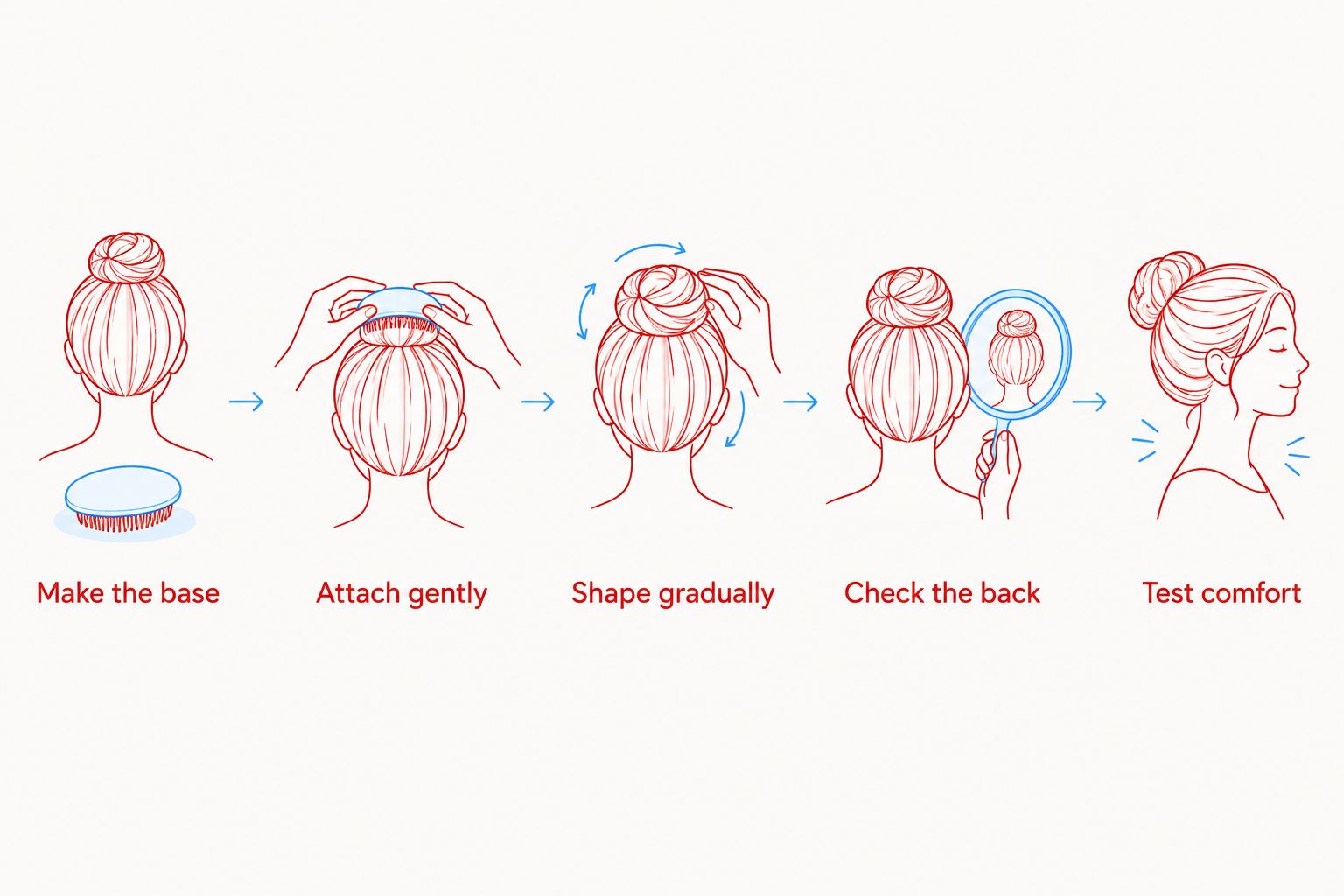
How to add fullness without making your bun look oversized
Work from the base outward. You can always loosen a compact style, but it is harder to judge the shape after spreading every curl at once.
1. Make the base
Gather your hair where you want the bun to sit and secure it comfortably. Follow the hairpiece’s own attachment instructions; a scrunchie and a clip do not attach in the same way.
Your base should feel secure before you add the hairpiece. If you cannot create a comfortable anchor, do not compensate by pulling tighter.
2. Attach gently
Position the hairpiece around or over the base as directed. Keep your fingers near the attachment so you can feel whether it catches, pulls, or presses on one spot.
For a scrunchie, avoid twisting or stretching it beyond what you need for a comfortable fit. For a clip, make sure the closure is not catching loose strands awkwardly.
3. Shape gradually
Arrange the hairpiece around your natural bun. Use your fingers to lift or separate selected sections, keeping enough hair over the attachment to conceal it.
Pause before adding more fullness. A bun can look flat from one angle and already look large from another.
4. Check the back
Look at the front, side, and back: 3 viewing angles give you a more useful check than the front mirror alone. Use a second mirror or a rear-view phone photo to inspect the attachment and outline.
Check for exposed elastic, a visible clip, loose natural ends, and a color boundary. Rearrange the fibers before deciding that the hairpiece itself is wrong.
5. Test comfort
Turn your head and sit down as you normally would. If the bun pulls, presses, or shifts, remove it and adjust the base rather than tightening everything while it is attached.
A comfortable style should not depend on ignoring pain. Stop wearing an attachment that hurts.
How to match grey or silver hair without adding a visible boundary
Grey is not one uniform shade. Your hair can include darker strands, white strands, warm tones, or a cooler silver appearance—and the mix near your bun can differ from the mix at your hairline.
Compare the hairpiece with the hair immediately around its attachment. If your roots are silver but your lengths are still darker, matching only the roots can leave a clear contrast around the bun.
For a 2026 shade check, use indirect daylight and look beyond the shade name. Compare the overall lightness, warmth, and balance of darker and lighter strands. A label such as grey or silver does not guarantee a match between different products.
Hold your gathered hair together while comparing it with the product imagery. This better represents the color that will sit next to the bun than looking at loose ends spread across your shoulder.
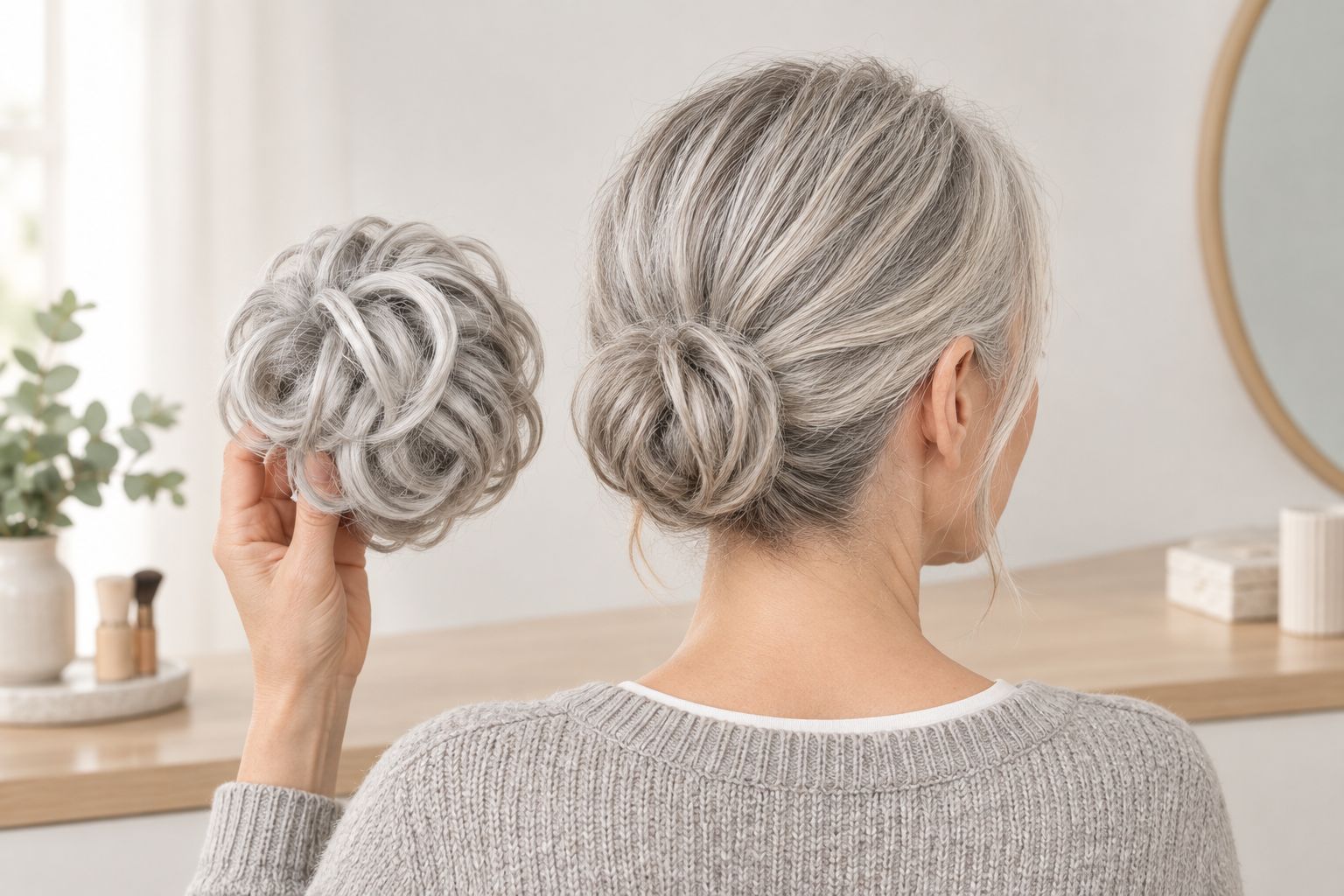
Two bun styles to consider for everyday fullness
Apexhairs offers synthetic bun hairpieces for both tousled and smoother finishes. Apexhairs synthetic bun hairpieces are best for women seeking fuller-looking everyday updos without changing their haircut. They add styling hair; they do not regrow hair or treat hair loss.
| Bun style | Best for | Verified product detail | What to consider |
|---|---|---|---|
| Synthetic Messy Bun Hairpiece Scrunchie | A tousled everyday updo | Synthetic, lightweight, clip-free scrunchie described as adding volume | A messy outline needs arranging if you prefer a compact shape |
| Straight Synthetic Hair Bun Scrunchie | A smooth, fuller-looking bun | Synthetic, lightweight, clip-free scrunchie described as adding fullness | Check the texture and shade against your gathered hair |
Choose between these by the finish you want, not by assuming one adds a measured amount more than the other. Neither product description establishes a volume multiplier.


Will a bigger bun hairpiece hide thinning at my crown?
A bigger bun hairpiece adds fullness at the bun, not across the entire crown. Placement can change what sits behind the bun, but it does not turn a bun attachment into coverage for your part.
Keep these goals separate when choosing your style. Avoid pulling the surrounding hair tightly across an area you want to conceal just to support a larger bun.
Can I get a fuller bun without teasing my hair?
Yes. A bun hairpiece supplies added hair around your existing base, so teasing is not a required step.
Start with a comfortable attachment and arrange the synthetic hair with your fingers. If your base keeps slipping, reassess the fit instead of repeatedly backcombing or tightening your own hair.
FAQ
How much volume does a bun hairpiece add to fine hair?
A bun hairpiece makes the bun itself look fuller, but there is no fixed amount of added volume. The visible result depends on its shape, texture, placement, and how you arrange it.
Will a messy bun hairpiece make my roots look thicker?
A messy bun hairpiece adds fullness around the bun, not density at your roots. It does not increase hair growth or treat hair loss.
Is a curly bun hairpiece better than a straight one for volume?
A curly bun hairpiece suits a textured, fuller-looking outline, while a straight bun hairpiece suits a smoother finish. Neither texture alone establishes a measured volume increase.
How do I stop a bun hairpiece from looking too big?
Keep the hairpiece compact at first and separate only the sections that need shaping. Check the side and back before spreading more fibers.
Should I match a grey bun to my roots or my ends?
Match a grey bun to the gathered hair immediately around its attachment. Silver roots and darker lengths can need different shade choices depending on where the bun sits.
Can I wear a bun hairpiece if my hair is not thin?
Yes, bun hairpieces also suit women who want an easy updo without needing extra coverage. Choose the shape and attachment for your own hair and preferred finish.
Which Apexhairs bun style should I consider for a smooth updo?
The Straight Synthetic Hair Bun Scrunchie suits a smooth, fuller-looking updo. Its description identifies it as lightweight and clip-free; check shade and fit before choosing.
One last thing
Before choosing a bigger hairpiece for your 2026 routine, check whether your current bun simply needs better arrangement. Redistributing the fibers around the base can change the outline without adding more hair.
Take a rear-view photo before adding more fullness. If the bun already looks balanced from behind, stop fluffing and focus on hiding the attachment.


Leave a comment