
Can you match a grey ponytail extension to new silver roots?
Yes—you can match a grey ponytail extension to new silver roots, but the most natural-looking choice usually connects the roots with the hair surrounding your ponytail attachment. Match the visible blend, not just the brightest strand at your part. A ponytail extension adds fullness behind your head; it does not cover the silver roots themselves, so placement matters as much as shade.
- Match a grey ponytail extension to the hair around its attachment, not silver roots alone.
- Grey, silver, and salt-and-pepper shade names are starting points; compare the actual blend in daylight.
- Apexhairs synthetic hairpieces suit women seeking fuller-looking everyday buns and ponytails, not hair-loss treatment.
- Choose an attachment your own hair supports comfortably, whether your hair is fine, medium, or thick.
Can you match a grey ponytail extension to new silver roots?
Yes. Start with the shade where your own hair meets the extension, then check how that shade relates to your roots. New silver growth and darker lengths do not need to become one uniform color for an updo to look intentional.
Use these 4 steps before choosing:
- Find the join. Gather your hair where you want the ponytail to sit.
- Check the blend. Look at the hair around that base, including darker strands underneath.
- Compare the shade. Check the extension against your gathered hair in indirect daylight.
- Check the fit. Choose an attachment your ponytail can hold without pulling.
The same root-to-length comparison applies when matching a grey hair bun to salt-and-pepper hair.
Why this matters
During a grey transition, your roots and ends can tell different color stories. Matching only the roots can leave a bright extension sitting against much darker gathered hair; matching only the ends can make the silver growth feel disconnected.
For your 2026 hairpiece choice, focus on the finished hairstyle rather than finding a perfect match to one loose strand. You are choosing how the colors meet when your hair is up—not trying to erase the transition.
This approach works whether you want extra fullness for thin hair or simply an easier everyday ponytail. Hair thickness changes the support you need, not the basic shade-matching method.
Silver, grey, or salt-and-pepper: which direction should you choose?
Shade names are not a standardized color chart. Use them to narrow your search, then compare the actual product photographs and shade options with your hair.
Silver generally describes a lighter, brighter-looking grey. Grey covers a broader range of light and dark appearances, while salt-and-pepper describes a visible mixture of darker and lighter strands. A silver-blonde blend can introduce a warmer appearance than the cooler silver you see at your roots.
| Shade direction | Best for | Advantage | Limitation |
|---|---|---|---|
| Silver-looking blend | Mostly light hair around the ponytail base | Connects with a lighter overall appearance | Can contrast strongly with dark lengths |
| Grey blend | Gathered hair with a medium-looking grey appearance | Offers a starting point between light and dark | The name alone does not identify the undertone |
| Salt-and-pepper blend | Clearly mixed dark and light hair | Echoes visible color variation | Can look too dark beside mostly pale hair |
| Silver-blonde blend | Hair with both pale grey and blonde tones | Connects lighter hair with warmer lengths | Can look too warm against cool-looking silver |
Choose the blend that resembles the attachment area before choosing the most appealing shade name. A beautiful silver sample is still the wrong match if it creates a sharp line against your own ponytail.
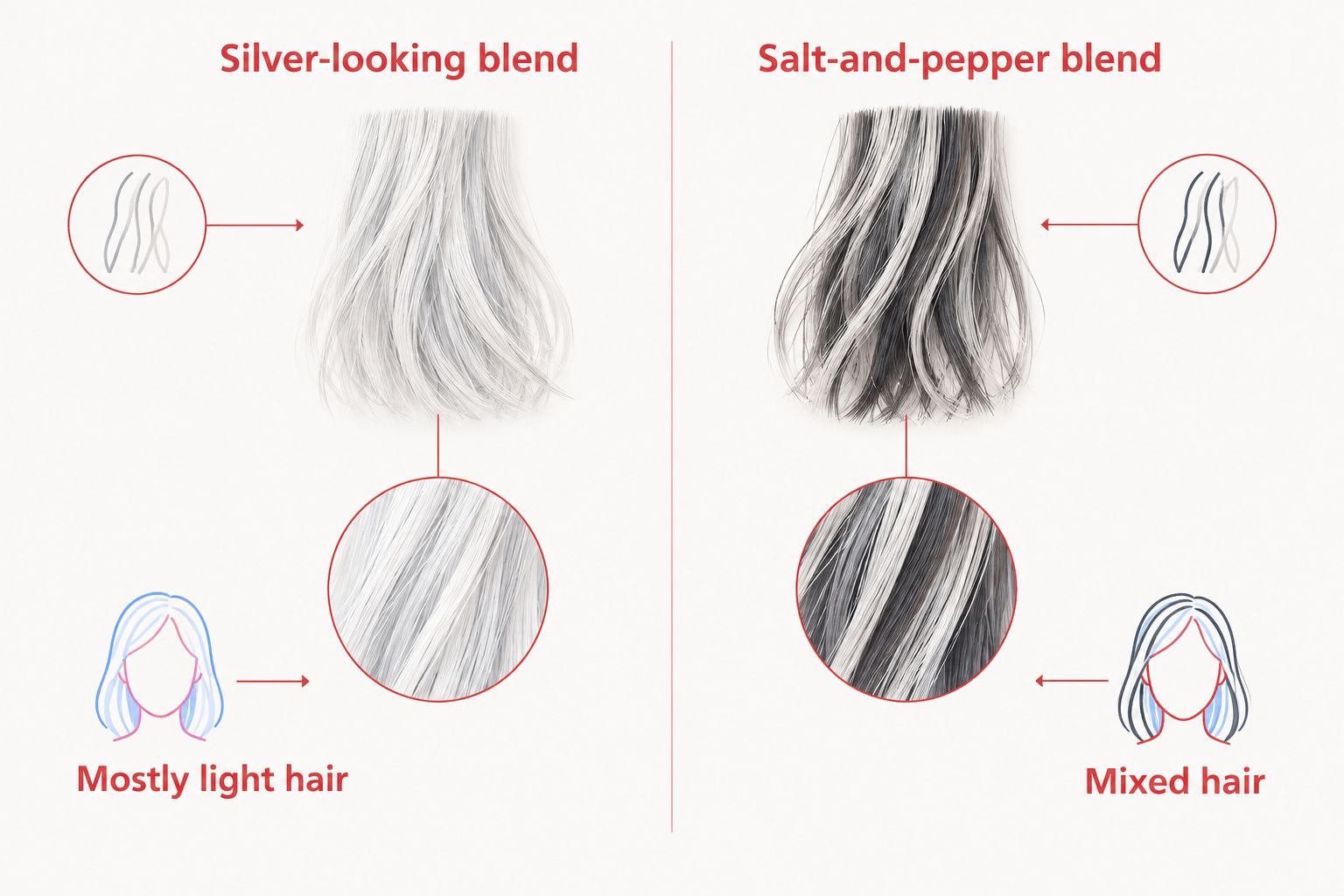
Why a grey ponytail extension match varies
The same hairpiece can look different beside loose hair and a finished updo. These factors explain why your first comparison is not always the most useful one:
- Root-to-length contrast. Pale roots above darker lengths create more than one possible matching point.
- Ponytail position. Moving the base changes which sections of your natural hair surround the attachment.
- Light and dark distribution. A mixed shade needs to resemble the balance of strands, not just their individual colors.
- Warmth or coolness. A blonde-looking grey and a cool-looking silver can appear different even when similarly light.
- Lighting. Warm indoor light changes the appearance of both your hair and the extension.
- Texture. Smooth and textured styles reflect light differently, which changes how obvious a color boundary looks.
When comparing shades in 2026, keep the lighting and hairstyle consistent. Do not compare one option beside loose hair indoors and another beside a ponytail at a window. Change one thing at a time so you can identify what actually improves the match.
How do you shade-match when only the roots are silver?
Match the join first and judge the roots as part of the whole hairstyle. If your gathered lengths remain dark, an entirely pale ponytail can create a deliberate contrast rather than a blended result. Neither look is automatically wrong; decide which finish you want.
Gather your hair before comparing
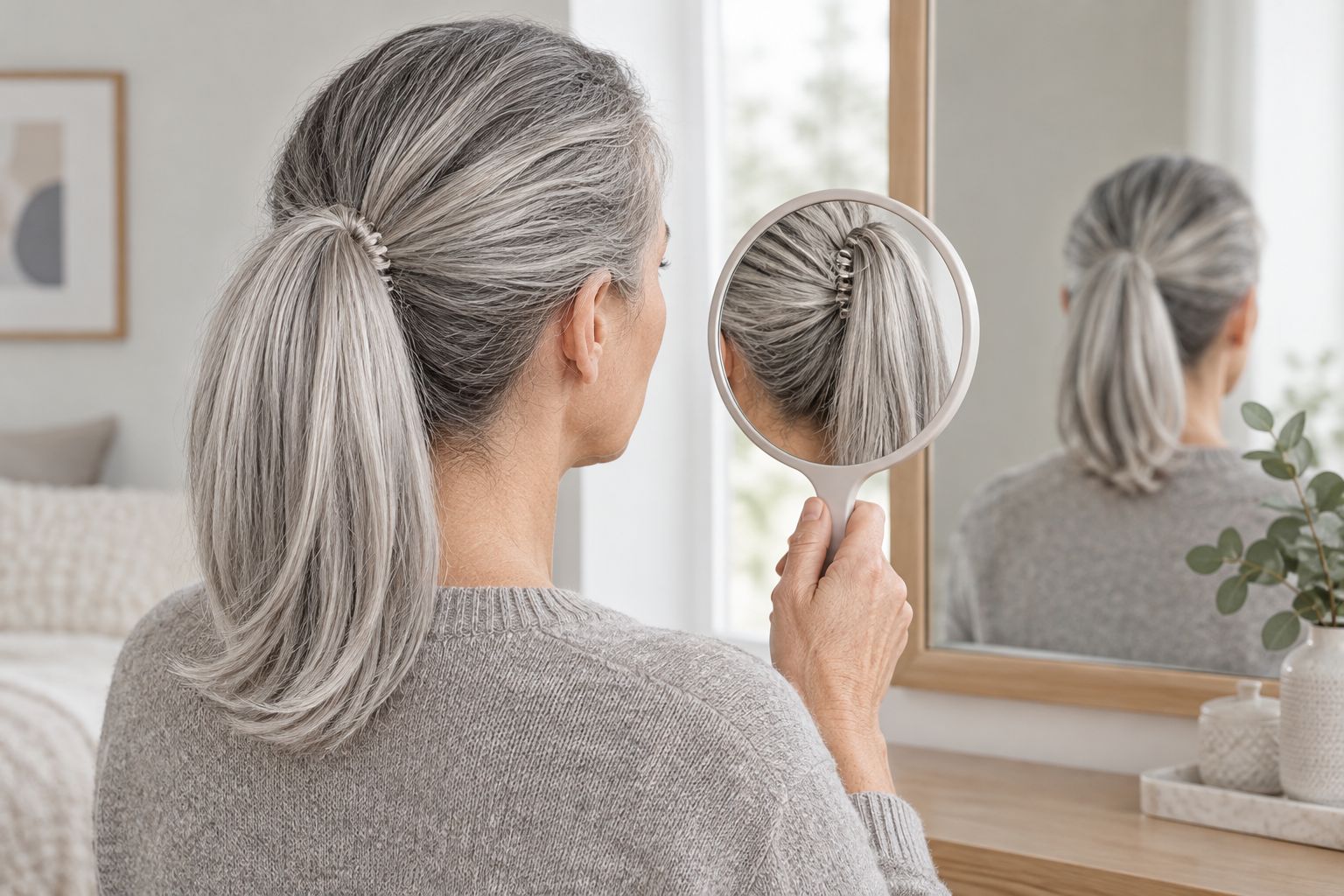
Put your hair into the position you expect to wear. Check the back and sides with a second mirror or a photograph taken without a color filter.
Notice which color sits immediately around the base. Your part can look very silver while the underside of your ponytail remains darker. That darker underside matters because it will sit beside the extension.
Compare lightness before undertone
First ask whether the extension looks lighter, darker, or similar to the gathered hair. Then compare whether it looks more golden, neutral, or cool.
This order keeps the decision manageable. A close undertone cannot hide a large difference in lightness, and a matching level of lightness does not guarantee matching warmth.
Check more than the front view
A front-facing mirror mostly shows your roots and face-framing hair. It tells you little about the join behind your head.
Check the side profile and back before deciding. A believable attachment area matters more than an exact match to the silver at your hairline.
How do you attach a ponytail without pulling your hair?
Start with a comfortable natural ponytail and follow the instructions for the attachment you choose. Do not tighten your own hair aggressively to compensate for an extension that feels unstable.
- Prepare your hair. Gently remove tangles and gather your hair without scraping it tightly against your scalp.
- Secure the base. Use a hair tie that holds your natural ponytail comfortably.
- Attach the piece. Position the extension according to its attachment instructions, keeping hardware away from uncomfortable pressure points.
- Check movement. Turn your head and look down. Readjust or remove the piece if it pulls, slips, or pinches.
- Check the join. Use a mirror to look for exposed attachment hardware and abrupt color boundaries.
These 5 steps are a fitting sequence, not a reason to tolerate discomfort. A finished style should not depend on repeated tightening.
Fine hair needs particular attention to grip and pulling, but thick hair also needs a comfortable attachment. More natural hair does not make an unsuitable clip or an awkwardly positioned piece comfortable.
Ponytail extension or bun hairpiece: which is easier to blend?
Choose a ponytail for a visible tail; choose a bun when you want the added hair gathered into an updo. Neither type automatically matches silver roots better. The placement and shade still decide how the join looks.
| Hairpiece type | Best for | Practical advantage | Practical limitation |
|---|---|---|---|
| Ponytail extension | Keeping a hanging ponytail shape | Adds a visible tail without restyling all your own lengths | Displays more added hair, making a shade mismatch noticeable |
| Bun hairpiece | Creating a fuller-looking gathered updo | Keeps the added hair concentrated around the bun | An oversized bun can look out of proportion or feel awkward |
A bun is worth considering if your natural lengths are difficult to arrange into the shape you want. A ponytail is the clearer choice if movement and a hanging tail are central to your everyday style.
For either option, judge the final size against your own hair and comfort. Extra fullness is useful only when the finished updo feels wearable.
Where Apexhairs fits into your choice
For a shorter ponytail shape, the Short Straight Ponytail Extension Claw Clip 8" is an Apexhairs option to evaluate. Its stated 8-inch length and claw-clip attachment give you concrete features to compare with your preferred style.
Best for: women considering a short, straight ponytail with a claw-clip attachment. The practical advantage is that defined shape and attachment format; the limitation is that neither confirms a match to your particular silver roots or guarantees a comfortable grip on your own hair.
Before choosing an Apexhairs ponytail extension in 2026, check the specific shade option and attachment guidance. Do not assume that every ponytail comes in the same greys, or that a shade shown on a different hairpiece is offered on this one.
Can a silver ponytail look natural with darker ends?
A silver ponytail can look intentional with darker ends, but it will not create a uniform color match. If your darker hair remains visible around the attachment, expect contrast rather than an invisible transition.
Try gathering your natural lengths neatly beneath the attachment, following the piece's instructions. If the boundary still looks too sharp for your taste, choose a blend closer to the gathered hair or change the hairstyle instead of forcing the match.
Should you dye or heat-style a synthetic ponytail to match?
Do not treat a synthetic ponytail like your natural hair. Follow the specific product's care instructions before using color products or heated tools; synthetic fibers do not all tolerate the same treatment.
For your 2026 shade decision, choose the closest suitable color rather than planning to correct it afterward. If heat suitability is not stated, keep hot tools away and adjust placement or styling by hand instead.
FAQ
Can I match a grey ponytail extension to just my silver roots?
You can coordinate a grey ponytail extension with silver roots, but check the hair around the attachment first. If that hair is darker, a pale extension creates contrast rather than a uniform blend.
What's the difference between grey and silver ponytail shades?
Silver generally describes a lighter, brighter-looking grey, while grey can describe a broader range of shades. Shade names are not standardized, so compare product photographs and the actual light-and-dark blend.
Is salt-and-pepper better when my roots are silver but my hair is dark?
Salt-and-pepper is a useful starting point when the hair around your ponytail contains both dark and light strands. It is not automatically the best match if the gathered hair looks mostly pale or mostly dark.
Can I wear a ponytail extension if my hair is thin?
You can consider a ponytail extension if your hair supports its attachment comfortably. Remove or readjust a piece that pulls, pinches, or needs excessive tightening to stay in place.
Will a grey ponytail extension cover my new roots?
A ponytail extension does not cover the roots across your scalp. It adds hair at the ponytail, so your root color remains part of the finished hairstyle.
Should I choose a bun instead of a ponytail to blend grey hair?
Choose a bun if you want a gathered updo, not because it guarantees a better shade match. Both buns and ponytails need a suitable color around their attachment area.
Which Apexhairs ponytail features should I check before choosing?
Check the specific shade, attachment, length, and care instructions before choosing an Apexhairs ponytail. The Short Straight Ponytail Extension Claw Clip 8-inch option has a stated short, straight shape and claw-clip attachment; assess its shade and fit separately.
One last thing
Choose your ponytail position before making your final shade decision. A low ponytail and a higher ponytail can bring different sections of your natural hair to the attachment, changing the color you need to connect with.
Keep a clear, unfiltered photograph of the back of your preferred style for your 2026 comparisons. It is a more useful reference than a close-up of silver roots alone—and it keeps the focus on the hairstyle you actually want to wear.


Leave a comment