
Can you style a messy bun hairpiece without hairspray?
Yes, you can style a messy bun hairpiece without hairspray: secure your own hair first, attach the piece according to its fastening method, then arrange the synthetic strands with your fingers. For your 2026 everyday routine, focus on a comfortable attachment rather than extra styling product; hairspray cannot correct a loose base or an uncomfortable fit.
- Can you style a messy bun hairpiece without hairspray? Yes—secure the base before arranging synthetic curls.
- Apexhairs synthetic bun hairpieces suit women seeking fuller-looking updos without restyling their own hair.
- Match grey or silver hair at the attachment point, not just at the roots.
- Choose a scrunchie bun for a wrapped updo or a claw-clip ponytail for a hanging style.
Why this matters
A spray-free updo starts underneath the hairpiece. When your own ponytail or bun shifts, rearranging the outer curls does not fix the attachment.
Separate hold from appearance: your hair tie and the hairpiece fastening support the style, while your fingers arrange the finish. If slipping is your main problem, start with how to stop a messy bun hairpiece slipping on thin hair rather than adding another product.
Can you style a messy bun hairpiece without hairspray?
Yes. Build a secure base, attach the hairpiece, and shape only the visible strands. You do not need to make a messy bun perfectly smooth; its deliberately tousled finish leaves room for softly arranged pieces.
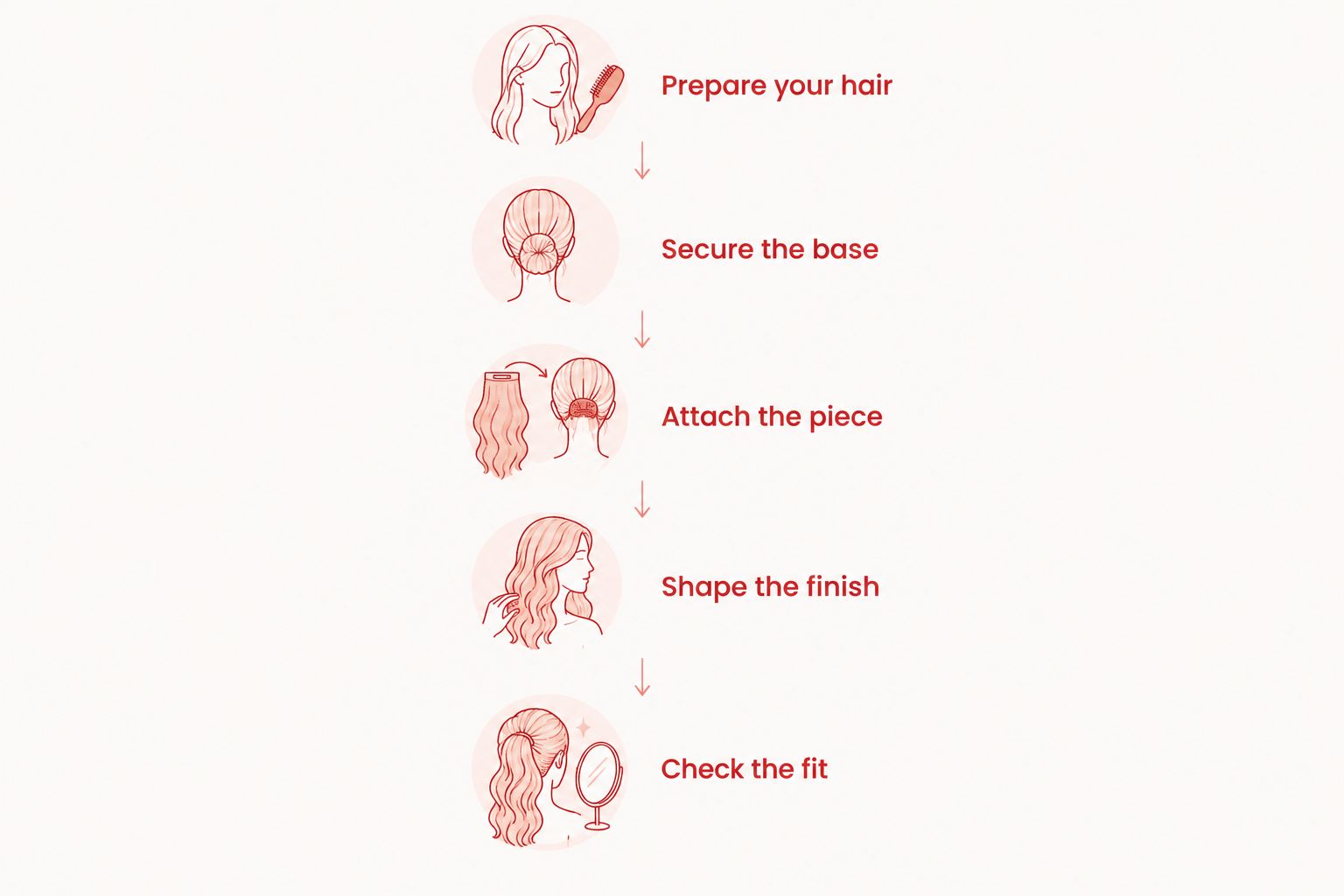
Use this sequence for your 2026 styling routine. Follow the instructions supplied with your particular hairpiece wherever its attachment differs.
- Prepare your hair. Gently detangle your own hair and gather it where you want the bun to sit. Keep the tension comfortable around your temples and hairline.
- Secure the base. Fasten your ponytail with a hair tie, then form a compact bun if the hairpiece instructions call for one. Check that your own hair stays gathered before adding anything over it.
- Attach the piece. Wrap a scrunchie-style hairpiece around the base as directed, or position and close a clip attachment according to its instructions. Do not force a fastening that feels strained.
- Shape the finish. Separate small sections with your fingers and distribute them around the base. Move the hairpiece strands rather than pulling out large sections of your own supporting hair.
- Check the fit. Look at the back and sides, then turn your head normally. If the base shifts or the attachment pinches, remove the piece and adjust it.
Use 2 mirrors to inspect the front and back without repeatedly twisting your neck. A phone photo also helps you spot an exposed band, uneven volume, or a section tucked in the wrong direction.
What if the bun still moves?
Remove it and test your own ponytail first. If that base moves, rebuild it before changing the hairpiece position.
If your ponytail stays put but the added piece shifts, revisit the fastening instructions and placement. More tension is not the goal: a secure style should not hurt.
Which attachment works best without hairspray?
Choose the attachment around the hairstyle you want and the base your own hair can comfortably support. Neither a scrunchie nor a clip removes the need for a secure foundation.
| Styling option | Best for | Main advantage | Main limitation |
|---|---|---|---|
| Messy bun scrunchie | A fuller-looking, gathered updo | Adds arranged texture around your own base | Needs a base the elastic can fit securely around |
| Clip-in bun | Positioning a bun with a clip fastening | Lets you place the added bun at the attachment point | Clip position needs checking for pressure and visibility |
| Claw-clip ponytail | A hanging ponytail rather than a bun | Adds a separate ponytail shape | The claw needs comfortable placement and enough supporting hair |
For a 2026 everyday styling choice, decide on the silhouette before the attachment. A compact updo and a hanging ponytail are different looks, even when both start with gathered hair.
The supplied ponytail options include an 8-inch short straight claw-clip extension and a 14-inch wavy claw-clip extension. Those lengths describe different styling options, not a guarantee of comfort or suitability; attachment fit still needs checking.
Choosing a synthetic bun for a spray-free routine
Choose a texture you already like instead of buying a piece that needs extensive reshaping. A curly messy bun suits an intentionally tousled finish; a straight bun suits a smoother outline, but leaves less room to disguise uneven placement.
Apexhairs synthetic bun hairpieces are best for women seeking fuller-looking everyday updos with added hair rather than a haircut. The added volume is cosmetic: a hairpiece does not regrow hair or treat hair loss.
The Synthetic Messy Bun Hairpiece Scrunchie is described as lightweight and clip-free, with a tousled finish. Its scrunchie format suits a wrapped bun routine, but you still need a base that holds comfortably.
The Messy Bun Hair Piece – Curly Synthetic Hair Bun is another option for an added curly bun shape. Choose it for the curly appearance, not on the assumption that curls will correct slipping or hide every shade mismatch.


Why spray-free styling results vary
Your result depends on the foundation and the shape you choose, not simply on whether you skip hairspray. Check these factors before changing your routine:
- Base security: a loose ponytail lets the whole arrangement move, even when the synthetic curls look tidy.
- Attachment fit: an elastic that does not sit securely or a poorly positioned clip needs adjustment, not extra surface hold.
- Hair length and layers: short ends need arranging around the base without pulling out the hair supporting it.
- Texture choice: a tousled bun accommodates a deliberately uneven outline; a smooth finish calls for more careful placement.
- Bun position: a placement that presses against a collar or headrest needs reconsidering for that activity.
- Shade match: a visible color change makes the join stand out even when the attachment is hidden.
How do you keep flyaways tidy without spraying the hairpiece?
Separate loose strands in your own hair from the synthetic strands you are arranging. Smooth your own surface hair gently with your hands or an appropriate brush, then tuck manageable loose ends into your natural bun before attaching the piece.
Do not keep pulling the finished bun tighter to chase every flyaway. A few soft strands fit a messy style; discomfort does not.
The distinction matters when choosing styling products, too: hairspray for braids and updos addresses surface hold, while a bun hairpiece also needs a secure fastening underneath. Advice about finishing your own hair does not establish that a spray is suitable for synthetic fibers.
For a 2026 product check, read the hairpiece care instructions and the styling product label together. If compatibility is unclear, leave the spray off the synthetic piece and use placement, gentle tucking, and finger shaping instead.
How do you match grey or silver hair without hiding the join?
Compare the hairpiece with the hair immediately surrounding the bun. If your roots are silver but your gathered lengths are darker, matching only the roots leaves a noticeable change where the piece meets your hair.
Grey is a broad description, not a single shade. Salt-and-pepper mixes contain visible light and dark strands; silver shades generally describe a lighter, cooler-looking finish, while brown-grey mixes retain a brown component.
Check the mix as well as the overall lightness. Use daylight and compare the hairpiece beside your gathered hair rather than holding it against a different part of your head.
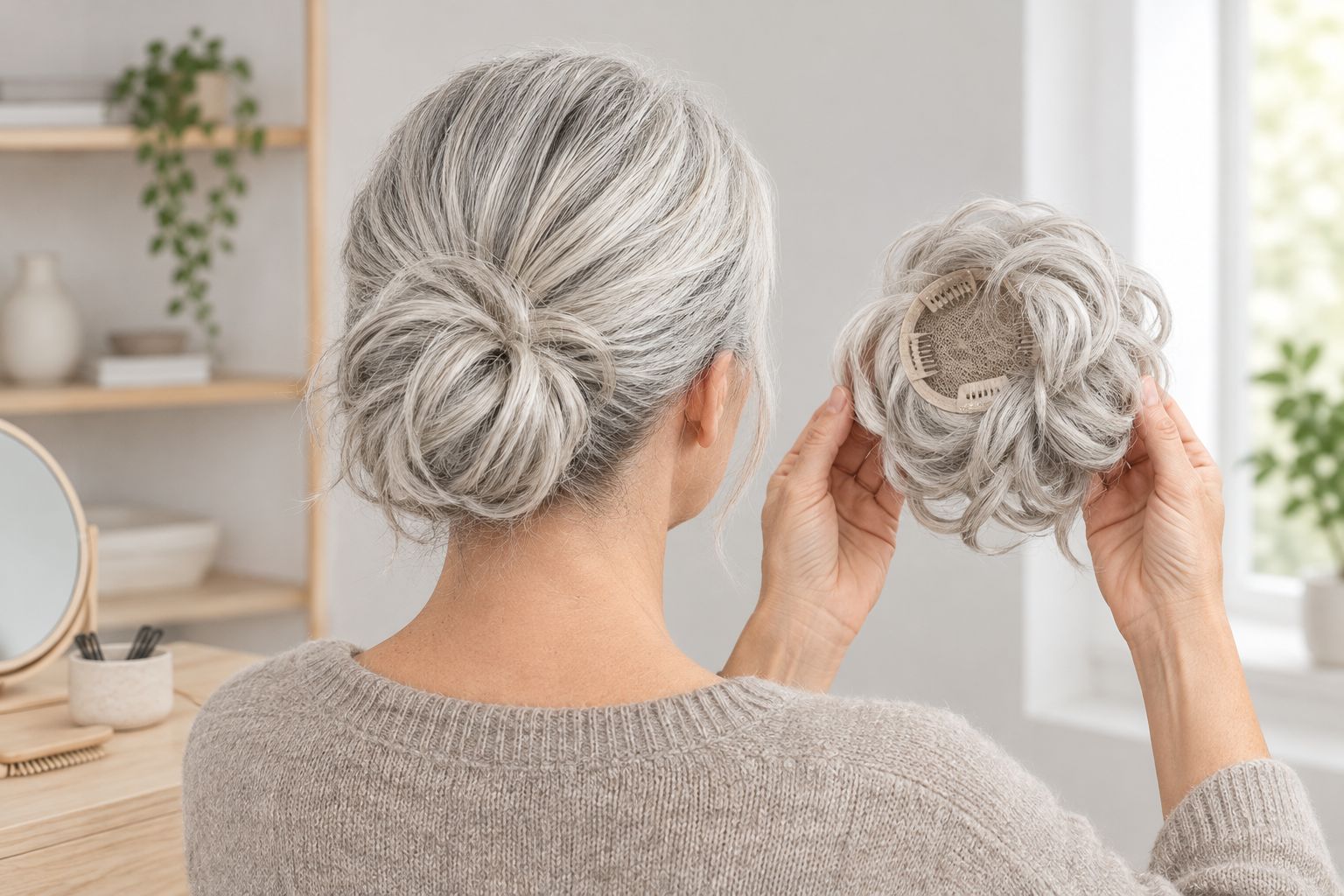
During a 2026 transition from dyed lengths to grey growth, reassess the match as the visible mix changes. A piece that blends with the ends is not automatically a match for newly grown silver hair.
What changes if your hair is thin, thick, or layered?
If your hair is fine or thin, start with a comfortable base rather than a tightly pulled one. Spread the finished hairpiece around that base without dragging out the strands holding everything together.
With thicker hair, keep your natural bun compact enough for the attachment to sit as intended. Do not force a scrunchie over a base that leaves the elastic strained or a clip unable to close properly.
For layered hair, gather the shorter sections before attaching the bun and check the sides afterward. You do not need thinning hair to enjoy an added bun; the same approach works when you simply want a different everyday shape.
Can you reshape synthetic curls without heat?
Start by separating and arranging the existing curl groups with your fingers. Support the piece while you work, and avoid tugging at resistant tangles.
Finger styling rearranges the existing texture; it does not create an entirely new curl pattern. Do not apply heat unless the instructions for that exact hairpiece explicitly permit it.
Should you choose a ponytail instead of a bun?
Choose a ponytail when you want hanging length rather than a gathered updo. Choose a bun when you want the added hair arranged around a compact base.
An 8-inch straight ponytail and a 14-inch wavy ponytail also give different outlines. Pick the style you want to wear, then check that its attachment fits comfortably—do not switch to a claw clip simply because a loose bun needs refitting.
FAQ
Can you style a messy bun hairpiece without hairspray?
Yes, you can style a messy bun hairpiece without hairspray by securing your own hair, attaching the piece correctly, and arranging its strands with your fingers. A loose base needs refitting rather than extra surface hold.
How do I stop my messy bun hairpiece from slipping without hairspray?
Check whether your own ponytail moves before adjusting the hairpiece. Rebuild a loose base, then refit the scrunchie or clip according to its instructions without creating painful tension.
Is a scrunchie bun better than a clip-in bun for everyday styling?
A scrunchie bun suits a wrapped attachment, while a clip-in bun suits placement with a clip fastening. The better choice is the one that fits your base comfortably and creates your preferred shape.
Can I brush a synthetic messy bun to make it smoother?
Follow the care instructions for the exact piece before brushing it. For a curly messy bun, start with gentle finger separation rather than brushing through the whole curl pattern.
Will a silver bun match salt-and-pepper hair?
A silver bun is not automatically a match for salt-and-pepper hair. Compare the light and dark strand mix beside the gathered hair around the attachment point in daylight.
Can Apexhairs bun hairpieces treat thinning hair?
Apexhairs bun hairpieces add cosmetic volume to an updo; they do not treat thinning hair or regrow hair. Choose a comfortable attachment and avoid using extra tension to compensate for an unsuitable fit.
One last thing
Before you reshape a bun that looks uneven, check whether the base is off-center. Repositioning the foundation is often the more direct fix than repeatedly pulling at the visible curls.
For your next spray-free attempt, finish attaching the piece before arranging its outline. Then stop once the fastening is concealed, the shape suits you, and your scalp feels comfortable.


Leave a comment